In her seven-year career in the emergency room, Wang Weiwei has already accustomed herself to pulling about two suicidal persons back from the brink of death per week, although she is only on duty once a week.
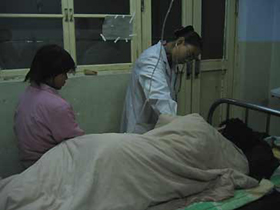
Wang Weiwei, doctor of Qinglong Hospital, is diagnosing a 42-year-old woman who tried to kill herself by taking diazepam pills. The woman, Ma Shuyan, came up with the idea after a minor quarrel with her husband.
"Most of them were rural women. And quite a lot are brought here more than once," said the doctor from Qinglong Manchu Autonomous County Hospital, Hebei Province.
Last month, 16 patients were hospitalized here because of taking poison. Eleven of them were rural women.
Most of them used organic phosphorus, a major type of pesticide.
The figure was more or less the same in previous months, or even decades, according to the hospital.
"But there are also an additional large number of suicidal people who are never listed in the records because they do not stay at hospital after the emergency treatment," Wang said.
But the high frequency of suicides among rural women is not only witnessed in this county in northern China, but is rather a common phenomenon nationwide, with young women aged between 15 and 34 bearing the brunt.
A comprehensive survey released by a panel from the Clinical Research Office on Communicable Diseases at Beijing Huilongguan Hospital last year says among the 24 surveyed hospitals in China, 14,334 suicidal cases were recorded by emergency rooms between 1990 and last year, in which 72 percent were from rural areas.
And 71 percent of these cases were women.
And the majority chose to take medicine or pesticides, it says.
As the latest available statistics, the report concludes that the suicide rate in China's rural areas is three to five times higher than that in cities, and women's suicide rate is 25 percent higher than men's.
Direct causes
"Most suicides in rural areas start with small quarrels between couples," said Xu Rong, a project officer with the Cultural Development Center for Rural Women (CDCRW).
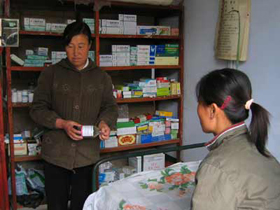
Li Suxia, a doctor from Qinglong's Donghao Village, shows an empty bottle of medicine that was used to treat patients poisoned by pesticides. She said she has to deal with five to six suicide cases every year, along with the other five doctors in the village.
"Some of them are accidental; some are actually rooted in unhappy marriages," said Xu, who is currently responsible for three ongoing suicide prevention projects in Hebei, one of which is based in Qinglong.
Wang Cuimei from Qinglong's Donghao Village is an example.
Within 14 years, the 42-year-old woman attempted three suicides by taking three different poisons.
"I made the first attempt 18 years ago by taking Dibaichong (a poisonous pesticide)," said Wang.
She explained it was because of her husband's bad temper.
Wang said that she had a serious argument with her husband which started from the trivial issue of her failing to hear her husband properly.
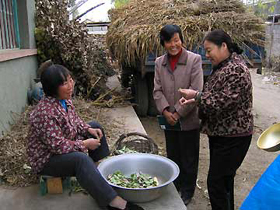
Xu Fengqin (first on the right), head of the Qinglong Women's Health Promotion Association, talks with a villager in Donghao Village about her daily life, together with Li Guimin (second on the right), a local official.
"I was thinking of death at that moment, so I took 20 pills of "Dibaichong," the mother of two boys said.
Wang was sent to hospital soon afterwards and stayed in bed and took six months to recover.
Seven years later, she took half a bottle of omethoate, a highly poisonous pesticide, for another suicide attempt.
"I was so angered to see my husband idling around all day that the idea of killing myself came up again," Wang said.
History was destined to repeat itself in 2000 as Wang recalled she "bought several diazepam pills every other day and stored them on purpose for a new suicide attempt."
Wang put all the blame on her husband, but she said she did not love her husband, which is the real reason behind her suicide attempts, according to Xu.
According to Xu, it was Wang's dissatisfaction about current marriage that resulted in her frequent desperate attempts.
There is an unwritten rule in this and the neighboring villages that women should be engaged at the age of 20. In this case, many women are married just for marriage's sake, and not many cases are based on love.
"What's more, rural men tend to be reluctant to express their love or care for their spouses, who have more romantic emotions," said Xu.
The survey for 2003 shows that among the 895 suicidal cases investigated between 1998 and 2000 at 145 disease supervision points nationwide, 62 percent of the attempted suicides were a result of unhappy marriages, which were also the cause of about 34 percent of actual suicides.
Economic pressures are another reason for suicides among rural women.
Li Suxiang, a villager from Donghao, tried to end her life by jumping into the sea because of poverty.
"Doing manual work here and there, her husband is often unpaid. Two children at school are also major burdens," said Xu.
Although Li was lucky enough to have escaped from death, the four-member family continues to have major problems.
"We earn no more than 400 yuan (US$48) a month, which can hardly cover our expenses," said Tan Qinghe, Li's husband.
A village of more than 2,600 people, Donghao has an average income per capita income of about 800 yuan (US$97).
Every household there has at least two children and most live with grandparents.
"For a four-member family here, average annual living expenses amount to 10,000 yuan (US$1,200). If the two grandparents are included, the figure may double, let alone the expenses for a house and children's weddings," said Li Guimin, one of the village's officials.
Building a house and marrying the children costs approximately 50,000 yuan (US$6,050) and 30,000 yuan (US$3,600) respectively, Li added.
Under such great pressure, local married women -- who spend most of their time at home doing chores and taking care of children and elderly relations -- have a far greater burden to bear than the men, who can occasionally find emotional outlets through working outside.
Negative factors
The high suicide rate among rural Chinese women refers to both an astonishingly large number of attempted suicides and a considerable death toll.
"Highly poisonous pesticides are the first choice for suicidal people in rural areas, because they are readily accessible to rural families," said Xu.
According to Han Jinzhi, chief nurse of Haixing County Hospital in Hebei Province, the most frequently used poisons include omethoate, methamidophos, DDT and herbicide, all containing lethal chemicals.
"Anybody who takes more than 100 millilitres of a highly hazardous pesticide is bound to lose their life if no immediate treatment is given," said Gu Baogen, a senior official with the Ministry of Agriculture.
"Each household in our village has at least one 500 millilitre bottle of omethoate. Some families also own methamidophos," Li Guimin said.
She added that highly poisonous pesticides are not only as cheap as 7 yuan (85 cents) a bottle, but can also be easily obtained.
"China has poor controls on the sale of highly lethal agrochemicals," said Gu, vice-director of the Institute for the Control of Agrochemicals.
There are more than 2,000 agrochemical producers in China, annually producing about 100,000 tons of highly poisonous agrochemicals.
Although the ministry has banned the production of 11 highly noxious pesticides and the use of 18 kinds of agrochemicals since 2002, however, they are still on the market.
The owner of a large pesticide shop in Xihao Village in Qinglong told the reporter that local farmers can buy any kind of pesticide from either regular outlets or numerous traveling vendors.
"We plan to stop the sale of five highly poisonous pesticides from 2007, including methamidophos," Gu added.
Many lives are also lost on the long journey to a well-equipped hospital due to the backward transport and medical infrastructure in such underdeveloped places like Qinglong, one of the around 500 poverty-stricken counties in China.
"Although most of the villages have their own doctors who can give preliminary treatment, seriously poisoned people have to seek treatment at our hospital, which is the only one in Qinglong with respiratory equipment," said Wang Weiwei.
Governing 396 villages, Qinglong has an area of 3,510 square kilometers. It takes two hours or more for many villagers to reach the county-level hospital, Wang said.
Besides, it usually costs hundreds of yuan to rescue a suicidal person, which in turn imposes heavy economic burdens on a rural family and results in repeated suicide attempts, she said.
Further reasons
There is no denying that every individual suicidal case can be attributed to different factors, nevertheless, the root causes are similar.
Despite the hereditary and communicable factor and some cases of depression, periodic suicides in rural areas are largely related to complicated social backgrounds.
China's rural women, who have a low educational level, are still subjected to a massive amount of discrimination.
"Under these circumstances, most women attach little importance to their lives," Xu Rong said.
"Rural women here mostly spend their lives pursuing three goals -- building a house, marrying off the son and becoming grandmothers," pointed out Xu Fengqin, head of Qinglong Women's Health Promotion Association, a local non-governmental organization established by the CDCRW.
The other side of the story is a long-term neglect of work on women's issues by grass-roots officials.
According to Li Guimin, who leads the local women's federation in Donghao Village, she can earn her full wage of 1,000 yuan (US$120) only if she achieves some success in implementing the nation's family planning policy.
"Grassroots officials, especially those who work for the local women's federation, have reached a mutual understanding that the work on women's issues means nothing more than working on family planning issues," said Li.
"We won't be paid if we want to do more for women such as organizing lectures, which always need sponsorship."
In addition, a lack of community life contributes to social problems.
Many households devote a great deal of time to rural production, and do not spend enough time communicating with each other.
Unlike cities, towns and villages are usually short in entertainment facilities or cultural activities, which aggravates the communication gap between rural people.
"Only if a family holds a big event like a wedding or a funeral, can the villagers get the chance to gather together," said Li.
Also, in order to make more money, increasing numbers of rural men are seeking jobs in factories or companies, leaving pieces of arable land for their wives, who usually find themselves with little to do during the long slack seasons.
Some women resort to suicide because they feel they have "nothing interesting in their lives;" while some are addicted to playing mahjong, gambling away their money, family and life.
Zhang Xiaoyun, a mother of two in Donghao Village, was ever described by her fellow villagers as "only smiling for 65 days of the year that she was playing mahjong."
"Mum occasionally talked about killing herself. We dare not to upset her, being afraid she would do it one day," said Li Xiaohui, Zhang's 16-year-old daughter.
"Mahjong is popular in villages and widely played by women, who play it simply to kill time," Li Guimin said.
Last but not least, no sound social welfare system has ever been established in rural areas to help farmers secure a basic standard of living, which therefore magnifies the economic troubles of many families.
Facts about suicide
*According to statistics released by the World Health Organization in 2003, about 1 million people commit suicide annually in the world. In other words, every 40 seconds witness a death as a result of suicide. And young people usually bear the brunt.
In China, 287,000 people commit suicide annually, including 156,000 women, according to the Beijing Suicide Research and Prevention Center.
In most other countries in the world, more urban people commit suicide than rural people. But this situation is reversed in China.
*It is estimated every year in China, between 20 million and 50 million people attempt suicide and fail, according to the Beijing Suicide Research and Prevention Center.
It is also estimated that the State has to spend millions of yuan dealing with suicides every year, according to the center.
The center says a suicide case is expected to affect six of his or her relatives, and 162,000 minors lose their father or mother due to suicide.
However, the psychological damage caused by each suicide can never be calculated.
(China Daily November 1, 2004)