 Although flowers are blooming in and the week-long Labor Day holiday beckons, what pleases Hu Xiaoyi most are the several bags of Maofeng (hairy peak) green tea, picked up on the slopes of the Yellow Mountain a few weeks ago and stocked up in the shop where he works .
The festive season for millions of tea drinkers like Hu can now begin in earnest as they can throw away last year's harvest and begin sipping the fragrant liquid with fresh green leaves swirling within.
For the Chinese, the fresher the tea, the better it is. Tea leaves picked up from April 5 to 20 are the best and most expensive.
With the aroma of tea in the air, Hu, along with some 300,000 tea lovers, experts and producers, will gather for the 2001 Shanghai International Tea Culture Festival, which began yesterday and concludes on May 2.
Last year, the Shanghai Tea Society honored more than 200 locals with "Veteran Tea Man" certificates for their close rapport with tea for 30 years or more.
Born in 1930, Hu became an apprentice at the city's famous Wangyutai Tea Shop in 1943. From then on, tea became both his life and career. He now works at the Zhejiang Tea Shop on the city's Jinling Road and green tea is his favorite.
"I drink eight to 10 glasses of green tea every day. I don't eat vegetables or fruits, and I know this habit is quite unhealthy. But for a 71-year-old, I only spent about 200 yuan (US$24) on medical treatment last year," said Hu. "Tea fulfills my body's need for vitamins."
"I hate the taste that lingers in the mouth after eating a fruit but love the flavor of good tea leaves. The flavor is so delectable that I don't want anything else," he concludes.
While tea helps keep Hu healthy, for Liu Xiuming, another "decorated" tea veteran, it helps him think.
Liu is a history professor with the Chinese Academy of Social Sciences and owns 50 teapots and several tea sets. He drinks all kinds of tea but oolong dark tea is his favorite.
Liu now lives in a rural house on Dongshan (East) Hill in Suzhou, Jiangsu Province, on the Taihu Lake, home of Biluochun green tea, writing historical articles and drinking tea every day.
"Wine muddles you while tea refreshes you," said Liu. "In addition to relieving thirst and being healthy, tea takes me to a higher philosophical plane, the other extreme of tea culture."
"I am glad I have understood this (philosophical) realm. When I drink tea I calm down. Fame and wealth don't matter to me," said Liu. "The tea tree is such a devoted plant, it grows every year and requires just a few fertilizers. We should learn from the character of this beautiful plant."
Every morning, after breakfast, and in the afternoon, Liu brews a cup of tea. He doesn't drink tea at night so that he can sleep. "When I am tired of writing, I admire my teapot collection for a while, drink some tea and feel refreshed. Tea helps me think," the scholar insists.
Almost all ancient Chinese scholars and literati loved tea. The Tang Dynasty (A.D. 618-907) poet Lu You, for instance, has written more than 300 poems about tea, Liu revealed.
History of Chinese Tea
In the primeval forests on Dahei Mountain of Yunnan Province is a unique 32-meter-high tree. It is the oldest tea tree in China, aged more than 1,700 years. But the history of Chinese tea is even longer.
An ancient Chinese book "Chuang-tzu" claims that Shennongshi, chief of the primeval tribe, developed farming and medicine. Around 5,000 years ago, during his search for edible plants, he tasted many leaves, fruits, vegetables and roots. On one particular day he got poisoned 72 times. Fortunately he happened to eat some tea leaves also. They worked as an antidote for the poison. From then on, Chinese people discovered that the magical leaves could relieve thirst, refresh the mind and also cure some diseases. Thus they began to drink the liquid stewed with tea leaves and the legend of tea was born.
During the Tang Dynasty, famous tea master and poet Lu Yu (A.D. 733-804) wrote the "Tea Principles," the world's first monograph on tea.Experts suggest that drinking tea is not merely an act of imbibing a beverage but also a way to enjoy Chinese calligraphy, poems, paintings and art. There are always calligraphy works and poems on a traditional teapot while the pot itself is a kind of archaic art form.
Tea Festival
The 2001 Shanghai International Tea Culture Festival raised its curtains yesterday at the Everbright City Square.
Organized on a larger scale than before, the eighth tea festival this year will feature an academic forum with 200 experts, a Sino-Korean pottery art exhibition, a tea ceremony show highlighting Chinese, Japanese and Korean styles, and an exhibition and trade fair of fresh and famous tea.
In the run-up to the festival, contests were organized to select the 10 best tea houses among the city's 3,000 outlets and top 10 tea art families from 150 participants. The results will be unveiled at the festival.
Even after the festival concludes, many packages for tourists to visit local scenic spots with links to tea culture will be offered.
The history of the tea culture festival goes back to 1994, when the government of Zhabei District held the inaugural event in its effort to promote the tea. The district used to be a major market place for tea before 1949 and Wu Juenong (1897-1989), China's modern tea master, lived there for seven years.
Shanghai is home to just one small tea garden (of Longjing green tea) on the Sheshan Mountain but is a big market and an important port for tea business. Every year locals consume up to 10,000 tons of tea leaves while the country's annual produce is 600,000 tons.
"In the early 1990s a Shanghainese, on an average, consumed 100 grams of tea annually. We are glad that the figure has now grown to 800 grams, indicating the festival has promoted the tea culture," said Jin Wei, a Zhabei District official.
Since 1992 more than 20,000 primary and middle school students have undergone training on the nuances of tea, the culture and ceremony as part of "quality education." They will be the new generation of tea aficionados.
How to Buy Tea
Rub the tea leaves with your hands to see if they break into pieces. If they do not, the leaves have absorbed moisture and are not good.
l Smell the fragrance.
l * Observe the shape of the leaves, if they are full and not crimpled, the tea is of high quality.
l * Brew the tea to observe the color. Fresh green or fresh yellow is good while clouded is not.
l * Observe the color of the tea once it is brewed. If the tea is brownish, it means the leaves are old. Fresh green tea should be just that: green.
l * Drink the tea. Bitter flavor is not good.It's safe to buy from well-known stores such as Huangshan Tea Store, Zhejiang Tea Store or the tea counter at the Shanghai First Provisions Store. Now is the time to buy fresh tea.
How to Enjoy Tea
Select a good tea -Among the famous species are Longjing (dragon well) green tea from West Lake in Hangzhou, Maofeng (hairy peak) green tea from the Yellow Mountain in Anhui Province, Biluochun (green spiral spring) green tea from Jiangsu Province and Tieguanyin (iron mercy) oolong dark tea from Fujian Province.
l Choose mineral water or pure water -
Canned water from the Hupao Spring in Hangzhou is the best.
l Choose the right tea sets for different types of tea -
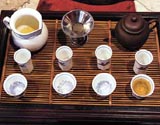
A transparent glass is often used to hold green tea, making it easy to see the shape of the leaves and the color of the liquid. Lacquerware from Fujian Province is for scented tea while black tea is better placed in porcelain or purple pottery pots from Yixing of Jiangsu Province. Oolong dark tea requires a specialized tea set from Fujian or Guangdong Province.
l The method varies for making different tea-
Pour nearly boiling water (85 to 90 degrees centigrade, one third of the glass) on to green tea, scented tea or black tea, wait a moment for the juice to filter through and then fill the glass.
But for Biluochun, a tender green tea from Suzhou, sprinkle it into the hot water (around 80 degrees centigrade) to maintain freshness.
Since oolong dark tea is made of old leaves, pour boiling water to draw the juice out. To maintain the high temperature, warm the teapot with hot water beforehand and shower the pot constantly.
l Finally enjoy the tea -This is similar to tasting wine: First observe the color of the liquid, smell the fragrance, and then taste the flavors. Before swallowing, swirl the tea in your mouth for a few moments to let different parts of the tongue taste the sweet and sour flavors.
(Eastday.com 04/27/2001)