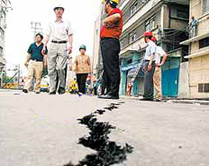
While China's economic star continues to rise, some parts of the country are sinking -- literally. Rapid development and overused groundwater supplies threaten to pull the soil out from under the nation's cities, reports China Daily's Qun Shan.
Alarmed by the grave results of a geological survey that 46 cities in China are sinking due to the excessive pumping of groundwater, the central government recently kicked off construction of two surface subsidence monitoring networks focusing on the Yangtze River Delta and the North China plain, respectively.
Under the administration of the China Geological Studies Bureau, the networks, which are to be completed in 2006, are expected to monitor the rate at which the ground is sinking as well as groundwater levels.
The cross-regional efforts are expected to unite the individual battles of the suffering cities with better co-ordinated measures, an official with the bureau said.
According to the survey conducted by the Ministry of Land and Resources, the rapid depletion of groundwater has produced more than 100 massive "funnels" covering a total area of 150,000 square kilometres across the country.
The Yangtze River Delta network will monitor roughly 100,000 square kilometres of land area, including Shanghai, eight cities in southern Jiangsu Province and six cities in the northern and eastern parts of Zhejiang Province.
The areas suffer from both severe surface water pollution and heavy economic losses caused by surface subsidence, said the official, who declined to be identified.
The North China plain network will oversee Beijing, Tianjin and parts of the provinces of Hebei, Shandong and Henan, covering 140,000 square kilometres.
This region has witnessed the most excessive pumping of groundwater in the world and covers the largest subsidence area with the most funnels on the planet, he said.
And the groundwater level of approximately 70,000 square kilometres in this region falls below sea level.
The cities of Shanghai, Tianjin and Taiyuan report the worst sinking, each of them having dropped by more than two metres since the early 1900s.
Meanwhile, the rate of groundwater pumping in the country has been increasing by 2.5 billion cubic metres annually during the last 20 years, according to Zhang Zonghu, a professor with the China Academy of Sciences.
Groundwater accounted for 19.8 per cent of the national water supply in 2000 as compared with 14 per cent in 1980, Zhang said. The percentage for cities in the dry northern and northwestern regions now stands at 72 and 66 per cent, respectively.
Severe situation
Surface subsidence picked up speed over the last two decades as a result of an increasing demand for groundwater caused by fast economic growth and urbanization, pollution of surface water and the construction of skyscrapers, analysts note.
Despite the central and local governments' efforts to limit the pumping of groundwater and replenish it with surface water since the 1990s, which has stemmed the rate at which Shanghai and some neighbouring cities were sinking, the total area suffering from surface subsidence is quickly expanding in the Yangtze River Delta, said Sun Wensheng, vice-minister of land and resources.
Altogether, 180 square kilometres in Suzhou, 43 square kilometres in Changzhou and 59.5 square kilometres in Wuxi have recorded subsidence of up to 60 centimetres since 1949.
Most of the subsidence plaguing the three cities occurred in the last 30 years, resulting in 13 large ground fissures, the largest measuring thousands of metres long and hundreds of metres wide.
Farmland in some areas in Suzhou is more than a metre lower than the surrounding surface water level, and farmers have to spend a great deal of money to drain off their flooded fields every year.
"Expanding individual sinking areas are starting to run into each other to cover the whole Yangtze River Delta," Sun warned.
The groundwater level in Shanghai's neighbouring areas averages 30 metres, while the level in some parts of Hangzhou, Jiaxing and Huzhou is as deep as 45 metres.
Although achievements in controlling ground subsidence have succeeded in the old district of Shanghai, the Pudong New Area has become the latest victim due to a combined depletion of groundwater and the construction of high-rise buildings.
According to the Shanghai Geological Research Institute, excessive groundwater pumping contributes to 70 per cent of Shanghai's surface subsidence, with the remaining 30 per cent created by the physical weight of skyscrapers.
More than 3,000 buildings in Shanghai tower 18 storeys tall or taller, while another 3,000 are under construction. And some 100 of the existing buildings in the city exceed 100 metres in height.
The Pudong New Area, which houses 1.4 million people in a 520 square-kilometre area, suffers most from severe subsidence.
Pudong's Lujiazui financial district, where the largest number of skyscrapers in Shanghai cluster, was found to have sunk 3 centimetres last year.
The foundation of Jinmao Mansion, China's tallest building at 420 metres, sank by 6.3 centimetres in 2002 -- and a 490 metre-tall skyscraper is under construction close to Jinmao.
Varying heights and the locations of high rises produce uneven pressure on the ground in Shanghai, said Yan Xuexin, deputy chief engineer of the Shanghai Geological Research Institute, which in turn creates uneven subsidence that may lead to safety risks.
Yang Jingping, chief engineer with the Shanghai Municipal Real Estate and Land Resources Bureau, noted that the rate at which the older city areas of Shanghai were sinking picked up again at the beginning of the 1990s, translating into more than one centimetre a year today.
Yang said the rising level of sea water as a result of global warming further complicates the issue. The sea level close to Shanghai is expected to increase by five centimetres by 2050.
Ground subsidence has created huge economic losses and started to pose a serious threat to buildings and people's lives.
Shanghai alone has suffered direct economic losses of 290 billion yuan (US$35.1 billion) in the last 40 years from destructive tidal waves, floods and other surface subsidence-related disasters.
The most recent accident was the cave-in at the city's No 4 subway on the banks of the Huangpu River in July, Yang said. Several nearby buildings tilted as a result.
Effusive efforts
China's fight against ground subsidence started as early as 1966 when Shanghai began injecting surface water back underground.
Prior to the establishment of the two regional surface subsidence monitoring networks, the central government started the large-scale, long-anticipated project to divert water from the Yangtze to the northern part of the country to reduce reliance on underground water.
Local city and provincial governments suffering from the most severe subsidence have also started imposing strict measures on the use of groundwater in recent years.
Jiangsu Province, for instance, has decided to close all deep-water wells before the end of this year in the fastest sinking areas of Suzhou, Changzhou and Wuxi; the pumping of groundwater in other areas will be strictly rationed, said Vice-governor Huang Lixin.
Huang said the province planned to cut groundwater pumping in the three cities by 51.5 million cubic metres this year from last year's volume to limit the use of groundwater to 100 million cubic metres.
Altogether, 1,507 wells will be closed, and draining from another 1,269 wells will be limited, he said.
The three cities are expected to spend 1.7 billion yuan (US$205.5 million) this year to build 678.8 kilometres of water pipelines with the capability of supplying 585,000 cubic metres of surface water a day.
In the last two years, the three cities have closed 2,749 deep-water wells, about half of the total in the region, and slashed the annual pumping of groundwater by 139 million cubic metres.
Huang noted that 86 per cent of the wells selected for the monitoring of groundwater levels in the three cities have reported a growth in water levels.
In Shanghai, the municipal people's congress in October passed a set of regulations to limit the construction of high rises, especially in the fast-sinking Pudong New Area.
A monitoring network covering 1,300 square kilometres of this Chinese financial centre was completed in October with an investment from the municipal government of 35 million yuan (US$4.23 million).
Meanwhile, the city government is also taking measures to inject more surface water underground. But replenishment fell off slightly in the last couple of years due to aging water-refilling facilities and a shrinking number of refilling wells because of rapid urban construction, said Zhang Agen, deputy head of the Shanghai Municipal Real Estate and Land Resources Bureau.
The city pumped 96.03 million cubic metres of groundwater last year but replaced only 13.75 million cubic metres as compared with 14.79 million cubic metres in 2001, Zhang said. However, the 2002 figure was only about 46 per cent of the annual sum recorded during peak years.
Shanghai started pumping groundwater in 1860. By the early 1960s, 200 million cubic metres were being used annually. As a result, Zhang said, the 144 square-metre old district of Shanghai sank an average of 1.75 metres from 1921-65.
Since the city began refilling groundwater resources in 1966, 600 million cubic metres of surface water has been injected underground, bringing the city's groundwater level back to a depth of about 20 metres at present.
Between 1966 and 2002, the old district sank by an annual 0.5 centimetres thanks to refilling efforts, Zhang said.
Nonetheless, the use of groundwater also started to pick up speed again in the late 1990s following a suddenly high water demand created by fast economic growth.
An official from the China Geological Studies Bureau said the two giant surface subsidence monitoring networks under construction will come up with scientific solutions to the problem in the Yangtze River Delta and the North China plain.
Experts hope that, with joint regional efforts co-ordinated by the central government, China can manage to control and stop the impending disaster.
(China Daily HK Edition December 11, 2003)
|