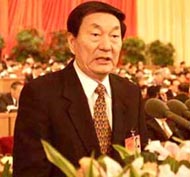
 Premier Zhu Rongji presided over an economic working forum on June 24. Some economists were invited to offer their advice on China's current difficult economic problems in the aspects of finance, taxation, employment and "san nong" (agriculture, countryside and farmer).
In fact, these experts have in-depth studies and original views on these problems: 1. The most outstanding problem of non-performing assets of the four major State-owned banks in the financial industry; 2. Reduction in the holding of State shares and the governance of listed companies; 3. Layoffs, unemployment and surplus agricultural labor force; 4. The relations between financial deficits and expansion of domestic demands; and 5. The way to increase farmers' incomes after China's WTO accession. It is predictable that perhaps here lies the outline of the next major action to be taken for China's economic reform, which is budding today.
The Financial Industry Is the First to Bear the Blunt
The biggest issue placed before China is the financial problem, the most striking one of which is the non-performing assets of the four major State banks. As a finance authoritative personage, Xie Ping, director of the research bureau of the People's Bank of China, pointed out: Currently, there are four major problems that hinder the development of State commercial banks.
First, the proportion of non-performing assets is still fairly high, it was 25.4 percent by the end of 2001. Second, profits of the bank are limited, some banks are still suffering losses. Third, inadequate capital funds for State commercial banks, their comprehensive competitiveness is poor, the per-capita index of the State commercial banks, including per-capita asset, per-capita profit, is equivalent to only one-fifth or one-sixth of that of foreign banks. Fourth, internal management of State commercial bank is weak, the number of cases occurred is relatively great, for instance, the situation of internal graft, corruption and absconding with public funds occurred from time to time, incurring great loss. The main reasons for the emergence of these problems lie in the fact that the reform of State commercial banks is not in place.
With regard to banking reform, relevant departments have outlined the need to accelerate the process of the reform of the share-holding system of State commercial banks and get them finally to start listing. However, there are different views in regard to the way of listing.
In this regard, Economist Wu Jinglian has his unique views. He suggested that the three-step tactics, commercialized management, corporation and listing put forward by the Chinese government, should be improved, i.e., the first and second steps should be merged and carried out simultaneously; with regard to the third step, the overall restructuring form should be chosen, while the partition listing method should be discarded.
Of course, China's finance concerns not only the problems of State banks. The entire financial system, including the banking system and the capital market system, is very feeble, and its ability to resist impact is very poor. Therefore, it is necessary to speed up the reform process of the entire finance. In this respect, folk finance has received increasing attention from economists. Wu Jinglian once advocated the development of folk finance, realization of the internal opening of financial industry and construction of a county regional financial system.
Folk finance, of course, focuses on medium and small financial institutions, however, in addition to the four major solely State-owned commercial banks and the 88 city commercial banks transformed from the original city credit cooperatives, the commercial banks so far approved for business include only 10 medium and small commercial banks and two housing savings banks.
Professor Lin Yifu with the China Economic Research Center of Peking University has deep feelings about this. He maintains that medium and small financial institutions should play an important role, instead of simply playing a supplementary part in the financial system based mainly on large financial institutions as they do at present. Because, he said, China's medium and small enterprises cannot develop without the medium and small banks.
Embarrassing .Securities Market
China has established securities markets for 10 years, to be more exact, they should be stock markets, from the very beginning they had shouldered the heavy task of getting State-owned enterprises out of difficulties, as a result, erroneous market rules have led to the accumulation of many problems.
Particularly the mitigation of State shareholding has not only affected the collection of social security funds, moreover, it has seriously distorted the management structure of listed companies, and this is exactly the source of all evils of the securities market.
However, the reduction of State shareholding started last year met with strong "resistance" from the investors, and the stock market responded with a steep fall. As a consequence, the reduction of State shareholding was stranded for a while, and the State Council was compelled to announce a halt to the reduction of State shareholding.
For this, Economist Professor Wu Jinglian has said more than once: what is more important for the mitigation of State shareholding is to repay social security funds the government owed to old workers and staff, the full circulation of stocks is the way for solving the problem of State share being the sole largest share, the full circulation of State share is not cashable for the reduction of State shareholding, these are two questions.
Of course, reduction of State shareholding has come to a halt, but the problem concerning the standard governance of the Chinese securities market will be carried on. The most fundamental of which is the governance of listed companies.
At a "Forum on the Development of Civilian-run Enterprises", Wu Jinglian directly pointed out the six major defects existing in the governance of Chinese companies: First, irrational equity structure; second, the "authorized investor" system; third, the "multi-level corporate system"; fourth, defects existing in the board of directors and board of supervisors; fifth, irrational relations between the board of directors and the execution level; and sixth, defects of the execution body of the company.
Economist Fan Gang also pays considerable attention to the Chinese stock market. He holds that the problem of the Chinese stock market is expressed not only in the stock market, but also involves the transformation of government functions, the reform of State-owned enterprises, the construction of rule of law, the process of industrialization, etc.
He said that one must not say the capital market is not good simply because something has gone wrong with it, what is crucial is to expose the problem when there is a mishap. Fan Gang said that a transparent, standard and fair capital market under the rule of law should be formed in China, the achievement of this needs at least 20 years, in this process, it is necessary to engage in constant reform and unending innovation, it is also necessary to "progress with time".
The Problem of Unemployment Concerns Stability
Professor Hu Angang with the Public Management Institute of Tsinghua University perhaps is one of the scholars who are most concerned about the problem of unemployment in China. Not long ago, his saying, "China is faced with a war of employment", has aroused widespread attention in society for a while.
He remarked that "the serious problem of layoffs and unemployment has produced tremendous influence in China's economy, society, politics and every other aspect of life and has become the most severe challenge to China's development" in the first 10 years of the new century.
From the angle of international comparison, Hu Angang pointed out that China's employment and unemployment have multiple syndrome. In his opinion, first, in traditional, regular departments (such as State-owned units and urban collective units) and local regions (such as the northeast region), there emerges the sudden "unemployment resulting from economic restructuring", i.e., the sudden rise in the rate of unemployment in an economic restructuring country, and the rapid increase in poverty-stricken population;
second, the urban labor market has already possessed the characteristics of the highest unemployment rate in the economies with a developed market, the difference is not brought by unemployment insurance and the overly high welfare level, but rather by the too large ability of manpower supply, actually, the unemployment insurance coverage is rather low, and the welfare level is also very low;
third, in rural areas, there is the overly high ratio of surplus agricultural labor power resulted from the serious shortage of employment in numerous developing countries, the difference is the long-term restriction on and discrimination against the shift of rural labor force to urban and developed regions.
Finally, whether the actual unemployed in cities and towns (equivalent to the total of the EU unemployed), or inadequate rural employment, the scale is large and is on rapid rise. On this basis, he expressed the view that at least within a short and medium term, China's cities and towns will possibly stay at a fairly high unemployment level, the problem of employment and unemployment has posed a largest challenge to China's economic development in the early 21st century.
Nevertheless, Hu Angang has also offered his own "prescription" for the treatment of China's unemployment. He believes that China will expand employment through accelerating the development of service trades, on the one hand, it will speed up the opening of various types of service markets and develop and expand employment through the market.
On the other hand, the rear services of all State-owned enterprises, State-owned institutions and State organs will offer public bids for society, practice socialization and marketization and speed up the dissociation from their affiliates, so as to create job opportunities in a big way.
In this respect, Wu Jinglian places more attention on small and medium enterprises. In his opinion, the development of small and medium enterprises not only facilitates the re-diversion of workers laid off from State-owned enterprises, but also provides work posts for the huge amount of surplus rural labor force.
Statistics data show that the work posts provided by China's small and medium businesses account for 75 percent of the total of China's urban employment, Among the 150 million manpower in the country's industrial departments, 110 million work in small and medium-sized enterprises.
Is There Financial Crisis?
After the budgeted financial deficit of 309.8 billion yuan was announced by the Chinese government early this year, discussion on a financial crisis was heating up for a while.
Economist Wu Shuqing indicated that whether the scale of deficit is appropriate or not is determined first by whether it promotes economic development. If there is no financial deficit, economy will not develop and financial revenue will not go up. Superficially, a balance between financial revenue and expenditure is very good, but this does not mean the economic situation is very good, nor does it mean the financial base is sound. Because the shadow of China's deflation remains, therefore, China's economic growth must be pulled by the "horse cart" set to motion by the government.
But many economists still put forward different opinions. Wang Luolin, vice-president of the Chinese Academy of Social Sciences, pointed out long before that the room for China's continued expanding financial policy is smaller than what it was in 1998, relying merely on the issuance of national treasury bonds to stimulate the economy is not a good method in the long run, furthermore, the efficiency of expanding investment by a financial method is decreasing as a whole, and is apt to produce corruption.
In regard to solving the "tough-aspect" problem of China's proactive financial policy, related experts have offered many constructive suggestions. Wu Jinglian points out that when implementing the policy of expanding domestic demand, we should shift the emphasis from increasing financial investment to promoting tax-for-fee reform. He said tax-cut is also one aspect of the proactive financial policy, don't think that tax reduction would lead to decrease in financial income, tax-cut may cause a decrease in financial revenue in the short term, but after the tax system is straightened out, folk investment increases, enterprise's vigor is called up, the tax base is enlarged, and the final total tax revenue will still increase.
Hu Angang made a calculation: China's personal income tax was 51.1 billion yuan in 2000, representing only 0.6 percent of GDP, far lower than that of low-income countries. This figure shows that tax collection by the Chinese taxation department on enterprises and other corporations is effective, but the efficiency of personal tax levy is relatively low, the payable personal income tax of most high-income earners was not collected in full. In view of this situation, China should draw on the international experience in the aspect of many tax-collecting methods, it should intensify punishment and raise the cost of tax dodge.
The Agricultural Question Causes Headache
The countryside is the largest potential market for China to expand domestic demand, but it is also a market that gives one headache. Such being the case, after WTO entry, bringing about a second leap for China's rural areas under the impact of foreign farm produce is an urgent task placed before the government, while increasing farmers' income is the most important task.
Wu Shuqing calls upon the State to reduce or exempt agricultural tax on the western regions and the major grain-producing areas. He reckons that this measure will reduce farmers' burden by upwards of 20 billion yuan; that part of wages for rural teachers originally borne by farmers is advisable to be guaranteed by central finance which should make some "sacrifice".
Ma Xiaohe, director of the Industrial Development Research Institute under the State Development Planning Commission, is an expert in agriculture. He pointed out that the Chinese government first of all can and should make full use of the 12 major "green box" policies allowed by the WTO to provide necessary support for agricultural production.
Additionally, in line with established stipulations, China also can make use of the "yellow box" policy to give necessary subsidies to domestic agriculture. In his opinion, making full use of the WTO agricultural agreement is not only a question regarding how should China's agriculture cope with the impact and challenge, but also be placed in the general situation for consideration in regard to the development of the national economy. Supporting agricultural development through State investment can directly increase farmers' income, enhance the international competitiveness of China's agricultural products, reduce rural unemployment, stimulate domestic demand, etc.
( July 3, 2002)
|