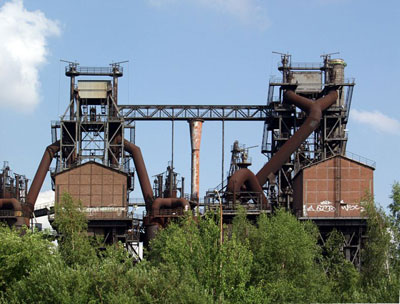
Taking a ride to the Huagong Bridge at Beijing’s Fifth Ring Road, we soon saw six big chimneys standing on the horizon. Liu Boying, an architectural expert who accompanied us on our trip, told us it was the famous Fatou Industrial Zone, once home to a number of factories. Now most of the factories have been relocated or demolished, and the only legacy is the chimneys on the former site of the Beijing Coking Plant.
The plant once formed a self-sustained miniature society, complete with school, hospital, and residential zone. For decades, the workers clung to it as the heart of their activities, but with the cooling of the furnace, the factory was shut down. With the last runoff from Furnace 1 on July 15, 2006, production at the 47-year-old plant came to an end. That day was a sentimental scene when the former plant head, 66-year-old retired Li Guishu could not refrain from tears. “I had worked here at its inception. I am reluctant to leave,” he said.
The workers left or were displaced, and the machines were auctioned, but what about the unmovable workplace and facilities? If things had gone on naturally, they would have been demolished and the site would have become a hot buy for real estate developers.
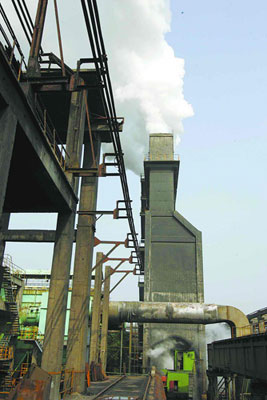
abandaned site of Beijing Coking Plant
But these plans were derailed after increased awareness of industrial heritage arose in public opinion. The officials from the Shougang Group, which has a natural kinship with the plant, invited Liu Boying to do research on the preservation of the site. Liu said it was possible and viable to convert it into an industrial heritage park. His thought was endorsed by a group of experts who visited the plant in May of 2006. They were pleasantly surprised at the manufacturing complex and petitioned the Beijing government to maintain them.
We took a tour around the abandoned coking works with Li Guishu serving as narrator and guide. At present, the coke production is little known to most people, Li Guishu said. Only the remnants of the buildings and equipment throughout the site serve as the evidence of the heavy industry and bygone days.
Nearly 50 years ago, fresh from his training in Shanghai and Anshan, Li Guichun arrived at the newly built plant surrounded by desolation. Its construction was the result of the “Great Leap Forward” campaign and took only eight months to complete.
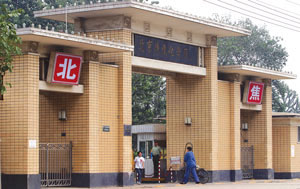
The gate board inscribed by the former vice president Zhu De is still well preserved as a reminder of its past glory. Today, the abandoned site is still guarded and only accessible to an approved and guided tour.
The office building and workers’ club have maintained its original Russian style. “In front of the office building was the statue of Chairman Mao. It was gilded and magnificent,” Li recalled with nostalgia.
Beijing Coking Plant
Before the coking plant was built, Beijing mainly burned coal for heat in winter when the city seemed wrapped in a gray shroud of soot. On November 18, 1959, Furnace 1 made its first contribution delivering gas through pipes to public buildings and households.
For its historic significance, Furnace 1 is still the signature facility in the plant site. The black mammoth is 4.3 meters high and 14 meters long, embracing 65 charring chambers arranged in a row. Up the clamped stairs within it, we arrived at the “inferno.” It was once the most poorly conditioned workplace, hot and dirty. The workers were required to wear thick protective outfit. In return, those workers got higher allowances and better food.
The gas produced by this coking plant was fed into the city gas network. As the center of gas production, the plant ensured a safe production. Its finished products were mainly supplied to Shougang for making steel. The giant carts to transfer and cool the cokes, redolent of the once bustling work scene, are placed next to the furnace. These carts were originally manipulated by manual work but afterwards by auto machinery after accidents.
Unbearable high temperatures and dust prevented the workers from working continuously. The tables and chairs in the restroom upstairs were covered with layers of coal dust.
Liu guided us through a terrace at the top of the furnace that would be reconstructed into a cafe and bar. Such reconstruction follows the German Hansa Coking Plant, which has remained almost unchanged after its facilities were put to public use.
Besides Furnace 1, there are three more furnaces (Furnace 2, Furnace 5, and Furnace 6), originally six, standing orderly beside the chimneys. Furnace 5 and Furnace 6 have the largest capacity, measuring 6 meters high and 16 meters long while Furnace 3 and Furnace 4 have been sold to other coking works.
Screenings were used to sort cokes; smaller-sized ones were used for metallurgy and bigger ones for steelmaking.
At the end of the plant site extends a railway far into the distance. It was used to haul coal here and coke out. But now rampant weeds have conquered the derelict railway beds. Liu said the railway line would be used to transport the future visitors.
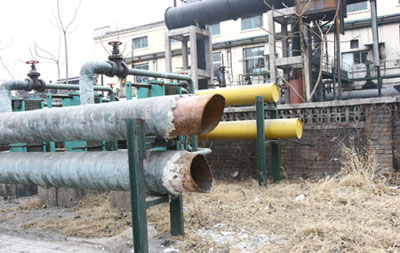
The chemical zone, the other major part of the site, was the result of its retrofitting to make it a diversified plant. The air here still carried an irritating fume. Li Guishu told us it was the smell of remnant sulfur and benzene. “Having known those chemicals to be hazardous, the workers preferred to work at the filthy coking zone,” he added.
The colorful chemical pipes are laid in a pattern like a labyrinth with some overhead and some on the ground. Liu said the future remodeling would convert those pipes into pedestrian corridor or terraces for the visitors.
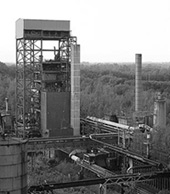
Moreover, various kinds of gas generators, recovery equipment, and cooling towers with remarkable industrial characteristics are scattered around the area. These special structures combined with appropriate outside decorations and lights will become an urban landscape that highlights the characteristics of industrial civilization. They can be developed into sightseeing towers, small sized museums, or creative workshops. This is just like the gas storage tank of a local steel plant in Oberhausen of the Ruhr region in Germany that has been turned into an important scenic spot after its transformation.
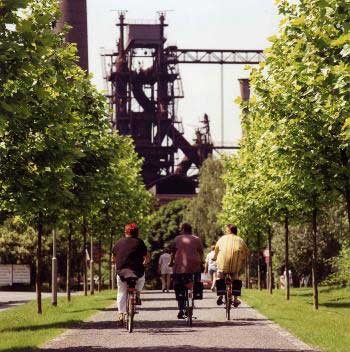
Duisburg North Landscape Park
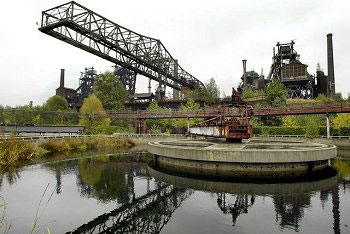
Polluted areas should have environmental control measures. Beijing Coking-chemical Plant has a sewage treatment plant composed of four huge round ponds. Walking on the cement around the pond, one can see the steel tubes distributed throughout the water. Liu Boying said that there was a similar sewage treatment pond in the Duisburg North Landscape Park. It was eventually transformed into a sightseeing pond by replacing the polluted water with clean water, and the sewage treatment facility and equipment were reserved as the sculptures and small sights of the park.
Pollution treatment is the major difficulty in turning the Coking-chemical Plant into a postmodern industrial relic park. The areas polluted by soot can be easily dealt with, but the areas polluted by tar must have the soil completely replaced; the recovery of the soil will be very costly.
Duisburg North Landscape Park
According to Peter Latz, the famous landscape architect and designer of the Duisburg North Landscape Park, it is inconceivable to build apartments or office buildings in such a polluted area. The cost would be very high and it would be very difficult to eliminate the pollutants completely. However, it is not a big problem to build a park in this area. After the soil is recovered, the residue will self-clean little by little as time goes on.
The Em-scher River ran through the whole industrial region of his Duisburg North Landscape Park and absorbed the sewage discharged by the factories and formed a polluted belt extending 400 km. Currently the sewage pipes have been laid in the river bed of the Em-scher River and above the pipe is the clean water. It has become a lifeline for the Duisburg North Landscape Park.
|
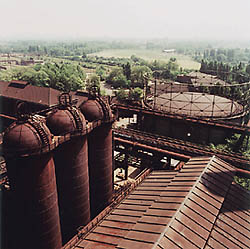
Duisburg North Landscape Park |
Peter Latz once came to visit the Coking Plant accompanied by vice-general architect of Andy. He told the reporter in the interview that he proposed to alter the original site as little as possible. He suggested keeping as many existing items as possible – industrial products, declining industrial remains, and the self-growing plants. To him the Coking Plant has become an industrial heritage park as such.
Chen Shijie is the Director of the Department of Industrial Distribution of Beijing Municipal Bureau of Industrial Development. Since the 1980s, one of their top priorities has been gradually moving polluting industries out of Beijing.
Initially the job was quite simple: selling land and tearing down buildings. So far 300 factories have been removed from Beijing, and skyscrapers have risen in the original places of these factories. Many factories have been turned into the targeted development zones of the real estate developers.
In 2003 Chen Shijie and his colleagues began to reconsider the practice of tearing down the factories. At that time Shanghai had put forward policies to transform the old factories and replace them with creative industries. As dozens of factories were named “creative industrial bases,” Beijing initiated “798”. Chen explained that maybe it was because Shanghai had a rather short history that it put more emphasis on the protection of the modern factory heritage. Beijing with thousands of years of history pays little attention to it. This period of industrial memory is now vanishing rapidly from Beijing. The workshops of the Beijing Second Cotton Textile Mill are going to be torn down. This means that such workshops are disappearing from Beijing forever. Previously chimneys were removed once they were discovered. As time passed by, chimneys have become very few. Chen found another one in the Jingshan backstreet. This chimney will not be removed because it has become a landmark of this area.
The removal of the Shougang Group and Beijing Coking-chemical Plant, two major industrial symbols of Beijing, in 2005 made the protection of Beijing industrial heritages more urgent. At the beginning of this year, the Beijing Municipal Bureau of Industrial Development and the Capital Museum started a collection of industrial cultural relics. Wang Chuncheng, dean of the Collection Department of the Capital Museum, who was in charge of the collecting job, drew a line between the factories more than 100 years old and those over 50 years. He told the reporter that this is for the convenience of the collection of the museum and on the characteristics of Beijing’s industrial history.
Chen said that the developers do not care about the industrial heritage, and the managers of the factories can get maximum benefit by selling the land. All these speed up the disappearance of the factories. But Chen soon found that they would not lose money in keeping industrial heritages. On the contrary, the rents of old buildings are higher than those of new buildings; 5 years of rent is equal to the price of selling the land.
China’s Industrial Heritage Protection Forum was held in Wuxi, Jiangsu on April 18, 2006. There is currently neither standard to decide which factories can be seen as industrial heritages nor relevant protection policies. Chen said that over the last two years, the Beijing Municipal Bureau of Industrial Development has started to say “no” to those planning to tear down the factories and sell their land. These factories can now apply for government funds up to several million and even 10 million yuan to convert the factories into heritage sites. Based on Shanghai’s experiences, one third of the factories are to be preserved, one third are to be transformed, and the rest are to be developed. Chen believes this practice is a good way to balance the interests of all.
Chen is doing experiments from factory to factory. The successful case is the 751 D-park, which has been transformed from workshops. Now it has drawn in many famous dress-designing brands. He believes that Beijing industrial heritage protection should put emphasis on “Beijing Coking-chemical Plant in the east and Shougang Group in the west,” because they have unparalleled landmark significance in view of scale and influence.
Duisburg North Landscape Park
(China.org.cn by Zhang Ming’ai and He Shan, October 30, 2007)