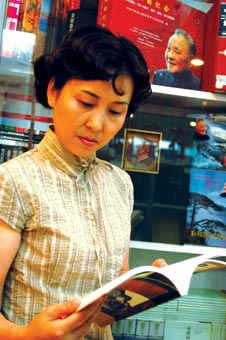
A decade can make big difference. For Zhang Jinming, her ten years' pursuit of democratic reform has signified hardship, perplexities, thrills and, most of all, great accomplishments.
Zhang Jinming, now the deputy secretary of the Ya'an Municipal Committee of the Communist Party of China (CPC) in southwest China's Sichuan Province, is a brave and open-minded woman. With great courage and even broader perspectives, she has made it possible to elect governmental officers democratically in many towns and counties under her domain. Her experimental practices are precious for China, a country that is intent upon embracing democracy. The history of Zhang's struggles is both captivating and stimulating.
In 1998, at the age of 41, Zhang was appointed as the Party chief of the Shizhong District of Suining City in Sichuan. She was responsible for several counties. When she began her term in office she encountered many thorny issues concerning low-ranking governmental officers. These problems had caused the public to complain vociferously. Zhang resolved to take affirmative actions. Considering it impossible to replace all the problematic officers in one fell swoop, she came up with the idea of public elections. She believed that public elections would not only reduce the pressures of high-level bureaus but also create more responsible officers.
Zhang chose Baoshi Town as her first experimental site. In April 1998, 600 local People's Congress representatives, village heads and villagers' representatives voted by ballot to elect candidates for the governor of Baoshi, then the town-level People's Congress chose the town governor by ballot again. This was the first time in China that town head had been elected in this way.
After these elections, more towns under Zhang's jurisdiction began to emulate Baoshi's electoral process. The Hengshan Town lifted restrictions on their gubernatorial candidate's political status and chose its governor through public election. Dongchan and Lianhua Towns pushed the practice much further. They publicly elected their Party chiefs from a pool of all local CPC members. All these reforms proved successful and were highly praised by higher authorities.
But not everyone had faith in these elections. Some still thought the higher-level governmental departments undoubtedly designated the so-called people's representatives and village leaders; the elections were simply for show. In order to convince them, Zhang thought it was high time to grant the voting rights to ordinary citizens and let them directly choose whoever they thought was suitable. Some of her colleagues did not agree, viewing her move as unwise and rash. Zhang hesitated. But later she went ahead, remembering that a provincial leader in a conference had given her the thumbs up to direct elections at the town and county level.
This time China and the world focused on Buyun Village. On a rainy day at the end of 1998, 6,000 ordinary voters, young and old, used their ballots to elect their village governor; the local People's Congress recognized his validity. This unprecedented event produced China's first directly elected village governor, Tan Xiaoqiu, who also happened to be a non-CPC member. In retrospect, political experts have always considered this as China's first direct election. Some imply that this election has profound impact upon Chinese history. Others have noted that the event proves ordinary Chinese are competent enough to exercise their democratic rights and that fundamental administrative units – villages – can hold fair elections without external interferences.
In the beginning of 1999, the media reported the election in Buyun village. Unfortunately their coverage brought great grief to Zhang Jinming. On February 24, 1999, the Sichuan provincial government telegraphed all its subsidiaries across the province to criticize the move. Zhang was scared because she was accountable for the elections. She feared an end to her political career and even speculated being taken into custody. Surrounded by depressing uncertainties, Zhang suffered intensely.
Fortunately, her provincial leaders were very tolerant. They viewed Buyun's elections as meaningful experimental practices. Zhang did not lose her job; instead she went on becoming vice mayor of Suining in charge of social affairs. But she was not pleased to be forced to leave the frontier of democratic reform. In the interim she began to contemplate all the reforms that she initiated. Finally she realized that any rash move aiming to radically change the current political system would not produce any positive outcome. It would, in fact, block the road toward progress because the basis of village and town level, also known as grassroots-level democracy, is very fragile. She concluded that reformers must first and foremost respect the current political system.
In 2002, Zhang seized a chance to conduct reforms again. Supported by her, Buyun again experienced a new electoral process. The election was unique. First, the general voters chose a candidate via ballots. The candidate then was nominated by the local CPC committee for election inside the local People's Congress. Obviously this mélange was a combination of old elements in the current political system mixed with the new elements indicating democratic reforms. Not surprisingly, this unique practice was granted the best governmental innovation award in 2003. The official governmental recognition gave Zhang more confidence in her theory – respect for the current political is the precondition of democratic reform.
The success of Buyun's reform encouraged many others coveting political reforms. A good friend of Zhang's even suggested that she further her reforms by westernizing the entire election procedure. Zhang turned down the advice directly. She quarreled with her friend; their friendship was wrecked. Some people believed that Zhang's experiment in Buyun represented a great political compromise and lost faith in her. But Zhang remained steadfast and determined to move forward.
In August of 2002, 45-year-old Zhang was appointed as Ya'an's standing CPC committee member and director of the organization department. In November the 16th National Congress of CPC was held in Beijing. The portentous conference signaled that inner-Party democracy was the lifeblood of CPC. Only via inner-Party democracy would democratic reforms in counties and county-level cities be carried out successfully.
Zhang foresaw an opportunity to further her reforms. She decided to expand her experimental practices into other political arenas. Within one month, supported by Zhang, Ya'an's Yucheng District and Yingjing County had their CPC representatives elected directly. This was the first time in the CPC's history that county-level CPC representatives had been elected by this means. Zhang also utilized a tactic of splitting the supervisory powers, policy-making and execution within the standing agencies of the county-level CPC congresses. Furthermore, in Yingjing County, members of the county-level committee of the Chinese People's Political Consultative Conference (CPPCC) attended the annual local CPC Congress instead of the local People's Congress. These Zhang-led reforms changed the role of the lower-level CPPCC from an economic affairs consulting organization into a truly political consultative organization as defined in China's Constitution.
In February 2004, Zhang was promoted to Ya'an's deputy secretary of the municipal CPC committee. She decided to restart her experiment in grassroots democracy. That year, in Feixianguan Town, all the CPC members directly elected their Party chief from a pool of candidates recommended by the local general voters. The town's secretary of the Youth League committee and the director of the local women's federation were picked through direct elections. In 2006, Zhang also introduced electoral reforms for representatives of the township-level People's Congresses as well as the Party and governmental officers in four counties at the same time. Zhang's reforms actually touched upon every corner of China's power structure.
In 2007, Ya'an's democratic reforms cooled down from the climax. Some officers were worried about the future and not sure if these reforms can go as far as expect. Some county leaders argued these reforms were financially unaffordable and thus shunned this kind of political change. Others doubted if the reforms could be really beneficial because certain places like Yingjing County experienced economic downturn instead of bloom after its reform.
Zhang has undoubtedly felt pressure. She understands the obstacles she is facing. But she has not lost her momentum. This year she volunteered to take charge of the local new countryside campaign. She feels that farmers, as the majority of the Chinese population, are always the true force behind political reforms. Zhang still believes that she can make a significant difference in Chinese society today.
(China.org.cn by Pang Li, August 22, 2007)