|
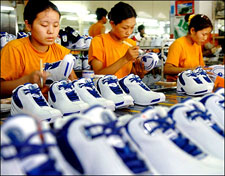
China's current pool of migrant workers, or cheap labor from the rural areas, is the second generation of migrant worker since China opened its economy 20 years ago. This new generation of worker looks very much like his urban counterpart in terms of appearance, but is no nearer to gaining a foothold in the city than his predecessors were.
Figures from the National Bureau of Statistics (NBS) show that the current migrant worker population working in cities is over 90 million, of which 45 percent are below 25 years old. But researchers are suspicious of these figures. Wang Chunguang, a researcher with the Sociology Institute of the Chinese Academy of Social Sciences (CASS), estimates that the number is more likely to be 150 million, 120 million of whom are second generation.
A large proportion of the first-generation migrant workers has gone back to their hometowns, after having retired, as it were. Only those who were successful in business or in securing a career for themselves remain in the cities.
A generation that knows no starvation
Dr. Liu Kaiming, director of the Shenzhen Institute of Contemporary Observation (ICO), defines the new generation of migrant worker as "one that has never known starvation".
China's rural reform took place in the 1980s, around the time when this generation of migrant worker was born. Except for the remote mountain regions, the reforms helped to ease food shortages in China's countryside.
During the course of his study of the new generation of migrant worker, Dr. Liu often visited factories scattered on the Pearl River Delta. He said he could distinguish between the new and first generation worker just from the physical appearance. "The first generation worker tends to look a lot older than he really is. He dresses simply and lives a frugal life. The new generation is as fashionably dressed as his urban counterpart, the only thing setting him apart from the urbanite being his self-confidence, especially when speaking," Dr Liu said.
When he first arrived in Shenzhen in 1997, Liu remembers long queues at the city's post offices every Sunday. They were migrant workers remitting money to their families. But those long queues have since disappeared. Liu wonders if the new generation migrant worker sends money home. His studies show that some of the women might, but not the men.
Although most of the new generation migrant workers don't send money home, many still spend all of their monthly salaries. The more common reasons cited for not being able to save include "everything in the city is expensive" and "low salaries."
Liu's conclusion is that the new generation of migrant worker doesn't have the same pressures that his predecessor had. For instance, they now don't have to worry too much about their families' education, basic living expenses or farming materials.
Another change that researchers have noticed is that the new generation is generally less willing to take on physically backbreaking work. The previous generation likened physical labor to farming, but not so for the new generation.
Wang Chunguang conducted a survey in 2000 on the new generation migrant worker in Hanghzou, Shenzhen and Wenzhou. He distributed 600 questionnaires and received 396 valid responses. The results of his survey were published in 2003 in Zhejiang Social Sciences, a bimonthly publication.
Wang told China Newsweek: "The new generation has had at least an elementary or secondary education. Their growing-up environment was much better than their parents' and many of them are only children or have only one sibling. We also found that many employers are unhappy with the new generation of migrant worker. One reason being they job-hop. Many of them are also enrolled in evening classes to improve themselves, which means they are unable to do any overtime."
The ICO, of which Liu is a director, operates reading rooms, computer and English retraining courses especially for migrant workers. "It doesn't hurt to learn," a female migrant worker told China Newsweek.
This change in work habits and practices is driving up the bottom-line of the cheap labor force. And with greater social development, the bottom-line will rise even further, thereby driving up manpower costs.
A professor on migrant worker issues from the Chinese University of Hong Kong (CUHK) related an incident where a female migrant worker sent him a multimedia message on the mobile phone. Unfortunately, his phone model is so old that it was unable to read the message. He later found out that over 70 percent of the new generation migrant workers own mobile phones, most of which are new models with color screens and polyphonic ring tones.
No roots in the city
For the new generation migrant worker, words such as 'farmer' or 'villager' have little significance because they have nothing to do with the environment that they're used to.
"The first generation of migrant worker had to submit to the disparity between city and rural areas. But the new generation is very aware that the system is not a fair and reasonable one," Wang said.
However, Liu added that many don't leave the city because they wouldn't be able to cope in the countryside. "They wouldn't be able to cope without the creature comforts -- TV, sanitation, recreational facilities and friends," Liu said, adding: "They don't know anything about farming."
Unfortunately, their roots are not in the city either.
"I don't feel at home in the city. Most of my friends are also migrant workers. I have little contact with local people. I buy what I need at a big supermarket because that way, I don't have to talk to them," Liu Tao, a migrant worker from Shaanxi Province told China Newsweek.
But Liu Tao added that through what little contact he had with the locals, he could see that there is less discrimination now against migrant workers.
What remains unchanged, however, is the attitude of local government, according to China Newsweek. They not only discriminate against migrant workers, but are also hostile towards them.
This autumn, Cai Jiao, a migrant worker from central China's Jiangxi Province who works in Panyu, Guangdong Province, approached the labor arbitration commission in Panyu to resolve his dispute he had with his employer.
He was treated with disdain and rudeness. He was even manhandled. But Cai stood his ground and told them that they, as government representatives, had a responsibility to uphold justice. Unfortunately, his brave words and actions came to nought. His case has yet to be heard.
"We pay taxes that pay their salaries. Why shouldn't they perform their duties?" Cai told China Newsweek.
Policy barrier
According to statistics provided by Liu Kaiming, Shenzhen made 118.3 billion yuan in revenue in 2004, with 80 percent of that revenue coming from the secondary and tertiary industries that employ migrant workers. About 42.5 billion of the revenue was spent on one million local residents, but not a fen was spent on the 8 million migrant workers.
"One billion yuan can solve compulsory education for 1 million children of migrant workers, which can also boost the privately run schools. It's obviously not a money issue," Liu said. "Two billion yuan can help build flats in industrial areas for families of migrant workers. The current situation is shocking. I once saw six couples living in one room."
In Dongguan, southern Guangdong, the cheapest flat sells for about 1,000 yuan per square meter, still beyond the reach of the average migrant worker.
Guangzhou has a policy that migrant workers living in Guangdong for seven years running can apply for a hukou or permanent residence, provided they first possess a temporary residence permit. However, how the system works is that few migrant workers are given temporary residence permits for seven years running. A Catch-22.
Local governments are still prejudiced and treat migrant workers as troublemakers, according to Yang Laiqing, a Party official from Longhua District, Haikou City, Hainan Province. Yang said less than a third of public servants consider migrant workers as equals.
(China Newsweek translated by Guo Xiaohong, Zhang Yunxing, and Zhang Tingting for China.org.cn, December 31, 2005)
|