|
The China Securities Regulatory Commission (CSRC) has submitted a radical reform plan Under which companies keen to go public and major underwriters, a new stock issuance approval committee will be set up.
China's stock market resembles its football in many ways. For years, the sport has produced more domestic controversies - such as the suspect calls made by referees - than any improvement on the international playing field.
Meanwhile, the stubbornly bearish stock market has witnessed the introduction of one poorly performing company after another.
Just as football fans know very little about how the China Football Association reprimands wayward referees, stock investors are kept completely in the dark about how the "trash shares" manage to get listed.
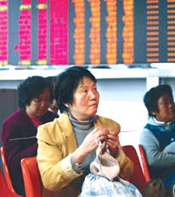
Dwindling stock investment enthusiasm, as demonstrated by the declining number of individual investors and the new record low that the share indices hit last week, is forcing authorities to step up reforms of the approval procedures for initial public offerings (IPOs).
The China Securities Regulatory Commission (CSRC) has submitted a radical reform plan to the State Council, which is expected to endorse and put it into effect at the end of this month.
Revolutionary reforms
Under the reform plan, hailed as "revolutionary" by financial experts, companies keen to go public and major underwriters, a new stock issuance approval committee will be set up, downsizing the former 80 members to about 25, according to a source close to the CSRC.
The names of the committee members will then be made public, and two-thirds of them will work full-time for the committee, the source added. Along with five CSRC officials, the remaining members will be made up of stock professionals, in contrast with the former practice of choosing the majority of the members from other government departments.
There will be no stipulation on the nationality of the members, according to another source, but the term of office will be limited to one year, and members can serve no more than three terms.
In approving the listing plans of a company, the decision of each member will be made public and must be accompanied by a written explanation of the vote he or she casts.
In addition, any company applying to go public can ask the CSRC to instruct a member of the approval committee to refrain from voting if it believes the member's involvement would constitute a conflict of interest.
Under the avoidance system, a part-time member whose employer holds shares in the applicant company is not qualified to vote nor are members who have had private contact with or accepted presents from underwriters or other associated persons before the approval meeting.
The CSRC will also establish a supervision mechanism to govern the committee members, accept public complaints and investigate any illegal or questionable behaviour on the part of the members.
Moreover, an applicant will be disqualified and an underwriter cannot recommend new applicants for a certain period of time if they are found by the CSRC to have interfered in the approval work of the committee.
The current double-approval procedures conducted by two different groups of committee members will also be abolished. An applicant will submit to only one approval meeting and, if unsuccessful, may apply again in six months.
"The new mechanism is open and transparent," said an underwriter who declined to be identified, "which will put an end to backstage manoeuvring and help block poorly preforming businesses from getting listed."
A CSRC official stressed that the reform of the approval committee was just part of the commission's fresh approach to ensuring the quality of listed companies.
"The reforms are to be the CSRC's third quality checkpoint that potential issuers must pass," he said.
The first checkpoint is stricter initial qualification. According to a CSRC notice issued on September 22, a company has to have been in business for three years before it can apply to go public, and the initial offering should not exceed 200 per cent of the company's net assets.
The second checkpoint is responsible recommendation. The CSRC is working on a set of new measures to employ a "recommendation mechanism" that requires underwriters to carefully consider those companies they put forward as candidates for listing.
Gan Liang, an official with CITIC Securities, said the underwriters will have to ensure the accuracy of the information released by a potential issuer before the listing as well as its credit standing after the listing.
Thus, those making the recommendations are compelled to apply stricter verification criteria to a would-be issuer in accordance with the more stringent standards, Gan said, which, in turn, will ensure the quality of those firms approved for listing on the stock market.
The former approval committee stopped functioning last month amid mounting criticism voiced by investors, underwriters and potential share issuers on the committee's choices of poorly performing companies.
Official statistics reveal a sharp deterioration in the business performances of 20 of the 41 companies newly listed in the first eight months of this year.
The combined profits of the 41 companies dived by 97 percent over the same period last year with a weighted average profit per share of just 0.0026 yuan, far below the 0.123 yuan level maintained in the first half of this year by all companies listed in Shanghai and Shenzhen.
The CSRC, meanwhile, says it has been unfairly blamed for the problems, as it does not control the decision-making process for choosing new share issuers under the stock approval mechanism as it now stands.
Of the 80 committee members, fewer than one-third came from the CSRC, while the rest were from other government departments, banks, the Shanghai and Shenzhen stock exchanges and research institutes.
The names of the members were also kept secret as required by the Securities Law that took effect on July 1, 1999.
Each approval meeting was attended by nine members, chosen through lots.
The selected members normally had only two or three days to go through the application materials of more than one applicant.
Although these anonymous members decided the fate of the applicants, they shouldered virtually no moral or legal liability for their secret votes, as there was no mechanism for checking members' conduct.
Underwriters and applicants often tried every means available to discover the names of the members due to be present at the meeting to decide whether their applications would be approved.
Large sums of money and energy were spent to gain little more than a list of members' names and to lobby for their support. Meanwhile, the members, almost all of whom worked part time on the committee and did not communicate on a regular basis among themselves, found it difficult to come up with fair and concurring judgements as a result of their limited and sometimes differing assessments of the applicants.
In addition, the lack of uniform standards for evaluating the applicants or the detailed listing requirements further eroded any effective checks on the powers of the committee and any sense of fairness, said economist Han Zhiguo, head of the Beijing Banghe Fortune Research Institute.
This unusual decision-making process certainly cannot guarantee the quality of the approved applicants, said an analyst. Many low-quality applicants got through with a single purpose in mind, to earn a fortune through an IPO without any intention of developing further.
"It is high time the current stock issuance approval system was terminated," said Professor Liu Jipeng of the Capital University of Economics and Trade. He suggested the CSRC come up with an award/penalty system and evaluate members'performance based on their written opinions presented at the approval meetings.
Once-bullish sector succumbs to market marginalization
"China's stock market is drifting out of the field of vision of the country's top decision-makers," said Han Zhiguo, head of the Beijing Banghe Fortune Research Institute, adding that some even consider the stock market less important than a leak on the embankment of the Huaihe River, which suffers frequent flooding.
Marginalization, Han said, is the greatest crisis facing the stock market, as its functions wither and its place in the national economy slides. Major issues involving the sector struggle to make the agendas of the leading State decision-makers and the legislature.
Cao Fengqi, a senior securities researcher at Peking University, said the foundation of China's stock market has been shaken by weak fund-raising functions and sluggish trading, with 90 percent of investors locked into the bear market.
The stock market's performance is in sharp contrast to the broader national economic picture. In a recent national survey of 180 listed companies, 20 fund companies and 47 securities companies, 78.55 percent of the respondents predicted the stock market would either fall further or remain bearish for the last quarter of this year. This from a sector that's otherwise bullish on the overall economic situation.
Many problems haunt the recovery and smooth development of the stock market in China. Wu Xiaoqiu, a senior securities researcher with Renmin University of China, cites the large proportion of shares not in circulation as the most serious dilemma.
CSRC statistics indicate that companies listed in Shanghai and Shenzhen boast a total of 619.9 billion shares, but only 219.4 billion of those were actually in circulation at the end of July.
Although the upcoming reforms cannot solve these major problems, analysts said, they can help rebuild investor confidence, as at least the quality of new issues will improve.
And the transparency promised by the imminent reforms on the approval procedures for IPOs will help reduce the amount of money applicants and underwriters spend lobbying committee members and impose checks on corruption.
(China Daily November 20, 2003)
|