Zeng, minister in charge of the State Development Planning Commission, gave his report to the 4th Session of the Ninth National People's Congress, China's top law-making body, on the implementation of the 2000 Plan for National Economic and Social Development and on the Draft Plan for 2001.
Economy Takes Turn
China's economy as a whole took a turn for the better in 2000, and the annual social and economic development plan was satisfactorily implemented, Zeng Peiyan, minister in charge of the State Development Planning Commission, said Tuesday.
The national economy continued to grow rapidly and there was continuous improvement in the quality of growth and in economic performance in 2000, he said.
China's GDP hit 8.9404 trillion yuan in 2000, up eight percent from the previous year, with the range of growth 0.9 percentage points higher than in the previous year. The general price level stopped falling, with the consumer price rising by 0.4 percent. Total profits of industrial enterprises of scale reached 426.2 billion yuan, an increase of 86.2 percent over the preceding year, with profits of state-owned or controlled enterprises rising 140 percent to 239.2 billion yuan. The sales rate of manufactured goods was 97.71 percent, 0.46 percentage points higher than in the previous year.
According to the minister, economic restructuring was going on vigorously and effective supply capacity increased. Fresh progress was registered in agricultural restructuring. The area of land sown to high-quality special wheat and early rice and soybeans was expanded by a good margin. Grain output totaled 462.5 billion kilograms despite serious drought conditions.
High-tech industries, a new growth area in the national economy, developed rapidly, the minister said.
Total output value of the telecommunications industry exceeded one trillion yuan for the first time, making the industry number one among all manufacturing industries. Production of mobile phones increased by 130 percent and production of semiconductor integrated circuits was up by 51.5 percent. China boasts the world's second largest fixed and mobile phone networks.
According to him, the technical creation system with enterprises as the main players and the cooperation between industry and universities were further strengthened, with 140,000 cooperative projects concluded.
Last year, the minister said, total fixed asset investment reached 3.2619 trillion yuan, an increase of 9.3 percent over the previous year. Capital investment in the electronics industry increased by 48.9 percent and in research and technical services, by 19.2 percent. Investment in technical upgrading rose by 13.2 percent. Investment in the western region increased by 14.4 percent, and the growth rate was 6.1 and 0.6 percentage points higher than that for the eastern and middle regions.
Financial Receipts Grow Significantly
China's financial receipts grew by a big margin and the financial situation remained stable, said Zeng Peiyan.
Zeng Peiyan said that the state financial receipts in 2000 amounted to 1.338 trillion yuan, an increase of 16.9 percent over the previous year; expenditures totaled 1.5879 trillion yuan, a rise of 20.4 percent; expenditures exceeded receipts by 249.9 billion yuan, leaving a deficit of 259. 8 billion yuan, 20 billion yuan less than the projected figure in the adjusted budget. There was a surplus of 9.9 billion yuan in the local budgets.
Last year, China continued to follow a sure and steady monetary policy and guide lending through credit policy. By the end of 2000, the broad money supply(M2) and the narrow money supply (M1) went up 12.3 percent and 16.0 percent as compared with the same period of 1999.
The net supply of cash money was controlled within 150 billion yuan. Loan outstandings totaled 9.9 trillion yuan, including 1.3 trillion yuan added in the year.
China's foreign reserves totaled 165.6 billion US dollars at the end of 2000, 10.9 billion US dollars more than the corresponding period of the previous year.
In the meantime, consumption demand recovered and rose steadily and the people's living standards continued to improve, said the minister. Retail sales of consumer goods totaled 3.4153 trillion yuan, an increase of 11.4 percent in real terms over the previous year.
Housing, tourism and other new hot spots of consumption emerged, he noted. Sales of commercial housing to individuals increased by 50.6 percent and accounted for 84.8 percent of total sales of commercial housing.
The Chinese New Year, May 1 and October 1 holiday periods became "golden times" for consumption. There were 740 million people going outings in the country and income from tourism totaled 317.6 billion yuan, an increase of 12.1 percent over 1999.
Last year, the per capita disposable income of urban dwellers reached 6,280 yuan and the per capita net income of rural residents was 2,253 yuan, an increase of 6.4 percent and 2.1 percent respectively in real terms. The per capita floor space of city dwellers was 10 square meters and that of rural residents was 25 square meters.
The program to increase the availability of basic education in poverty-stricken areas made headway. More efforts were put into the fight against poverty, resulting in a further reduction in the number of people without adequate food and clothing in rural areas and the basic attainment of the objectives of the seven-year poverty alleviation program (1994-2000), according to Zeng.
SOE Reform Objectives Basically Achieved
The objectives of the three-year SOE bailing plan were basically achieved by the end of last year.
"We continued to deepen all other reforms," Zeng, minister in charge of the State Development Planning Commission, said at the ongoing 4th Session of the 9th National People's Congress, China's highest law-making body.
Progress was made in establishing a modern corporate structure in key large and medium-sized state-owned enterprises. Debt-to- equity swaps were carried out, more enterprises were listed on the stock exchanges and boards of supervisors were set up for key large state-owned enterprises, promoting transformation in their operating mechanism and improvement in their performance.
By the end of 2000, the 6599 loss-making state owned or controlled large and medium-sized enterprises that began to make losses in 1997 had been cut by more than 70 percent, the minister said.
"We quickened our pace of establishing a social security system, " Zeng said.
More efforts were made to ensure that the basic cost of living allowances for workers laid off from state-owned enterprises and the basic pensions of retirees from these enterprises were paid on time and in full. More than 90 percent of the retirees received their basic pension payments from non-state sources.
Reform of the pricing system continued. Electricity rates in rural areas where power grids had been upgraded or the power supply management system had been restructured were gradually made the same as those in urban areas.
Domestic prices for refined petroleum products were gradually brought into line with those in the international market, and pharmaceutical prices and medical service charges were successfully redressed.
Some 238 items of fee collection related to motor vehicles were scrapped. Prices for telecommunications services were reviewed and special reviews of prices related to tourism, electricity and refined petroleum products, fees collected by public security departments and educational fees in rural primary and secondary schools were conducted, according to the minister.
The minister also reported fresh progress in the reform of the grain and cotton distribution system, saying that state-owned grain enterprises stopped making huge losses.
"We have basically set up a vertical management system for the central grain reserves, and have built more grain and cotton storage facilities."
The government effectively regulated the supply and price levels on the market by selling in large quantities of its cotton and sugar in stock, Zeng said.
Additional T-Bonds Play Major Role, Minister
The additional treasury bonds issued by the Chinese government played an important role in promoting economic growth, China's top planner Zeng Peiyan said Tuesday.
According to him, a total of 360 billion yuan worth of long- term treasury bonds was issued, resulting in a total increase in investment of 750 billion yuan in the form of local matching funds and an increase in bank loans, making it possible to concentrate resources on doing something big that we have not been able to accomplish for years.
Zeng listed three major areas that benefited from the issue of treasury bonds.
-- Infrastructure. The money raised was used to reinforce more than 16,000 kilometers of dikes of major rivers and lakes, increase about 4.3 million hectares of water-efficient irrigation, construct 174,000 kilometers of roads, including 10,230 kilometers of expressways, construct 2,070 kilometers of railways, complete rural power grid construction and transformation in 1000 counties (prefectures and cities), build and transform nearly two million kilometers of high- and low-voltage power transmission lines, build state reserve grain depots with a total capacity of over 35 billion kilograms and improve capacities of urban water, heat and gas supplies and urban sewage treatment.
-- Technical progress of enterprises and upgrading of industries. The money raised by T-bond issue supported more than 300 projects that apply high-tech research results to production and 880 key technological upgrading projects were incorporated into the interest discount scheme.
-- Ecological development and environmental protection. Pilot projects were launched to improve the ecological environment through comprehensive control in key areas. They include natural forests production, natural pasture protection and restoration of slope farmland to its original purposes as woodland or pasture in the central and western regions. Support was given to projects to prevent and control environmental pollution in Beijing and to the control of sandstorm source areas around Beijing and Tianjin 44 water pollution control projects were launched in the Huaihe, Haihe and Liaohe river catchment areas and the Taihu, Chaohu and Dianchi lake areas.
-- Social development. Some 694 infrastructure projects in teaching, experiments and research were launched and the teaching and learning conditions of institutions of higher learning improved.
Zeng said efforts were made to strengthen management and auditing of T-bond financed projects and uncover cases of misappropriation of capital and irregularities in project contracting.
Progress in Science, Technology
Zeng told that fresh progress was made in implementing the strategy of developing the country through science, technology and education, and all social undertakings developed.
Breakthroughs were made last year in some areas of science and technology, said the minister in a report to the session on the Implementation of the 2000 Plan for National Economic and Social Development and on the Draft 2001 Plan for National Economic and Social Development.
With the successful launch of the Fengyun II meteorological satellite last year, China became the third in the world to develop, manufacture and launch heliosynchronous orbit and geostationary orbit meteorological satellites, said Zeng.
He went on to say that major success was achieved in efforts to develop super hybrid rice, and the major technical indices and overall performance of the large-scale parallel computer system Shenwei I were up to the international advanced level.
High-speed broadband networks were set up, electromagnetic biochips were invented in China, said the minister.
The successful independent development of the first humanoid robot in China shows that the country has attained the international advanced level in robot technology, said Zeng.
He also talked about significant progress in the reform of the system for managing research institutes, the rapid development of non-state science and technology enterprises and the gradual establishment of a state system for encouraging innovation.
The minister said all forms of education at all levels developed and China continued to develop education designed to raise the overall quality of students.
The goal of making nine-year compulsory education basically available throughout the country and basically eradicating illiteracy among young and middle-aged persons is now becoming a reality, he said.
Nine-year compulsory education is now available in 85 percent of the country's populated areas, and the proportion of illiterate young and middle-aged persons among the population has dropped to less than five percent, he said.
He added that significant progress was made in reform of the management system of higher education, and colleges and universities enrolled 2.21 million students in 2000, an increase of 610,000 over the previous year.
Adult higher education developed rapidly, and development of culture, art, the press, publishing, radio and TV, film, social sciences, family planning, health, sports, preservation of cultural and historical relics and other undertakings was accelerated, said the minister.
Radio coverage reached 92.1 percent of the population and TV coverage, 93.4 percent. The natural population growth rate was 0.64 percent.
He said China will adhere to a strategy of developing the country through science, technology and education, and will work for sustainable development while energetically developing all social undertakings.
China will vigorously promote the application of scientific and technological advances in production, and development of general, key and support technologies that can promote structural improvement will be accelerated.
Great efforts will be made to promote the new agricultural technological revolution. Basic and applied research will be strengthened. Efforts to develop national key laboratories will be intensified, according to the report.
The minister said the state pilot knowledge innovation project will be comprehensively promoted, and a tax policy will be adopted to support the development of high and new technology products.
China will reward personnel who make outstanding contributions to the development of science and technology, he said, adding that in enterprises where conditions permit research achievements and technical patents may be turned into shares on a trial basis.
Development of education will be accelerated, he said. "We will deepen reform of the way schools are operated and step up efforts to restructure education."
Education designed to improve the overall quality of students will be promoted, while the application of IT in education will be stepped up.
"Plans call for the enrollment of 160,000 graduate students in 2001, an increase of 24 percent, and 2.5 million undergraduate students in colleges and universities, an increase of 13.1 percent."
Zeng said China will continue to keep population growth under control and improve the quality of the population, continue to deepen reform of the drug and health management system.
Health services and facilities in both urban and rural areas, especially in rural areas, will be improved.
"We will prevent and reverse the spread of large-scale epidemics."
Financial Receipts Grow Significantly
China's financial receipts grew by a big margin and the financial situation remained stable, said Zeng.
Zeng Peiyan said that the state financial receipts in 2000 amounted to 1.338 trillion yuan, an increase of 16.9 percent over the previous year; expenditures totaled 1.5879 trillion yuan, a rise of 20.4 percent; expenditures exceeded receipts by 249.9 billion yuan, leaving a deficit of 259.8 billion yuan, 20 billion yuan less than the projected figure in the adjusted budget. There was a surplus of 9.9 billion yuan in the local budgets.
Last year, China continued to follow a sure and steady monetary policy and guide lending through credit policy. By the end of 2000, the broad money supply(M2) and the narrow money supply (M1) went up 12.3 percent and 16.0 percent as compared with the same period of 1999.
The net supply of cash money was controlled within 150 billion yuan. Loan outstandings totaled 9.9 trillion yuan, including 1.3 trillion yuan added in the year.
China's foreign reserves totaled 165.6 billion US dollars at the end of 2000, 10.9 billion US dollars more than the corresponding period of the previous year.
In the meantime, consumption demand recovered and rose steadily and the people's living standards continued to improve, said the minister. Retail sales of consumer goods totaled 3.4153 trillion yuan, an increase of 11.4 percent in real terms over the previous year.
Housing, tourism and other new hot spots of consumption emerged, he noted. Sales of commercial housing to individuals increased by 50.6 percent and accounted for 84.8 percent of total sales of commercial housing.
The Chinese New Year, May 1 and October 1 holiday periods became "golden times" for consumption. There were 740 million people going outings in the country and income from tourism totaled 317.6 billion yuan, an increase of 12.1 percent over 1999.
Last year, the per capita disposable income of urban dwellers reached 6,280 yuan and the per capita net income of rural residents was 2,253 yuan, an increase of 6.4 percent and 2.1 percent respectively in real terms. The per capita floor space of city dwellers was 10 square meters and that of rural residents was 25 square meters.
The program to increase the availability of basic education in poverty-stricken areas made headway. More efforts were put into the fight against poverty, resulting in a further reduction in the number of people without adequate food and clothing in rural areas and the basic attainment of the objectives of the seven-year poverty alleviation program (1994-2000), according to Zeng.
Developing Western China
The large-scale development program for China's western region was unfolded and the implementation of strategic concepts was begun, said the minister in charge of the State Development Planning Commission.
He said, an integrated plan for developing the western region was worked out and policies and measures for implementation were put in place. Vigorous efforts are under way to build communications, energy and water conservancy facilities in the western region.
Zeng made the remarks in his report on the Implementation of the 2000 Plan for National Economic and social Development and on the Draft 2001 Plan for National Economic and social Development (2001-2005) delivered at the current NPC session.
The pilot projects to restore cultivated land to woodland or pasture in selected areas made steady progress, and as a result about 752,667 hectares of cultivated land and approximately 524,667 hectares of barren hills and uncultivated land were covered with trees and other vegetation, according to Zeng.
Work on projects designed to protect natural forest resources progressed smoothly and efforts to control sand and conserve water and soil in a comprehensive way advanced steadily.
Zeng said, the western region should develop special industries that take advantage of local strengths, and set up bases for the development, processing and comprehensive use of local resource advantages.
Great efforts should be made to develop energy bases, making full use of hydropower, solar energy and wind power, and to vigorously promote tourism by developing local rich natural landscape and places of historical interest, Zeng stressed.
Agricultural foundation in the western region will be consolidated and reinforced and support will be given to the production of special agricultural products, he said.
Zeng said, priority will be given to the development of science, technology and education and best efforts will be exerted to train people well, put them to best use and attract trained and qualified personnel; development of science and technology facilities will be accelerated in the western region; major support will be given to developing basic education in the region, assisting each of the western provinces and autonomous regions and the one city directly under the Central Government in developing a university and helping some counties improve their vocational and technical education.
Areas in the east must help the designated areas in the west in an effort to improve education, Zeng said, plans and policies will be worked out for the development of trained personnel in the western region and develop a mechanism allowing outstanding people to emerge and to take full advantage of their skills and knowledge.
The exchange of cadres and expert personnel between regions will be increased.













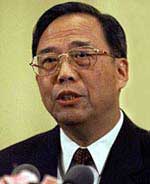 Zeng, minister in charge of the State Development Planning Commission, gave his report to the 4th Session of the Ninth National People's Congress, China's top law-making body, on the implementation of the 2000 Plan for National Economic and Social Development and on the Draft Plan for 2001.