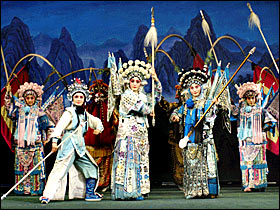
Chinese Culture Minister Sun Jiazheng delivered a speech entitled Chinese Culture Today: Aspirations and Dreams at the National Press Club in downtown Washington on October 3, 2005, two days after a month-long Festival of China opened at the John F. Kennedy Center for Performing Arts.
The following is the full text of the minister's speech:
Chinese Culture Today: Aspirations and Dreams
Good morning, ladies and gentlemen:
Firstly, I would like to extend a warm welcome to all of you for your presence here today.
The Festival of China has witnessed its grand inauguration in Washington D.C. recently. It is my great pleasure to talk to you today about the Chinese culture today. I would like to take this opportunity to have a heart-to-heart communication with you. Culture, while reflecting the living conditions, emotions and wishes of human beings, can also have active influence on their subsistence and development. In this sense, culture can represent people. Therefore, a better understanding and knowledge about the Chinese culture will help one know more and understand the Chinese people today.
The Chinese government is now upholding the principle of "people first," implementing a scientific approach to development, and working hard to build a harmonious socialist society. This is a continuation and advancement of the past twenty years of reform, opening up and development of the Chinese society, as well as a basic direction for the future social development of China. It is not only a national development strategy adopted by the Chinese government, but also a reflection of the mainstream cultural thoughts and values in the Chinese society. Contemporary Chinese culture is a mirror of contemporary Chinese people's mentality and a reflection of their innermost emotions and aspirations. The political proposition and social ideal for harmony have a profound influence on the development of contemporary China and the cultural character and spiritual styles of our nation. By briefing you on Chinese culture today and the Chinese people living within this culture from this perspective, I think we can grasp the essence of the Chinese culture and the fundamental spirit of contemporary Chinese people.
In the past 26 years since reform and opening up, China's modernization has made great achievements, bringing about profound changes in economic, political, cultural and social life. Our ancient country has been revitalized, standing before the world with renewed youthful energy. In 2004, China's GDP reached US$1,650 billion and US$1,270 per capita, an average growth rate of 9.4 percent. The overall national strength has been continuously increasing and people's living standard been greatly improved. This is truly a remarkable progress. It is not in line with reality to ignore this progress and exaggerate the problems existing in China; it also runs against the fact to overestimate China's current development, regarding China as a developed country which will soon overtake the US. In spite of the historic achievements, China's leaders remain sober-minded, bearing in mind that as a developing country with a population of 1.3 billion, China's foundation for development is quite poor. Take GDP as an example. The GDP of China is less than one seventh that of the United States and its per capita GDP is just one thirtieth that of the United States, trailing behind the 100th among over 200 countries in the world. Ambassador James Sasser and Ambassador James Lilley present here today must have known that huge differences exist in different regions in China, and many people live in the rural areas. In today's China, there are more than 100 million people still living on less than US$ 1 per day, among whom about 30 million only have less than US$ 0.5 each day. Now as we are just beginning to feel a breath of coldness in the autumn, the Chinese leaders have already started to worry whether farmers in poor areas can live through the winter warm and full. There are numerous problems in China either left over by history or waiting ahead in our way forward. To solve them and eventually realize the dream of building a harmonious society, we need the efforts of several generations. Since we already know how lofty our mission is, we will never be afraid of the long way we need to go. Thanks to the hard work in the past 26 years, we have already solved the problem of feeding our people, who account for 23 percent of the world population, by using just 7 percent of the world farmland, and have built a relatively well-off society. However, a philosopher once said, "When a man is hungry, he has only one worry; once he is well-fed, innumerous worries will find him." The former worry is about survival, whereas the latter one is about development. It is in such a process of continuously solving problems in the pursuit of development that China gradually moves toward the ideal society. In the past two decades, the Chinese people have been deeply aware of the need to persistently concentrate on development. Successive governments in China have made great efforts to tackle domestic problems, taking measures to enable our people to subsist. When the 1.3 billion people can lead a safe and sound life and the country develops in harmony, China can be a greater force in promoting world peace and development. This can be China's biggest contribution to the world. Adherence to the principle of "people first," the scientific approach to development and cherishing harmony is a typical Chinese vision, which we believe can serve as a bridge for heart-to-heart communication with the world.
From the very beginning of the human society, there have always been three fundamental conflicts -- conflicts between man and nature, within the human society and within man himself. It is mankind's eternal dream and aspiration to transform conflicts into harmony. I suppose many of you present here today have either visited or heard about the Forbidden City in Beijing, the biggest royal palace in the world. The names of the three major halls in the Forbidden City well reflect this Chinese traditional philosophy. Among them, Tai He, or Supreme Harmony, signifies the dialectic unity of heaven and earth, and harmony between man and nature; Zhong He, or Central Harmony, indicates the state of tranquility and stability in human society; and Bao He, or Preserving Harmony, refers to the peace of mind and health in body and the balance between the two. The names of the three halls have well reflected the values of Chinese traditional culture -- the pursuit of harmony. However, the prerequisite of social harmony is the independence of our country, liberation of our nation and freedom for our people, for which the Chinese people have waged arduous struggles.
Today, our efforts to build a harmonious world are also in line with China's reality. President Hu Jintao has proposed six requirements in building a harmonious society, namely, "democracy and the rule of law, equality and justice, trust and fraternity, vigor and dynamism, safety and order, and harmony between man and nature." In order to fulfill those requirements, we are attaching unprecedented importance to the value, rights, interests and freedom of human beings, the quality of life, the potential for personal development, the happiness of the people, and the coordinated economic, political, cultural and social development, as well as the harmonious coexistence between man and nature.
In building a harmonious society, the economy is the foundation, politics the guarantee and culture the soul. In the course of development in the 21st century, there appears a new cultural awareness to put culture in such an important place and entrust it with such lofty mission, since it is closely related to the character of a nation and has impacts on every aspect of our social life. Its functions to educate, inspire and to bring beauty are more often realized in indirect, far-reaching and subtle ways. Culture is like water, nurturing everything in quietness.
The harmonious society that we're striving to build is one which respects the interests and appeals of all social groups, where people can fully realize their potential, get what they deserve, and live a well-off, peaceful and happy life. In terms of culture, this ideal boils down to safeguarding basic cultural rights and interests of all citizens, and addressing the multi-level and diverse needs for culture of all members of the society.
In China, we have recently seen five changes in people's demands for culture: firstly, a considerable increase in the quantity of needed cultural products; secondly, need for higher quality cultural products and services; thirdly, diversification and marketization of cultural consumption; fourthly, more scientific and modern means of production, dissemination and consumption of cultural products; fifthly, increasing demands for more in-depth intercultural communications and exchanges. Therefore, we focus on the prosperity and development of culture and hope to improve the living standard of our people and boost their self-development through quality cultural products and services. Furthermore, we strive to soothe, inspire and cultivate our people through culture, enriching their inner world, producing a sense of tranquility and happiness for them and fostering their creativity. We are committed to the establishment of a framework for the advancement of culture and the building of a learning society for all. This framework will comprise an enabling environment for cultural innovation, a comprehensive system of cultural laws and regulations, a widely accessible network of public cultural services, a sound and viable cultural market, and a well-functioning cultural administration and management system that can give impetus to the cultural circles for the creation of more works of excellence and development of more cultural talents. At the same time, we will continue to earnestly promote international cultural exchanges, and strengthen heart-to-heart communication between the peoples of China and around the world. The production and trade of cultural products are also important elements in economic development. The Chinese cultural market has a great potential and competition in this market is intensifying. Cultural products that are beneficial to the recipients, especially to the mental and physical health of young people, social harmony and world peace, are becoming more and more popular, whereas products with pornographic and violent contents are faced with increasing repulsion and objection. As a culture minister, I maintain that culture should not be regarded only as a tool for making money, but should be used to satisfy spiritual needs of the people. Human development can not rely only on economic development. Our cultural undertakings and enterprises should listen and respond to the humanistic call from the public.
With regard to the protection of intellectual property rights, it is obvious to all that the Chinese government has made great efforts and achievements. It is not out of pressure that the Chinese government adopted steadfast measures against piracy to protect intellectual property rights, but out of its intention to protect the rights and interests of the creators and investors. It is in line with the fundamental national interests of China. Without the protection of intellectual property rights, a nation's creativity can be badly undermined, leading to a drastic weakening of the impetus for development. Therefore, the Chinese government is very serious, determined and firm in intellectual property right protection and has adopted the following measures:
1. Improving the law and cracking down on piracy according to law;
2. Strengthening education on intellectual property right protection and calling on the public to fight against piracies;
3. Focusing on some key regions and industries severely afflicted by piracy;
4. Working out a long-term and effective system and mechanism to address the problem.
Motion Picture Association of America and some companies such as Time Warner wrote letters to the Ministry of Culture of China last year, affirming the Chinese government's efforts and achievements in fighting piracy and protecting intellectual property rights.
In the past over two decades since the reform and opening up, China has undergone tremendous changes, which are not just manifested by the mushrooming skyscrapers or simply the statistics. The biggest change is the change of Chinese people's outlook on themselves and the world. With a broader mind and heart, Chinese people connect their own well-being and happiness to the peace and development of the world.
In today's world, peace and development are the mainstream, but uncertainties and instabilities still disturb world peace and development. In recent years, the world has witnessed many shocking events, including imbalance in social development, widening gap between the rich and the poor, deterioration of ecological environment, rampancy of terrorism and transnational crimes. All these have posed severe threats to the survival of mankind. Where is humanity heading? Where is the world going? What kind of rules should we abide by in the future world? These questions have never been more pressing than they are now.
China's foreign policy is the extension and externalization of its theory of domestic development. At home, we pledge to build a harmonious society and secure peace, well-being and happiness for all Chinese people, and in the world, we will firmly pursue the independent foreign policy of peace, and seek to maintain friendly relations with all other countries in our shared pursuit for peace, cooperation and common development.
The pursuit of harmony and aspirations for peace, deeply rooted in Chinese traditions, are in the fundamental national interests of China, and it is also what we have learnt from the sufferings of our nation in the recent history. For over 100 years after the 1840s, China, as an extremely poor and weak country, never stopped being invaded by foreign forces, until it stood up against the danger of total foreign occupation and national extinction and fought arduously to win back its independence and liberation. 2000 years ago, Confucius, a famous Chinese philosopher, once said that "Do not do to others what you do not want done to you." This maxim has been the moral principle strictly abided by the Chinese people and is also a golden principle in foreign relations. The Chinese people, who once suffered lots of threats and aggression, highly value this hard-earned peace. We are deeply aware of the close link between the security and interests of China and those of the world. In recent years, there has been increasing talk of a "China threat." We cannot change such views held by a small group of people, because prejudice is often further away from the truth than even ignorance. But for most people, their doubts and concerns are all because of their lack of knowledge about China's current situation and cultural traditions.
Regarding the principle of cultural development, domestically, China advocates the idea of "letting a hundred flowers bloom and letting a hundred schools of thought contend;" externally, it is committed to maintaining world cultural diversity. Each country has the right to choose its own culture; and it is only up to the country itself to determine what kind of culture is suitable. It is as obvious as the fact that the fish chooses the water it wants to live in and the bird picks forest for its habitat. No matter how others comment on our thoughts or system, only we ourselves are clear what suits us best, just like the fact that to judge whether a pair of shoes fit or not, you have to ask the one who wears them. Differences among various national cultures have existed since the start of history, and they are the preconditions for maintaining the richness and diversity of world cultures. Different mentalities and attitudes in viewing and handling differences can lead to two totally different results: either to pursue "harmony in differences," seek mutual benefit, achieve a win-win situation, and realize harmonious coexistence and peace through enhancing mutual understanding and tolerance, or to follow the obsolete Cold War mentality and rush into mutual suspicion, alienation, confrontation and even war. Mankind should control its own fate. To our great relief, there is growing consensus in the world for the right choice.
The United States and China are oceans apart and have completely different historical backgrounds, but both are countries which are home to diverse ethnic groups with integrated cultures, and both boast vast territories and hardworking and intelligent peoples. There are big differences between China and the United States, which will naturally bring about some confrontations and frictions; however, it is just these differences that have produced great curiosity and attraction for each other. Without such differences, the world might become more peaceful, but at the same time, to a large extent, it would lose its glories and fall into monotony. Time is moving forward and China's views about the world have seen major changes in the past two decades. The ancient Chinese philosophical idea of "harmony in differences" is now glittering with renewed rays of wisdom in this new era.
This year marks the 60th anniversary of the world's victory in Anti-Fascist War and Chinese people's victory in the War of Resistance Against Japanese Aggression. On this very day last month, we held a grand celebration in Beijing in commemoration of this great triumph of justice over evil, brightness over darkness and progress over regression. In that great war which determined the future and fate of the world, China and the United States fought on the same side and relied on each other through thick and thin. The Flying Tigers from the United States who fought bravely in China during the wartime have become a household legend in our country. In Nanjing where I once worked for a long time, there is a graveyard for the American pilots. Although their bodies have already been moved back to the US, a lot of Chinese people still go there and offer flowers to them on the Tomb Sweeping Festival each year. During the war, China opened its gate to Jewish people who were persecuted by the German Fascist. Today, many Jewish people including some who live in the United States still look upon Shanghai, where they found asylum during the War, as a place for survival and rebirth. Both the Chinese and American cultural community stood shoulder to shoulder in the same trenches during the war. When the war broke out, many eminent figures, such as the famous American scientist Albert Einstein, educationist John Dewey and literary master Theodore Dreiser, gave great support to China, either by fighting on the Chinese land, or giving speeches and raising funds for China in the United States and around the world. At that time, among western countries, the United States sent the largest number of journalists to China. This experience of our two peoples sharing the same destiny is a memorable chapter in the history of China-US relation.
China-US relation has gone through numerous ups and downs and its current development didn't come by easily. This year marks the 56th anniversary of the founding of the People's Republic of China. When we look back into the history, we see China and the US in severe confrontation during the first 30 years. The US refused to recognize the new China and imposed blockade on it. China, in order to safeguard our independence and sovereignty, stood up and fought back, loudly voicing across the country the call to "fight against American Imperialism." Of course, the international environment at that time had a great bearing on the relation of the two countries. Thanks to our joint efforts, China-US relations began to ease in 1972 and were normalized in 1979. In the past over two decades, the sound development of our bilateral relations has brought about tremendous benefits to the two countries and the peoples. The exchange and cooperation between our two peoples have also been increasingly strengthened with friendship further enhanced. The day before yesterday, during the 100-minute opening performance of the Festival of China, there were nearly 100 times of applauses. The audience was moved by the programs from China, and I was deeply touched by the applauses and enthusiasm of the American audience. The opening performance has testified not only the success of the Chinese people but also that of the heart-to-heart communication between the two peoples. The success of art relies on the interaction between the creator and the audience. The improvement of China-US relations is a result of the joint efforts from China and the US.
Of course, China-US relation is not always plain sailing. It is fairly natural that conflicts, frictions, disputes and differences exist in our bilateral relations. The key is how we look at them and deal with them. Here I would like to share with you some of my ideas on China-US trade issues. First and foremost, I would like to clarify that I am neither a foreign minister nor a minister for commerce; I just want to share my personal views from the perspective of a cultural minister. There have been heated disputes on China-US trade issues. Trade departments of the two countries have had many negotiations and achieved desirable results recently. In the trade of goods and commodities, the United States always stresses its big deficit; however, in the trade of cultural products, China has an even bigger deficit. As the cultural minister, I am not having an easy time. I would like to show you some statistics. From 2000 to 2004, China imported 4,332 films through various channels, 40-50 percent of which were American; among those imported movies, over 4,000 have been shown on CCTV and local TV stations and 40 percent of them came from the US; and among the 211 films shown in the cinemas, 53 percent were from the US. In the past five years, the imported revenue-sharing movies totaled 88, with 70 of them or 80 percent from the US. I wonder if any of you present here today can tell me how many Chinese movies are being shown in the US now and how many Chinese cultural products are being sold in the US market. We might reply that there are only a few. Despite such a huge deficit, China never put so much blame on the US. Instead, we thought about our own problems and found that though we have fairly good cultural products popular with the American audience, we don't know how to sell them. We don't have adequate marketing network, experience and knowledge to promote our products. We need to learn more in this regard. Meanwhile, we also hope that the US market could be more accessible so that more good cultural products from China can enter.
As for the trade deficit, I suggest that our American friends look at it from an easy and long-term perspective. If the US could change its discrimination trade policies towards China, the export to China would be increased, and subsequently, the deficit can be reduced. The various restrictions on exports to China and imports of Chinese products are quite detrimental to China-US trade relations. To be frank, the Chinese people are late-comers in understanding market economy and the WTO. In this regard, the US is our teacher. However, why the rules and knowledge which we have learned from our American teachers aren't working when we deal with the United States? China enjoys a huge market with great potential and commercial opportunities. The powerful economy and strong technology of the US can certainly reduce your deficit through the increase of export to China. How many hats, shoes, dresses and toys can a Boeing plane buy in exchange! Therefore, we should take a long-term perspective and adopt a uniform standard on China-US trade issues, instead of only caring about immediate interests and simply relying on statistics to make decisions. I think in the long run, the US is in an advantageous position both in terms of strength and benefits in China-US trade relations. However, every time there is a small increase of Chinese products in the US market, protests would follow. This is really against the demeanor of the United States as a big and powerful country. Therefore, I maintain that as the biggest developed country in the world, the US can have a broader mind and a more far-sighted vision instead of a vulnerable psyche.
China is the world's largest developing country, and the United States is the world's largest developed country. Both our countries have great peoples with kind hearts and immense creativity, and broad markets in which the two economies can well complement each other. We have common national interests in many areas, especially in global issues such as the fight against terrorism, maintenance of global and regional security and protection of the environment in the world, as well as in economic, trade, scientific, technological and cultural exchanges. We have a lot to learn from each other. There are those who tend to exaggerate the differences and frictions between the two countries and our two cultures, and overlook our common interests and compatibility. It is natural and not surprising to have differences or conflicts, but what matters most is that we should solve these conflicts and problems on the basis of mutual respect, equal consultation, candidness, sincerity and reciprocity. Standing high and seeing far is the typical Chinese way of thinking, while emphasizing details marks the American people's spirit of pragmatism. Combination of the two can enable us to see more clearly what our peoples' expectations are and where the world is heading, and thus to negotiate on and settle specific issues. "One cannot lift himself up while sitting in a basket." Only through dialogue can we achieve mutual understanding, complementarity, favorable interaction and common development. China and the United States should enhance communication, find the differences and similarities between the two cultures, and embrace the connections and concords of the two cultures in all their diversity. It is my hope that all of you present here today can be envoys of China-US cultural exchanges, and jointly establish a new world cultural order characterized by harmony.
The exchanges between China and the US need us to open our hearts and minds. Culture originates in, and in turn speaks to the human heart. And my speech today is aimed at conveying my wish to promote the heart-to-heart communication between our two peoples. What gives me great pleasure is that such a wish is not just my expectation, but has become an ongoing cultural process and an objective historical trend.
Before my speech is concluded, a story comes to my mind -- the story of a young couple and their lovely daughter in New Orleans of the US. Not long ago, they were invited by the Beijing International Culture and Tourism Festival to visit Beijing and give performances on American folk art. Just after they received the invitation, the hurricane hit their home, taking everything they owned and making them penniless. However, they still strongly wished to go to China. With the help of an overseas Chinese friend, they eventually realized the visit. When their story was told to thousands of households by Chinese television, a lot of Chinese audience was moved to tears. From the story of this family, the Chinese people saw the US, the American culture and the optimism and confidence of the American people in face of catastrophes. Chinese people love the American people as well as their culture and art. Next year will see a grand exhibition celebrating 300 years of American art held in China and presented by the Guggenheim Museum. The artistic exchanges can stimulate new creations and connect even two strange countries and their peoples
closely together.
Ladies and gentlemen, not long ago, China released the theme slogan of the 2008 Summer Olympics, "One World, One Dream," which reminds me of Dr. Martin Luther King's famous speech I Have a Dream. Dr. King said, "I have a dream that one day every valley shall be exalted, every hill and mountain shall be made low, the rough places will be made plains, and the crooked places will be made straight." The Chinese people today share the same dream with him. Our earth, which has fostered splendid civilizations for thousands of years, is both the material foundation of our subsistence and a common homeland for human spirit. Both China and the United States are great countries and our peoples are endowed with great wisdom. 26 years ago, at the Kenney Center in Washington D.C. where the Festival of China has just opened, Deng Xiaoping held an American boy in his arms and said with deep emotion, "now all the people in China and the people in the United States are shaking hands!" 26 years have elapsed, and the little boy in Deng's arms has already grown up. But for more lovely children in China and the US, for the children of the world, for the earth we live on and for our common dreams, shouldn't we hold our hands even tighter?
Thank you!
(China.org.cn November 23, 2005)