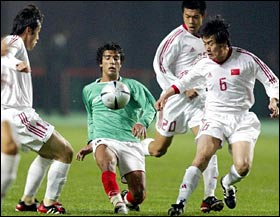
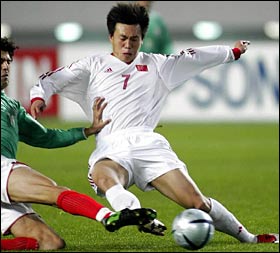
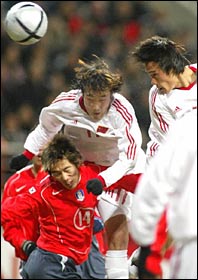
On March 3, South Korea beat China 1-0 in the Asian zone Group A, Olympic soccer qualifiers so continuing a 20-year tradition of dominance on the field. Playing a home game in Wuhan seventeen days later, the Chinese team was held to a 1-1 tie by Malaysia, which had not been considered a serious contender.
Despite a 3-1 victory over Iran on March 27, China can hold out little hope for the Athens Olympics since it trails by five points behind group leader South Korea with three matches to go.
Deeply touched by the fact that Chinese soccer has made no headway in shaking off its years of under-performance, National People's Congress (NPC) deputy Chang Jinyue has proposed that the government introduce a timetable for the withdrawal of state-owned capital in order to promote the reform of professional soccer.
On March 5, Chang, with the support of 32 other deputies, submitted the proposal entitled "Protecting State Assets, Promoting Sports Competition Reform" to the Second Session of the 10th NPC.
In the words of the proposal, "In other countries it would be considered unusual to see state-owned capital involved in professional sports such as soccer and basketball. But in China huge amounts of public funding have rolled into these high-risk industries."
Since China introduced professional league matches in 1994, state-owned capital has been a mainstay of the soccer industry. The new Chinese Premier League (CPL) is to make its debut this season. And it had been set to continue the trend for it also enjoys financial support from many state-owned enterprises including electric power companies, tobacco firms and media corporations.
Fifty-five-year-old Chang is a private entrepreneur from east China's Shandong Province who has sponsored sports activities for decades. He stresses that it is market forces that should determine investment in professional sports.
"Massive public funds have poured into China's soccer market regardless of the investment returns. Such unsound investment is at variance with the general pattern of market activities. This has not only served to encourage soccer fraud and bribery but has also resulted in the loss of state assets," Chang said.
The intervention of public money has merely served to weaken the market. In sharp contrast with the performance of their clubs, players' incomes have been soaring, attracting public condemnation.
"As far as I know, players in our first division soccer league have been commanding incomes 130 times per capita income, which is about US$900 a year in China," Chang said, "However in countries such as Britain, Germany, France and Spain, which have long-established soccer industries, professional players' incomes are no more than 30 times those of ordinary people. Soccer incomes have clearly become divorced from reality here."
Chang suggests that administrative departments should put an end to state-owned enterprises investing in professional soccer, while at the same time encouraging and supporting the flow of private capital into the market.
Chang concedes that at first the intervention of state-owned capital did indeed provide a considerable impetus to the development of professional soccer in China. However as time passed, state-owned enterprises gradually cornered the soccer market blocking out the entry of private capital. He sees this as not only going against a spirit of fair play but in the long run as harmful to the development of the sport.
"With its job already done, it's now time for state-owned capital to withdraw from the soccer market," Chang said. "Instead, the state should invest more money in sports infrastructure through such activities as building soccer fields and improving public exercise facilities. This would help attract more and more people into sporting activities."
Chang recognizes that the withdrawal of state-owned capital may well have a temporary negative impact on Chinese soccer. However with the rapid development of China's private economy, today's private enterprises have the resources needed to invest in the game.
It is anticipated that policies will be put in place to support a model of private capital plus foreign investment for Chinese professional soccer. "This is the only way we can hope for improvement in the overall level of Chinese soccer," Chang said.
Chang's soccer proposal attracted wide support among the NPC deputies. The rule is that a proposal cannot be tabled at a NPC session unless it carries the signatures of least 30 deputies. In fact Chang had no trouble at all in raising the necessary number of signatures. He said, "All of the deputies I asked were willing to sign. I stopped once I had reached 32 because I didn't need any more. The proposal was submitted to the secretariat of the NPC and will be forwarded to the relevant governmental departments for consideration. They have half-a-year to prepare their responses and after that we can see if it will finally become legislation."
However Chang's proposal has not gone forward without encountering some opposition. "In the short term Chinese soccer still needs the support of state-owned capital," said Yin Mingshan, CPPCC member and founder and CEO of the Chongqing Lifan Industrial (Group) Co. Ltd.
Yin submitted an alternative proposal to the Chinese People's Political Consultative Conference (CPPCC). This proposes a self-regulatory model for Chinese soccer. When interviewed on the issue of the use of public funds to support soccer he said, "Private enterprises operate with their own money, while state-owned enterprises seem to be able to chase after the top soccer players regardless of cost. We can't just go from one extreme to the other, from total dependence on public money to getting rid of it completely."
"Less than a decade has passed since soccer could take to the field on just tens or hundreds of yuan," Yin said. "Today soccer needs to be underpinned not only by investment but also by the necessary equipment, management and services. Private enterprises just aren't ready."
Yin's view is that it should not be administrative intervention that decides if the state-owned enterprises should quit Chinese soccer. He said, "We should act according to market forces. Those state-owned enterprises that are genuinely committed to the long-term sustainable development of Chinese soccer and which have made sound investments based on the realities of the market could no doubt continue in the game."
However Li Dejiu, a former official of the Bayi Club, which was disbanded last December, said, "Chang's proposal reflects current public thinking. At the end of the day state assets are public resources and they belong to the people. It is clearly inappropriate to invest such funds without taking due account of the risks involved. Experience in professional soccer over the years has proven that no matter how powerful a private enterprise may be it just can't compete with the deep pockets of public funding."
According to Li, the commercialization of Chinese soccer has been held back by the closeness of the relationship between the state owned enterprises and the government. This has seen some of these enterprises driven by government intervention to become somewhat reluctant soccer investors whose activities have then served to disturb the natural workings of the market. "As far as I know, some enterprises such as the Yizhong Group would like to quit soccer. However, they are unable to find other enterprises willing to take over from them and the government won't allow them to just walk away from their responsibilities to the game," he said.
Li said, "The introduction of the new Chinese Premier League (CPL) might be an overly optimistic move at the present time. Whether or not soccer should be supported by public funds is a matter that requires legislation. What Chinese soccer really needs now is standardization of the market with effective back-up legislation. If the proposal put forward by the deputies can promote the legislative process, then there will be some hope for Chinese soccer," he said.
However, if Chang's proposal were to be accepted, more than half of all CPL clubs could find themselves facing reorganization or transfer of ownership. The records show that 7 of the 12 CPL clubs are backed by state-owned enterprises, or directly by the government.
The following is a full list of CPL clubs showing their sources of financial backing:
State-owned backing
Beijing Guoan Club, CITIC Group
Liaoning Club, Liaoning Provincial Sports Administration
Qingdao Yizhong Club, Yizhong Group
Shandong Luneng Club, Luneng Electrics
Shanghai International Club, Zhongyuan Group
Shanghai Shenhua Club, Wenguang Media
Tianjin Taida Club, Taida Development Area
Private backing
Chongqing Qiche Club, Lifan Group
Dalian Shide Club, Shide Group
Shenyang Jinde Club, Jinde Group
Shenzhen Jianlibao Club, Jianlibao Group
Sichuan Guancheng Club, Guancheng Group
Soccer criticized at NPC and CPPCC sessions
During previous NPC and CPPCC sessions, deputies and members have addressed problems besetting Chinese soccer. They have dealt with such issues as soccer players' high incomes, bribery of referees and rigged games. However Chang's proposal for the withdrawal of the support of state-owned capital from soccer comes as the first of its kind to address this aspect of the game.
In January 2002, during the eighth session of the Zhejiang Provincial People's Political Consultative Conference, Xie Lijuan submitted a proposal entitled "We Must Not Allow Black Whistles to Spread Unchecked".
"Referees who take black money are no different to those government officials who abuse the power of their positions for personal gain. Black money is unmitigated corruption and must be investigated by the judicial departments so as to cut off the talons of this particular devil," said Xie.
In March 2003 during the 10th NPC, deputies submitted proposals and suggestions on China's soccer management and legislative framework. During the 10th CPPCC, the China Democratic National Construction Association submitted a proposal that pointed out that the gap between urban and rural incomes had exceeded generally recognized international limits and that the incomes of male soccer players far exceeded those of others engaged in sport.
CPPCC member, Ma Junren said that the costs involved in running the male soccer teams in China were almost as much as for all the other sporting events put together. "They can only spend money instead of playing soccer and there's no prospect of them winning a world title for the next several decades," said Ma.
CPPCC member, He Huixian said that management system failings were at the root of the corruption. "It's necessary to deepen the reform of sports' administration," he argued.
The fact is that the Chinese Football Association is funded by the central government as is the Football Sport Management Center of the State General Administration of Sports. For some 10 years these two bodies have shared responsibility for heading up the richest sport in China. This dual responsibility mechanism with its shared staff and two different name-boards just cannot meet today's requirements for deepening reform.
CPPCC member, Li Shuwei said, "Bribe-taking referees can now be sentenced since today soccer is not above the law. There have been black whistles in Chinese soccer for a long time. What matters is the legislative framework and putting Chinese soccer onto a proper legal footing. Without a sound legal system, problems will continue to occur in the future. Soccer is not a minor issue for it has a bearing on social stability and economic development."
(China.org.cn by Li Jingrong and Shao Da, March 30, 2004)