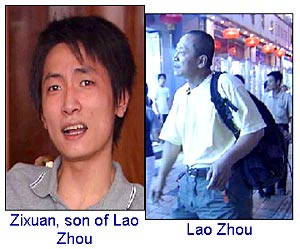
In 2001, two years after the boy turned 18, Lao Zhou kicked his son out the door, believing he should live on his own.
The father's action has become a symbol of defiance of China's age-old traditions of parenthood and education, which Lao Zhou recounts in his new book, I'll Only Feed You Until You're Eighteen, published in April by Hainan Publishing House.
The author goes by the informal nickname of Lao Zhou (Old Mr. Zhou) even on the cover of his book. Although his given name is unknown, he has revealed that he obtained his master's degree in education after China's university system got back on its feet after the Cultural Revolution (1966-1976), and for a while he taught at a college.
Yet Lao Zhou hates the system so much that he dragged his son Zixuan out of school when the boy was only 13.
"I am in total despair of our educational system. There is nothing useful you can learn in our schools and you cannot expect to develop any real talent out of it. All you learn is memorization. Yet parents are gloating that their kids have climbed in the school ranking," Zhou writes in his book.
In the book, he attacks China's educational system as one that stifles creativity and personality. Education should spur one's creativity, he argues, and help cultivate his or her individuality and unique set of values. Parents should help their children to achieve that as early as possible.
"Our basic education is designed to strip kids of their normal lives. They are shut inside classrooms for a dozen hours each day, and naturally they hate their school experience. Even the best kids from the top schools do not like it. It is horrible," Zhou said.
Zhou himself did not go through the torment of the typical middle school. He turned 13 at the height of the Cultural Revolution, when the Red Guards had crushed the country's educational establishment. He and his pals went fishing, built birdhouses on roofs, put together a radio and secretly listened to Western classical music, which was in those days denounced as "bourgeois decadence."
He says he learned all the rudiments of life this way, "so I do not feel sad at all for that wild-child experience."
When Zixuan was in junior middle school, he showed the same propensity for getting wild. Lao Zhou was frequently summoned to the school to be lectured on his responsibilities. But parents are consumers of a service called "education," he thought, so why should they be treated this way?
One day when he was again called to the school, he made Zixuan a dropout.
Lao Zhou tried home schooling by customizing teaching materials in accordance with Zixuan's personality. His son liked playing ping-pong, so he sent him to a sports school. But two years of training did not produce a ping-pong wizard. Zhou also asked some of his friends who were college teachers to tutor Zixuan, but again there were no tangible results.
When Zixuan turned 18 he expressed a willingness to return to "a normal school," but Lao Zhou brushed it aside. "The important thing is not for you to go to Peking University or Tsinghua. The best school now is McDonald's. You should make it on your own."
Zixuan did not work at McDonald's, but at a variety of odd jobs. None lasted long. For some time he had to subsist on instant noodles.
He is now working at an Internet cafe, but he is not exactly self-sufficient. Instead he lives with his mother, who is divorced from his father, and mom has never seen him bring in a single penny in salary.
Father and son are not on speaking terms now.
"When we meet again it should be man to man," declared Zhou senior during an interview with China Central Television (CCTV).
"What is the point of meeting him?" asks the son. "It is not like we have met before."
Most people feel that Lao Zhou's alternative methodology of education has failed spectacularly.
"If you want to conduct an experiment, you go to a lab. Why experiment with your kid? He is a human being, not a guinea pig. I feel the two of them have embarked on a gigantic joke," says Zixuan's mother.
Zixuan, the target of his father's "experiment," is ambivalent about it. "I cannot say it is good or bad. My feeling is that the time I spent with my father was very short, three or five years in all. Whatever I will be has nothing to do with him, whether I make it big or end up in jail." He sounds bitter.
Lao Zhou is torn, too. He hates it that Zixuan is still using the conventional standard for success in evaluating himself. On the other hand, he regards himself a failure because the son does not even want to talk to him.
"I do not have the desire to make my son into a dragon," he says, referring to the Chinese metaphor for overachievement. "I have a simple wish that he should be more learned and more accomplished than I am."
However, Zhou cannot define what "learned" or "accomplished" entails. "I do not even know whether I want him to be slightly better than I am or slightly worse, learn a little more or a little less," he said in the interview with CCTV.
Conventional wisdom seems to be embodied in the remark of Wang Xiao, associate professor of education at Beijing Normal University: "There are indeed many problems with China's education. Some of them can be hidden from view by procrastination. This father did not compromise. He did not yield to the current establishment, which I applaud. But that cannot be used to nullify the function of mandatory education, to which every child is entitled. It is a right that should not be taken away."
A junior at Shanghai's Fudan University concurs, adding: "For all its defects, the current educational system should not be demonized. I grew up in this system and I am happy and healthy, just like people around me."
After the story appeared on the official website of the Xinhua News Agency, a reader wrote: "To stop breast-feeding does not mean to stop feeding. In a sense, Lao Zhou is just like those parents who have set their kids' sights on Harvard -- they have overestimated the kids' talent. When the child is still a toddler, they want him to race in the Olympics."
But this view represents only about 20 percent of the respondents to an online poll, which, it should be cautioned, is unscientific in nature. A far larger number, 56 percent, favors Lao Zhou's approach.
"What Lao Zhou says is mostly right," says one parent. "Nowadays college kids need their parents to make their beds for them. They bring their laundry back home. That is not normal."
Evidence of parental overprotection is abundant. While their children are in kindergarten and elementary school, many parents take off early from work and pick them up after school, or assign a special person for that job. After children graduate from college, whenever possible, parents will leave no stone unturned in helping them get jobs.
Many parents do not have the slightest idea they do not need to babysit their children beyond the age of 18. The tradition of parental overprotection is exacerbated by the "little emperor" phenomenon of a typical urban family having only one child.
In a country where parents seem to have a collective controlling disorder, Lao Zhou's rebellion immediately sets him apart, shocking some and inspiring others.
"He is a pioneer, charging into an unknown territory ahead of everyone else. So it is not surprising that he will pay dearly for it. Both he and his son are victims, nominally of his outrageous scheme, but fundamentally of the existing educational structure and public mentality," says another parent.
"Whether it is right or wrong, Lao Zhou's exploration is meaningful. It is like a ray of sunshine. More people will follow him," says Wu Wen, a China Youth Daily reporter who was among the first to cover the story, interviewing Lao Zhou in 2002, one year after he sent his son out.
Writer Zhang Chi calls what Zhou has done "a roar in a sea of silence."
That may be an overstatement. Many parents are aware of the side effects of the education system. They are saddened by their kids' gruesome burden of rote learning. Yet all the entrance exams have set up barriers to nonconformity. Either you play by the rigid rules or you risk eternal condemnation to the periphery of society.
"We know the exams, as they are currently structured, are hardly adequate in assessing a student's potential. But nobody has come up with a feasible alternative," says the vice president of a university in Guangzhou, whose daughter is toiling under piles of books that she essentially crams into her memory regardless of understanding.
Once she gets into college, what she learns will most probably be out of touch with the needs of the real world. "China's schools impart knowledge that often has little to do with the outside world," writes Yang Dongping, a researcher at Beijing Institute of Technology. "It is the result of borrowing the system from the Soviet Union in the early 1950s. The Soviet model congealed with China's traditional value of education, so it was not just out of political thinking."
And traditional education in China, from the Confucian era, has always been to wipe out any trace of independent thinking and mold students into mental slaves, contend many experts.
Lao Zhou was not the first to launch a quixotic rebellion against this system. In the Qing dynasty (1644-1911) a literary author by the name of Jiang Shiquan wrote that his mother taught him 10 new words every day when he was four. Later he was forced to read all the classics. All she wanted was for him to excel in the imperial examinations and become a high-ranking official. But his father had other ideas. He took the boy on journeys to China's great mountains and rivers. "What's good about a 10-year-old memorizing 3,000 words? Those are just words in books. Nature can teach him more," said Jiang Jian, the father.
Lao Zhou, like Jiang, is an exception in our society. The difference is that there are more people now who recognize the significance of Lao Zhou's act of revolt. But that does not necessarily mean others will join him.
"I envy your courage, but I would not be able to do the same thing," says one parent.
(China Daily August 3, 2004)