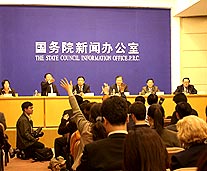
Health Minister Zhang Wenkang, Vice Health Minister Ma Xiaowei, Director Qi Xiaoqiu of the Disease Control Dept. of the Ministry of Health, and Director Li Liming of the Chinese Center for Disease Control and Prevention, met the press and answered questions from Chinese and overseas correspondents in Beijing on April 3 on the epidemic in China of Severe Acute Respiratory Syndrome (SARS) also referred to as ?atypical pneumonia?.
Q: Since the earliest SARS cases appeared three to four months ago, why do the Chinese media cover so little about the disease? And why was the relevant information from China?s authorities released so late?
Zhang Wenkang: As ?atypical pneumonia? is not in the lists stipulated in China?s Prevention and Control Law of Epidemics, we have to collect enough information about and appraisal of the epidemic to establish a new epidemic reporting method and regulation. In addition, the disease was only found in several provinces of China. According to our law, it should be reported by local authorities. Actually, Guangdong Province and Guangzhou City, the capital of the province, held a press conference on the epidemic in February and briefed the media about the disease situation. Around the middle of February, we notified the country about the SARS epidemic found in Guangdong. We then decided that monthly reports on disease control would be made later throughout the country.
China has been reporting daily to WHO on the latest SARS situation as of April 1, in line with international practice.
Q: How does the Chinese government comment on Taiwan?s cooperation with WHO in SARS control? Will China?s mainland assist Taiwan in SARS control and prevention?
Zhang Wenkang: The Chinese central government and people from China?s mainland are always concerned for the health and life of our Taiwan compatriots. With close attention to SARS cases found in Taiwan, we are willing to render any possible support for them and are willing to join hands with related international organizations to help them. In the meantime, we are ready to collaborate with medical experts from Taiwan in this regard.
The cross-Straits medical exchanges are unblocked and the saying that Taiwan has no access to relevant information on the epidemic, from the Chinese mainland, is wrong. Each year several hundred or several thousand medical experts from both sides of the Straits conduct exchanges. The remark from the Taiwan authority that we disregard the health of Taiwan compatriots is not true. It is imperative for both sides of the Straits to step up cooperation, take measures and effectively bring the epidemic under control.
We hope that the Taiwan authority won?t complicate the issue deliberately, make some baseless, irresponsible remarks, or try to join WHO, which only accepts members with sovereignty, under the cover of human rights and under the excuse of SARS. All their efforts in this aspect are not wise and will not bare any good fruit.
Q: Mr. Minister, you said just now that traveling in China is very safe. But, WHO has already warned people around the world not to go to HK and southern China. Could you please clear up whether tourists currently are free to travel to HK and southern China?
Zhang Wenkang: Chinese Ministry of Health has been keeping close contact with WHO on the epidemic of ?atypical pneumonia? (SARS). By now, the epidemic situation of SARS in parts of China has been brought under effective control. At the same time, we have gained precious experience in treatment and prevention of the disease.
WHO is to make its solutions and suggestions according to objective and actual situations. For instance, WHO has just denied the suggestion of listing Beijing as epidemic-stricken area.
In regard to the reasons why WHO made the above solution, experts from WHO are now working in Beijing. They will report to WHO if staying in Beijing is safe. As they don?t know the epidemic situation in Guangdong, WHO announced Guangdong to be epidemic-stricken area. Now, experts from WHO have arrived in Guangdong, starting the second phase of cooperation with China on the issue. I believe when they find out the situation there, WHO is going to reconsider their suggestions.
Q: Some foreign media coverage has said the statistics concerning the epidemic announced by the Chinese government yesterday shows the disease in China, especially in Guangdong, to be spreading rapidly. What would your comment be on that?
Zhang Wenkang: Some foreign media have said that without basis. According to the report made by the health department of Guangdong provincial government, a total number of 361 SARS cases were reported in Guangdong in March, reduced by 47.5 percent compared with February. Of these, 145 cases occurred in the first ten days of March, 128 in the second ten days, and 88 in the last ten days. A total of 507 cases were discharged from hospital, a reduction of 18 over February. Numbers of the cases have been declining continuously since the start of April. Therefore, I don?t know how they could make this conclusion.
Q: In the early phase of SARS, WHO asked to send experts to Guangdong Province to carry out on-the-spot investigations. Just now you mentioned that the Chinese central government also sent quite a lot of experts to the province to carry out investigations. Why did WHO have to wait such a long time to go there?
Zhang Wenkang: China has maintained good relations and cooperation with WHO especially in the prevention and cure of SARS. In February this year, WHO asked to carry out investigations on SARS in China. The Chinese government agreed and received WHO experts in Beijing in late February. Since then, WHO has sent three groups of experts at different times to Beijing and had a comprehensive grasp of the work conducted by the Chinese government in the clinical diagnosis, cure and cause of SARS. They have carefully discussed related technological problems with Chinese experts. WHO experts had a comparatively high opinion and positive assessment of the work conducted by the Chinese government on the prevention of the illness. They express their appreciation for Chinese experts in the study of SARS and suggested further cooperation in the clinical diagnosis, epidemiology and pathogen.
The Chinese government has given active support to the work. Most members of the first research group are experts in epidemiology. The Ministry of Health invited experts in more subjects to the third group for the purpose of wider research and cooperation. Both sides agreed that the cooperation would proceed by stages. The cooperation started in Beijing and would extend to Guangdong in the light of requirements. Now the first phase?s task has been finished in Beijing. From now on, they will work in Guangdong Province. WHO welcomes China to become a member of the global networks of virology and epidimilogy established by WHO for SARS. The Ministry of Health has clearly expressed that China will link its network with international ones.
I also suggested to the director of WHO?s west pacific region that an international seminar be held in Hong Kong where experts will be called together to summarize the work of the first stage and propose new plans for the future. The director has adopted my suggestion and the seminar will be held soon.
Q: Can you give some suggestions and guidance, Mr Li, since SARS is spread in some other places of the world? What kinds of work should they do?
Li Liming: Recently, a package of suggestions and plans for the prevention of SARS has been published on China?s CDC website. First, aimed at the characteristics of SARS, i.e. special incidence groups and ways of spreading SARS, the prevention work will be conducted in accordance with the respiratory system disease. Second, preventive measures should be taken to prevent infection inside hospitals. Third, the training of medical staff will be strengthened to have a better understanding of the characteristics of SARS in order to conduct work with a clear aim.
Zhang Wenkang: After several months of effort by the central government and experts of Guangdong Province, China has gained a great deal of experience in the diagnosis, cure and prevention of SARS. The experiences have been collected in book form, including the disease?s diagnosis standards, cure plans, hospital discharge reference standards, hospital disinfecting and isolation working guidance, disinfecting methods for public places, and preventive measures for communities. The English edition will come out soon and it will be provided for WHO also soon.
Q: In recent weeks, Beijing has also found cases of ?atypical pneumonia?. You were asked yesterday on a program of China?s Central Television (CCTV) ?What on earth ?atypical pneumonia? is?? Why didn?t Beijing learn lessons from Guangdong? It will be conducive to the prevention of the disease if you let the public know about the disease. During your briefing, you said there are already prevention measures for the disease. It can be cured. Do you mean it can be cured through medicines or cured by the patient?s own immune system?
Zhang Wenkang: The cases reported in Beijing are not primary cases. They are imported cases. That is to say a patient who infected the disease outside Beijing but sought treatment in Beijing. He was diagnosed with ?atypical pneumonia? or SARS. His parents and several relatives companying him to Beijing contracted the disease. Several doctors who treated him also contracted the disease. Beijing Municipal Health Department has learned experiences and lessens from Guangdong and they have soon taken proper isolation treatment for this patient and other patients who were infected by him as well as those who had contact with him but haven?t yet developed symptoms. Beijing has also received a patient from Hong Kong. It is because Hong Kong has informed us in time of the epidemic situation, we had taken isolationist measures as soon as the patient arrived in Beijing. Because Beijing has learned lessons from Guangdong, Beijing has effectively controlled its imported cases and a few cases caused by these imported cases. Therefore, it hasn?t spread out into society. Because the cause of the ?atypical pneumonia? has not been identified, currently there are no typical and especially effective medicines to treat the disease.
However, according to the experiences of Guangdong, we have taken positive treatment in order to increase patients? immune system. The patients can be cured. At present, the majority of the patients have recovered and been discharged from hospital. According to the experience of Guangdong, the combination of western and Chinese traditional medicines has a better curative effect.
Q: If the Ministry of Health was able to inform earlier the health departments of Hong Kong on information concerning the disease including some data, could the health departments of Hong Kong have better prevented the disease?
Zhang Wenkang: the Ministry of Health had briefed Hong Kong health authorities on the experience and measures taken by Guangdong in prevention of the atypical pneumonia through various channels. The Hong Kong authorities had adopted effective measures to counter the disease. However, since the cause of this epidemic disease has not been identified, it has its own process of development. According to the experiences of Guangdong, it may have a three-week peak incubation period and then the cases declined gradually because of adopting proper measures. We wish and also believe that Hong Kong is able to control the spread of SARS as soon as possible. We will further cooperate with Hong Kong in epidemiology, clinical treatment and aetiology.
Chief Executive of Hong Kong Special Administrative Region Tung Chee-hwa suggested Hong Kong to cooperate with Guangdong. We agreed. We are now discussing the details of cooperation with Hong Kong at a working level. We will further our cooperation under the Basic Law of Hong Kong.
Q: China is now exporting SARS. Has China given any help to other countries? If so, through which channel, WHO or bilaterally? Has China briefed other governments on related information including prevention and treatment?
Zhang Wenkang: Guangdong first discovered and reported SARS cases, but this doesn?t mean that Guangdong exported this disease just as we do not consider that AIDS originated in the United States for it was first discovered and reported there. At present, the world should make a joint effort in discovering the pathogen of the epidemic and its distribution at a possible earlier date so as to curb the disease effectively.
Q: Just now you said that China?s health department had earlier provided the information to Hong Kong?s health authority through various channels, but the fact is now that the epidemic has spread to many countries in the world, with some 2,000 people affected. This means either the mainland reported the information in an inappropriate way or the Hong Kong side failed to take appropriate prevention measures after receiving the warning from the mainland. Who do you think should take the responsibility? If the world was informed of the epidemic earlier in a more effective way, it should have been under more effective control. What?s your opinion?
Zhang Wenkang: SARS cases have been discovered and reported in some places in China, Guangdong and Hong Kong in particular. Such cases have also been reported in some other countries and regions. Some of the patients in those countries and regions had been to Guangdong and Hong Kong, but some others had not. Hence it?s not reasonable to say that the Chinese mainland or Hong Kong exported the disease.
So far, we have not found the exact origin of this difficult and complicated disease. It is after a period of time and after suffering considerable difficulty that Guangdong accumulated experience in diagnosing, treating and preventing SARS. I believe it is not possible for Hong Kong or any other region to command the methods of preventing and treating the epidemic just depending on the knowledge of a few health officials. The effective control depends on the knowledge and cooperation of the public, medical personnel and the patients.
(China.org.cn April 4, 2003)