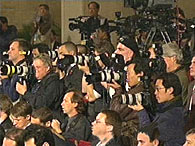
Chinese President Jiang Zemin and US President George W. Bush met the press after their formal talks at the Great Hall of the People Thursday morning. Following is the full text of the press conference, including opening remarks and question and answers.
Opening remarks of Jiang and Bush at the joint press conference
President Jiang Zemin:
First of all, on behalf of the Chinese government and the Chinese people, I would like to express my warm welcome to President Bush's visit to China.
This is my second meeting with President Bush. Four months ago, we had a successful meeting during the APEC meetings in Shanghai.
In our talks today, President Bush and I reviewed 30 years of Sino-US relations and had in-depth discussions on bilateral relations and the current international situation. We have reached consensus on many important issues and achieved positive results in many areas.
We hold the common view that, faced with the current complicated and constantly changing international situation, China and the United States, two countries with an important influence in the world, should reinforce their dialogues and cooperation, appropriately handle differences and jointly promote the development of Sino-US constructive cooperation relations.
We agree to reinforce high-level strategic dialogues and contacts at different levels and between different departments, so as to increase mutual understanding and mutual trust. With thanks and pleasure, I accepted President Bush's invitation to visit the United States before attending APEC meetings in October this year in Mexico. At the invitation of Vice President Cheney, Vice President Hu Jintao will visit the United States in the near future.
We agree to actively carry out exchanges and cooperation in economic and trade, energy, science and technology, environment protection, prevention and treatment of AIDS, law enforcement and other fields, hold strategic dialogues on regional economic and financial issues, and will convene three joint meetings within this year on economy, trade, and science and technology respectively.
President Bush and I also had an in-depth discussion on the international anti-terror campaign, and agreed to step up consultations and cooperation in this regard on a two-way and mutually beneficial basis, and reinforce medium- and long-term mechanisms for anti-terror exchanges and cooperation between the two countries. We also exchanged views on a series of important international and regional issues, and decided to step up communication and coordination.
Appropriately handling the Taiwan question is the key to ensuring a steady development of Sino-US relations. I explained to President Bush the Chinese government's basic position of "peaceful reunification; one country, two systems" regarding the settlement of the Taiwan question. President Bush stressed that the US side will adhere to the One China policy and observe the three Sino-US joint communiques. During the talks we both expressed opposition to "Taiwan independence" and the hope of solving the Taiwan question peacefully.
China and the United States have different conditions, and the existence of some differences is normal. President Bush and I discussed these problems candidly. As long as we both adhere to the spirit of mutual respect, equality, and seeking common ground while reserving differences, we could continuously reduce differences, have consensus on a broader range of issues and promote cooperation between the two countries.
I wish and believe that my meeting with President Bush will have a positive impact on the improvement and development of Sino-US relations.
US President BUSH:
Thank you, Mr. President.
I appreciate so very much your hospitality. We have just concluded some very candid and positive talks. It is true that I invited the president to the United States next fall. It's true he accepted.
Now, this is the 30th year--30th anniversary of President Nixon's first visit to China, the beginning of 30 years of growth in the US-China relationship. Our ties are mature, respectful and important to both our nations and to the world.
We discussed a lot of issues starting with terrorism. We recognize that terrorism is a threat to both our countries. And I welcome China's cooperation in the war against terror. I encourage China to continue to be a force for peace among its neighbors, on the Korean Peninsula, in Southeast Asia, and South Asia.
China, as a full member of the WTO, will now be a full partner in the global trading system and will have the right and responsibility to fashion and enforce the rules of open trade.
My government hopes that China will strongly oppose the proliferation of missiles and other deadly technologies.
President Jiang and I agree that the United States and China could cooperate more closely to defeat HIV-AIDS.
Our talks were candid, and that is very positive. The United States shares interests with China, but we also have some disagreements. We believe that we can discuss our differences with mutual understanding and respect.
As the president mentioned, we talked about Taiwan. The position of my government has not changed over the years.
We believe in the peaceful settlement of this issue. We will urge there be no provocation. The United States will continue to support the Taiwan Relations Act.
China's future is for the Chinese people to decide, yet no nation is exempt from the demands of human dignity. All the world's people, including the people of China, should be free to choose how they live, how they worship and how they work.
Dramatic changes have occurred in China in the last 30 years, and I believe equally dramatic changes lie ahead. These will have a profound impact, not only on China itself but on the entire family of nations.
And the United States will be a steady partner in China's historic transition toward greater prosperity and greater freedom.
Thank you, Mr. President.
Full text of Question and Answers
QUESTION: Thank you, Mr. President, for you hospitality. President Bush, on the question of strategic nuclear policy, you've said you want to develop a missile defense system in order to defend the United States and its allies from the threats and dangers of the 21st century. Do you invision a circumstance where that includes Taiwan? And President Jiang, if I may, with respect, could you explain to Americans who may not understand your reasoning why your government restricts the practice of religious faith, in particular, why your government has imprisoned more than 50 bishops of the Roman Catholic Church?
BUSH: I did bring up the subject of missile defenses in the broad context of protecting ourselves and our friends and allies against a launch by a threatening nation.
I explained to the president that we were--had just recently gotten out from the underneath 1972 Anti-Ballistic Missile Treaty and are beginning to explore the full options as to whether or not a system will work. And that's the extent of our conversation.
QUESTION: Just now, President Bush mentioned that today marks the 30th anniversary of the first visit to China by President Nixon. In a few days time, the 28th of this month, will mark the 30th anniversary of the release of the Shanghai communique. So my question to President Jiang is that, how would you characterize the relationship over the past 30 years?
JIANG: We will have, in February, the 30th anniversary of the first visit to China by President Nixon and the release of the Shanghai communique. The visit by President Bush coincides with this day, and his visit is highly meaningful.
Thirty years ago, leaders of China and the United States acted together to put an end to mutual estrangement and open the gate for exchanges and cooperation between the two countries.
History has proven that it was with great vision that our leaders took this major move. The growth of bilateral ties over the years has brought tangible benefits to the two peoples and played an important role in safeguarding peace in the Asia-Pacific region and the world as a whole.
At present, despite profound changes in the international situation, China and the United States have more rather than less shared interests and more rather than less common responsibility for world peace.
The importance of the relationship has increased rather than decreased, so to build a constructive and cooperative relationship serve the desire of not only the people of the two countries, but also of the people throughout the world.
The Chinese side is ready to join the U.S. side in reflecting on the past and looking to the future, increasing exchanges and cooperation and enhancing understanding and trust. I'm deeply convinced that, so long as the two sides bare in mind the larger picture, take a long-term perspective and abide by the principles in the three China-U.S. joint communiques, the relationship will make even bigger strides forward in the years ahead.
Thank you.
QUESTION: President Jiang, do you agree with President Bush that there should be a regime change in Iraq? And if so, would you support the use of all necessary means to accomplish that? And with respect, sir, we're eager to hear the response to your--the original question about the arrest of Catholic bishops in your country and attention to religious groups in general? And President Bush, you have thanked the Chinese for their cooperation in the anti-terror campaign. As that campaign evolves, can you say today what would be the single most important contribution that China could make, and did you receive any assurance today that that will happen?
BUSH: Let me start. We discussed the Korean Peninsula. I told the president that I was deeply concerned about a regime that is not transparent and that starves its people.
I also--he reminded me that he had a conversation with Kim Jung Il last fall urging Kim Jung Il to take up Kim Dae Jung's offer for discussion. That was constructive leadership.
I then told him that the offer I made yesterday in Seoul was a real offer and that we would be willing to meet with the North Korean regime, and I asked his help in conveying that message to Kim Jung Il. If he so chooses, if he speaks to the leader of North Korea, he can assure him that I am sincere in my desire to have our folks meet.
My point is that not every theater in the war against terror need be resolved with force. Some theaters can be resolved through diplomacy and dialogue. And the Chinese government can be very helpful.
Furthermore, in the first theater in the war against terror, part of the call for our coalition is to make sure that Afghanistan becomes a self-supporting peaceful nation. And the Chinese government is supportive of the aid efforts to make sure that we aid the new post-Taliban, Afghani government and its opportunities to develop its own army as well as its own economy, its own security. So they've been helpful there as well.
Thank you.
QUESTION: I've got a two-part question. First, in recent years China has enjoyed rapid economic growth and its national strength has increased. Some people in the United States have concluded that, because of this, China has posed a potential threat to the United States, and they call for a policy of containment against China. What is your comment, President Jiang? And secondly, in your opening remarks, President Jiang, you mentioned that the key to steady growth of a Sino-U.S. relationship is the proper handling of the question of Taiwan. President Bush, in his opening remarks also elaborated on the U.S. position on Taiwan. President Jiang, could you comment on what President Bush has said on the question of Taiwan?
JIANG: We are living in a world of diversity. As two major countries with different national conditions, China and the US have indeed certain disagreements, but they also share broad and important common interests.
So the old mindset which views relationships between countries as either of alliance or confrontation ought to be abandoned and a new security concept which features security through mutual trust and cooperation through mutual benefit should be established.
It's true that since the inception of the reform and opening up program, China's national strengths and people's living standards have somewhat improved in recent years, yet compared with the developed countries, our economic and cultural development remains quite backwards.
With a population of over 1.3 billion, the road ahead is still very long before we can basically complete modernization and deliver a better-off life to all our people.
To focus on economic development and the improvement of people's livelihood is our long-term central task. What China wants most is a peaceful and tranquil international environment with long-term stability: Do not do unto others what you would not like others to do unto you. Even if China becomes more developed in the future, it will not go for bullying or threatening other countries.
Facts have proven already and will continue to prove that China is a staunch force dedicated to the maintenance of peace in the region and the world at large.
Now, let me comment on the questions posed to me by the American correspondents as they raise the questions for President Bush.
When it comes to meeting the press, I think President Bush is much more experienced. I will do my best to answer your question.
In the first question, the correspondent mentioned that some of the Catholic Church people have been detained. I want to explain that, since the founding of the People's Republic of China, all our constitutions, including amendments, have provided for the freedom of religious belief. In China, there are many religions, which includes Buddhism, Catholicism, Protestantism, Islam and a typical Chinese religion, Daoism, and their religious faiths are protected by our constitution.
I don't have religious faith. Yet this does not prevent me from having interest in religion. I have read the Bible. I have also read the Koran, as well as the scriptures of Buddhism.
I often have meetings with the religious leaders in this country. For instance, when we are about to celebrate the new year or during the holiday season, I would have meetings with them and exchange views.
Whatever religion people believe in, they have to abide by the law. So some of the law breakers have been detained because of their violation of law, not because of their religious belief. Although I'm the president of this county, I have no right interfering in the judicial affairs because of judicial independence.
You also ask about the Korean peninsula issue. President Bush has also commented on this. In our talks just now, the two of us exchanged views on the Korean peninsula. I want to make clear that we have all along pursued such a position. That is, we want Korean Peninsula to have peace and stability.
We hope that the problems between DPRK and ROK can be resolved through dialogue, and we also sincerely hope that the contacts between the United States and DPRK will be resumed.
All in all, in handling state-to-state relations, it is important to resolve the problems through peaceful means, in the spirit of equality and through consultation.
And that's why I've explained our consistence and clear-cut position on the question of the Korean peninsula. It's quite near.
You ask about Iraq. I think, as I made clear in my discussion with President Bush just now, importantly that peace is to be valued most.
With regard to counterterrorism, our position has not changed from the position I made clear to President Bush when we last met four months ago in Shanghai, and that is, China is firmly opposed to international terrorism of all forms.
I'm very pleased to see that Afghanistan has now embarked on a road of peaceful reconstruction. I wish them well. I hope they will succeed in rebuilding their country and enjoy national unity and peace.
Let me conclude by quoting a Chinese proverb: "More haste, less speed." That is to say, despite the fact that sometimes you will have problems that cry out for immediate solution, yet patience is sometimes also necessary.
Or perhaps, I could quote another Chinese old saying to describe the situation: "One cannot expect to dig a well with one spade." So we need to make gradual efforts to fight terrorism.
Thank you all.
(China Daily February 21, 2002)