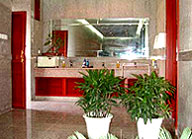
 The “New Beijing” is not ignoring one of life’s most basic considerations, the toilet, which is something that many a foreign tourist will be happy to know. The toilet -- once the downfall of Beijing’s tourist industry - has been elevated to a position where it now merits its own star-rated system. Over the next two years the city plans to build 64 four-star, 197 three-star and 118 one-star toilets at all its major tourist attractions.
Seventy star-rate toilets already have opened at scenic spots like the Summer Place, the Badaling section of the Great Wall, the Palace Museum and the Beijing Working People’s Palace of Culture.
All of this diminishes the chances of any foreign tourist encountering the dreaded Gonggongcesuo (public toilet in the oriental style which requires squatting over an open trough) thanks to a determined Beijing Tourism Administration who heard the tourist cries of woe and took action.
For years, toilets were a major tourist complaint. In fact one-third of all complaints received by the Beijing Tourism Administration were about toilets. And those complaints were not minor, according to Zhou Shuqi, the deputy director of Planning-Statistics Department of the Beijing Tourism Administration.
Zhou said that what tourists objected to can be described in four words: “smell” (tourists said they could find a toilet by its smell); “jump” (once inside they jumped to avoid stepping on residue left by previous occupants), “weep” (they wept when they squatted down and could see maggots in the pit below) and “smile” (when they looked up they smiled in embarrassment when they found they were not alone but with many other people who were staring at each other face-to-face.)
Zhou said the last problem seemed particularly difficult for foreigners who like and expect privacy in toilets, while Chinese toilets were totally open.
The Beijing Tourism Administration formed in 1987, from the beginning earmarked considerable funds for toilets. The problem, according to Zhou Shuqi, was that in the early days of China’s tourist industry, attention was placed on setting up travel services rather than on the facilities themselves where the main consideration for toilets for some time was that they met city sanitation codes.
Tourism officials nationwide soon learned that what was considered good enough for the average Chinese citizen would not do for foreign tourists. Acknowledging the complaints, in the early 1990s the National Tourism Administration launched a Three-Year Plan to Renovate the Public Bathrooms at Scenic Attractions. Around 2 million yuan (US$ 242,000) went into the first batch of new toilets in Beijing such as at the Great Wall, Summer Palace and Forbidden City.
Testimony to the fruits of these early efforts come from a critic of the women’s bathroom at the Great Wall at thebathroomdiaries.com The following comment also includes a word to the wise - Even as the toilet situation improves in China, carry toilet paper with you. Under the new star-rated system, three and four-star bathrooms must have toilet paper available in each individual stall. However, while one and two-star facilities must provide toilet paper, the paper can be located in a central position in the room rather than next to the toilet.
“Located along walk up to the Great Wall entrance at Badaling. Fairly clean, with more squat-style than Western toilets. Private stalls, but without toilet paper in each. Free toilet paper can be obtained from a dispenser near the sinks. Hands-free automatic sinks and air-dryers. Go early in the morning while the bathrooms are still clean and bring your own paper just in case. Visited the women's restroom--have no idea what the men's room is like.”
By the mid-1990s the Beijing Tourism Administration working together with the Forestry Bureau, Environmental Sanitation Bureau, Cultural Relic Bureau and Municipal Management Committee poured millions of dollars into toilet renovation.
During that period, Beijing invested about 40 million yuan (US$ 4.8 million) to renovate 119 tourists toilets to get them all to at least the Category II (good) public bathroom standard set by the Beijing Municipal Administrative Committee. After 1997, the Bejing Tourism Administration continued to renovate some 20 tourist bathrooms a year, at the cost of about 1.5 million yuan (US$182,000) a year.
Then with the Beijing Olympic 2008 bid very much in mind, and with the support of Zhang Mao, the vice-mayor of Beijing, the Beijing Tourist Administration pulled out all the stops: It decided to introduce a 4-star toilet system under a tourism star-rated toilet construction committee with Zhang Mao as the director; Yu Changjiang, the vice-director of Beijing Tourism Administration, as the vice director and Zhou Shuqi as the executive committee member in charge of all the specific works.
Helping to design the star-rating system for toilets were various departments including the Municipal Administrative Committee, Forestry Bureau, Municipal Quality and Technical Supervision Bureau, Cultural Relic Bureau, Finance Bureau and heads of various major tourist attractions worked together to come up with a plan different from any before and based on similar considerations as the plans for star-rated hotels.
The committee designed a 28-page Beijing Municipal Tourism Attractions-Toilet Quality Assessment Report which provides inspectors some 58 points including area size, hours, toilet paper, mirrors, emergency call buttons, background music, soaps and other lotions, building material, drainage, ventilation, landscaping, etc. on which to award stars for bathrooms. For instance, point #3 is overall area. A one-star toilet facility must have at least 40 square meters; a two-star toilet must be over 60 square meters; a three-star toilet must be over 80 square meters; and the four-star must be over 100 square meters. Also, all levels must have a 4:6 ratio of men’s area to women’s area.
This brings up one of the differences in the new standards: The women’s room is larger. Traditionally, the men’s toilet facility was more than twice the area of the women’s; under the new system the women’s bathroom is larger than the men’s. Zhou Shuqi, the deputy director of Planning-Statistics Department of the Beijing Tourism Administration, said that in feudal society women stayed at home without any opportunity to work so there wasn’t much need to consider them in public bathroom design. The new guidelines are based on more than women’s change of status in society, he said, they are based on scientific study that shows a woman on average will spend two or three times more time using a toilet than does a man. Hence the new ratio.
The star-rated toilets also consider the elderly and disabled as well as children. From one-star to four-star, toilet facilities now must at least have one stall especially designed for the handicapped and as well as lower urinals for small boys. A platform for changing infants is not required at the one and two-star level but is required for the three and four-star bathrooms. The highest rated toilets provide more, like lotions and hot towels, totally different from the previous public bathroom standards.
In two years, all the 747 toilets in 148 tourist attractions-or 95 percent-should be finished, according to Zhou, and the Tourism Administration will then be continuing its 1.5 million yuan (US$182 thousand) investment in toilets as it had before.
At this time some of the star-rated toilets require a small fee for admission to pay for attendants and other expenditures, but the goal is to have free access to all.
We at china.org.cn decided we would like to check out one of the highest-rated toilets, and we found one thanks to the good graces of Wu Weiping, vice director, of the Beijing Working People’s Palace of Culture east of the Forbidden City. Already completed, these toilets will be open in this fall.
Two-star toilet
Three-star toilet
Four-star toilet
Now that the toilet has achieved star-status in China, it might be a good time to take an overview of the whole situation. After all- China invented the toilet, invented toilet paper and long before Thomas Crapper is said to have invented his marvelous flush toilet, emperors were using the flush and even more exotic devices to enhance their palatial bathrooms. China has its toilet history, literature, mythology and sociology. Our toilets have even inspired philosophers.
History
According to archeological discoveries at the Banpo relics site in , the first toilet in China can be traced back approximately 5,000 years. We know through similar discoveries that in the Western Zhou Dynasty (BC c1,100-BC c771) and the Warring States Period (BC 475-BC 221), toilets were in common use - simple shafts used by one person or one family.
But much of recorded history in China as elsewhere relates not to the common folk, but rather the elite whose stories reveal quite a bit about the development of the toilet from its humble beginnings outside the hog pen.
Modern-day European and American tourists to China who have cast a wary eye at the unfamiliar "squat" style oriental toilet (traditional in Japan and other part of Asia as well as in China) cannot take comfort in what we believe is the first written description of the toilet in Chinese history:
Jin Wengong, the monarch of the State of Jin and also the first king of the Spring and Autumn Period (BC 770-BC 476), slipped into the toilet shaft while peeing and drowned. This is according to the Zuozhuan, the first chronological history covering the period from BC 722 to BC 464, presumably illustrating The Spring and Autumn Annals and attributed to Zuo Qiuming, the official historian of the State of Lu, but generally believed to have been completed in the early Warring States Period (BC 475-BC 221).
Shi Chong of the Western Jin Dynasty (265-316) had no such problems - it's said in history books that his toilet chamber included a bed and that whenever he went there to relieve himself he was attended by as many as ten maids, who also saw that he got a change of clothes on each occasion.
In fact, bathrooms of the rich and famous had become so elaborate by the time of the Wei Dynasty (220-265), that visitors were sometimes baffled by their arrangements. Wangdun, who would marry Princes Jingyang, the daughter of Emperor Si Mayan, entered the palace bathroom to find a beautifully decorated box hanging on the wall in the toilet chamber that contained dates. "What a wealthy family," he thought, "they even have the luxury of eating dates while using the toilet." And he ate all the dates in the box. But, actually the dates were provided only for people to stuff into their nostrils to prevent inhaling any unpleasant odors. Wang Dun's faux pas was discovered and became the cause of great merriment in the palace.
Emperors beginning in the Han Dynasty ( BC 206-AD 24) had the privilege of finding in their toilet facilities (xieqi). Such things as jade urinal in the shape of a tiger cub, called a huzi, which received the royal urine from its mouth, and loved doing so, according to folk traditions. Of course, the emperor also had a chamber pots (qingqi or hunqi) for more serious business. In the Tang (618-907)and Song(960-1279)Dynasty, hu (tiger) became a taboo word and instead both urinals and chamber pots were referred to as ma (horse) implements, hence mazi and matong. Of course, all this was long before 1859 when Queen Victoria had her toilet decorated in gold.
As early as the Han Dynasty, emperors were using the flush toilet, according to archeologists who found one quite similar to the kind we use today, with arm rests as well, in a tomb in the Mangdang Hill in Shangqiu of central China's Henan Province. It was part of an underground palace whose wealthy owner thought his soul after death would need all the comforts of home.
Philosophy
In the Warring State Period (BC 475-BC 221), the Qin Dynasty scholar and prime minister Li Si (?-BC 208) made a notable observation while on the toilet. This was a traditional "squat" style oriental toilet, more specifically a shaft with wooden boards on the top. When Li Si was squatting there one day, the mice in the shaft got a start and took off fast. He felt very sorry for those thin and small mice. But, soon afterwards, Li Si came across some big and fat mice in the storehouse, stealing rice. These mice showed no inclination to stampede. On the contrary, with an air of contempt, they even stared at Li Si. This discrepancy in mouse behavior bothered Li Si until he realized the reason:
The mice in the toilet did not have it so good, so they were alarmed while the mice in the storehouse had it great, so they were calm and composed. And so it is with people, Li Si realized, that a person has a sense of esteem or not according to his living conditions.
So Li Si decided to leave the school of his teacher, Xunzi (BC 313-BC238) a philosopher and scholar of the late Warring States Period to travel and seek his fortune. Xunzi asked how he could venture out into society without finishing his learning. Li Si answered what is the point of learning when one does not have enough to eat? How can a person have dignity when his stomach is empty? Li Si gave up his studies mid-stream to venture into the world where he at some point met Emperor Qin Shihuang (BC 259-BC 210), the first emperor of the Qin dynasty, also called Yingzheng, who unified China for the first time in history. Li Si later became a high-ranking official in the Qin court. All this we learn from reading a biography of Li Si in Shiji, the first history book written by Si Maqian. And so we may take note of Li Si's ascension in life inspired by his musings on the toilet.
Mythology
While Chinese written records relate rich and colorful stories about the toilet, much went on before recorded history during a time when people worshiped gods and goddesses, who seemed to be everywhere. They might appear at any time or place in the human world, the nether world, in a mountain, river,door, bed, the kitchen range or even the toilet.
The legends of the Goddess of the Toilet -- Zi Gu and Qi Gu -- were widely known in China although the names were sometimes different. In some southern places the Toilet Goddess was known as San Gu or Kengsanniangniang.
The most important Toilet Goddess that people worshipped was Zi Gu, who started out as a beautiful and well-educated lady who was married to an actor and who lived in what is now Shandong Province during the Tang Dynasty (618-907) in the reign of Empress Wu Zetian. Zi Gu became Toilet Goddess in the following way:
Li Jing, the official of the county, murdered Zi Gu's husband and forced her to become his concubine. But Li's official wife envied Zi Gu's beauty. So on the 15th day of the first lunar month, the official wife killed Zi Gu in toilet. Zi Gu's wronged spirit lingered there day and night, especially when Li Jing went to the toilet. He heard Zi Gu's weeping and saw her ghost fighting with his wife. When Empress Wu Zetian heard of the story, she conferred on Zi Gu the title of Toilet Goddess. Later generations worshipped Zi Gu on the Lantern Festival (15th night of the 1st lunar month) by taking out a puppet of paper or wood and saying, "Li Jing has gone away with his official wife, let Zi Gu appear." If the puppet showed any movement at that point, it was an indication that the Toilet Goddess had arrived.
The Toilet Goddess takes on another form in the story of Qi Gu, who was the concubine of Liu Bang (BC 256- BC 195), the founder of the Western Han Dynasty and the fisrt Emperor of the Han Dynasty (BC206-AD 220). Qi Gu had a fierce quarrel with the Empress Lu Hou over the choice of the crown prince that engendered a deep hatred between the two women. After Liu Bang died, Lu Hou took revenge by degrading Qi Gu to the level of slave. But that wasn't enough. Further, she cut Qi Gu's hands and feet off, cut out her eyes, blackened her ears and cut out her tongue - to produce what she called "human pig." And finally, Empress Lu Huo threw Qi Gu into a toilet and then invited the new emperor and high-ranking officials to have a look. It is said that the Emperor fainted at the sight. This is a story from Shiji, written by Si Maqian.
Shen Kou (1031-1095), a statesman and scientist of the Northern Song Dynasty(960-1127),reported that his relatives worshipped the Goddess, and that they reported they really saw her. According to the scholars Su Dongpo, one story reported that the Goddess once took possession of the daughter of one Wang Lun who worshipped Zi Gu. Moreover, everyone in the household caught sight of the Goddess - at least above the waist. Her lower body was covered by clouds.
Beijing's Public Bathrooms
In the Spring and Autumn Period (BC 770- BC 476), cities began to appear, and with them came bathrooms -- usually built in small residential compounds, a tradition that continued into the Sui(581-618) and Tang (618-907) dynasties. Not until the Song Dynasty (960-1279),did the occasional public bathroom begin to show up on the main streets.
Privately owned public bathrooms also appeared during the Tang (618-907) and Song (960-1279) periods. These were built and managed by night-soil collectors who, despite their low social status, made a fortune.
In late Qing Dynasty (1644-1911), most of the few public bathrooms were made up of a shaft with two bricks on the topside and small walls on four sides. Most people preferred chamber pots to toilets so they could deal with everything at home and take the pots to the river to be cleaned. Day by day and year by year, this undoubtedly caused pollution problems.
Up to the early part of the 20th century, people still did not pay much attention to the public toilet environment. Take Beijing, For example. Only six or seven public bathrooms were available along Changan Avenue, the main street of Beijing in the early 20th Century.
According to historical records, the toilet in Beijing has a history of over 3,000 years, which is as long as the history of the city itself. The first toilet here was found in the Yan State relic site in the village of Dongjialin in what nowadays is Fangshan County in Beijing. As a major city with over 800 years of history, Beijing has seen many powerful rulers come and go. None of them, as far as we know, laid any importance to the public bathrooms used by the common people. Of course, this might have something to do with their own accommodations at the palace as mentioned in the history section above.
So for quite a long period in history, the good citizens of Beijing had to share one toilet, a kind of pit used by both men and women, young and old. When one person went in, he or she had to make a mark outside the door. And the next follower had to cough or otherwise try to make clear whether or not somebody was inside to avoid any embarrassment. The crucial time was in the morning, when the line to use the bathroom might become quite long.
One example of Chinese cross talk, a comedy dialogue that is a popular and complex art form in China, describes a typical morning at the public bathroom in the old days of Beijing. In the morning, everybody waited in line, waiting for their turn to use the facility. When a young man moved to his turn in line, he shouted back to the house, "Mom, it is our turn, after you. Hurry up."
However, after 1949 dramatic changes came to public bathrooms in Beijing. And in the 1960s, with the development of social collectivization, Beijing began to promote more toilets for the public. Many public bathrooms were built along the main streets. At that time, they were divided into the second-generation style and third-generation style. The former one kept a bit of the old tradition that required people to carry out the excrement and urine in pots. The latter one could be flushed and had a center cesspool. The latter ones are still being used in some old residences today in Beijing.
The fourth-generation style of toilet was equipped with flush facilities, stalls with doors and water taps.
Something should be clarified here about the lack of bathroom stalls with doors which so many foreign tourists have found in Beijing, and resented. This state of affairs has an historical basis, the author believes
According to our textual research, it was the Koumintang government that removed all the partition walls during the Civil War in order to keep a lookout and prevent Communist Party members from exchanging information.
Although the Kuomintang tactics may have restricted secret exchanges, the tearing down of the stalls also provided a good open public place for people to communicate and exchange views. So ever since, public bathrooms in Beijing also have been friendly public places where citizens could, while using the toilet, chat and exchange views, drawing on the collective wisdom to gain all kinds of useful ideas, and all because of no doors on the toilets.
In the 1990s, all the main streets of Beijing had public bathrooms with modern flush toilets. And today, people can even see hi-tech ecological public bathrooms in Beijing that are non-flush to save water. The energy for lights and ventilation in these toilets comes from solar energy, and the waste is disposed of scientifically to make fertilizer.
Off course, it will be a long time before these hi-tech public bathrooms are generally used in the whole city.
The Countryside
The city toilet revolution also has stirred toilet renovation in the countryside.
Most Chinese farmers, deeply influenced by tradition, have stuck pretty much to the old ways of doing things with the toilet not too far from the hog pen. Even now, some people would rather spend over 500 thousand yuan (US$ 61,000 )on a new house than spend a little on a modern toilet.
In 1980, central China's Henan Province succeeded in promoting a new style toilet in the countryside which efficiently disposed of excrement and urine. But this toilet never gained real popularity. By the end of 1998, only about 35.5 percent of the people in the province had converted to modern toilets.
In 1998, departments concerned in Guangxi Province imported from Sweden new ecological and sanitary toilets that can scientifically dispose of waste to be turned into fertilizer which then can be used on the land. Many experts think that this new style toilet will change toilet history in the Chinese countryside for thousands of years to come.
Toilet literature
Posture, space, freedom and writing surface are the most important elements for the creation of toilet literature. In terms of the posture, we have three categories: The standing, the sitting and the squatting styles. The standing style is suitable to create large, outstanding works, like slogans. The sitting style is suitable for more intimate works, some delicate and some not. The squatting style, however, is really not suitable for creating works.
In terms of space, a stall with a writing surface combined with the sitting style provides the ideal for toilet literature. This may explain why the toilet literature of North America is so wonderful. North Americans have long works,elegant articles, and dialogues, strong language, poetry and pictures. Colorful and splendid.
Chinese toilet literature may seem rather dull in comparison, but we too have our excellent works. Here are a couple of modern examples that recently have come to the attention of the author:
"Please look to your left side," a note on the wall says. Looking left, one reads: "Please look back." Looking back, one sees the message: "Please look up." Looking up, one sees the final message: "Please don't look around when you are in the toilet."
The other employs a more useful kind of humor: In the men's room in front of the urinal in a toilet at a cafeteria there is a cartoon of San Mao,a famous literary character in China known for his antics, in a military uniform firing a rifle. The caption reads: "Aim straight ahead, adjust the sight and fire." Most get the implication while enjoying the art.
Our ancestors were more elegant. Here is an example of a traditional Chinese couplet from history:
The first line reads: "Enter with fast steps, double-time." The second line goes "Leave at your leisure." In another one, the first line goes: "Even though you are a peerless hero, you must still bow and squat when you arrive here." The second line goes,"Even if you are a chaste and innocent woman, you must still drop your drawers when you come here."
Practical Suggestions
1. Places to Find a Good Toilet
Star-rated toilets in tour attractions
Big supermarkets and shopping centers
Hotel lobbies
Places that serve coffee
2. How to Read the Signs
Most public bathrooms in the big cities have the distinguishing international stick figures of a man or a woman; some also include the British "W.C."(for water closet as the toilet is known in England). The Chinese character for "men" is 男 and the Chinese character for women is"女."
3. A Word to the Wise
Carry toilet paper with you. Most free public bathrooms do not provide toilet paper. Even at some of the one star-rated tourist toilets, paper is provided but only at a general location in the room, not at the stalls. Some Public bathrooms require a small entry fee. An attendant should be available in these to provide toilet paper. If you do not know Chinese and are in a hurry - your own toilet paper might come in handy in this situation, too.
(china.org.cn by Sara and unisumoon, the editor of English travel column) 09/21/2001