A signed article titled "A Look at Plane Collision Incident From Perspective of International Law" published Sunday stresses the US side's breaching of international law in regards to the collision between a US military spy plane and a Chinese fighter jet.
The article by Li Qin presents an in-depth analysis of the airplane collision incident from the perspective of international law.
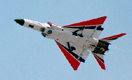
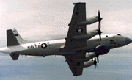
On the morning of April 1, a US EP-3 military spy plane conducted military reconnaissance in the airspace near China's island province of Hainan, and the Chinese side immediately sent up two military jets to track and monitor the plane, the article says.
In the flight, the US plane violated flight rules and veered suddenly towards one of the Chinese jets, bumping into it and causing it to crash. The pilot of the Chinese jet was missing and there is now no possibility of his survival, it says.
Right after the collision, the US plane intruded into the Chinese airspace and landed at the Lingshui Military Airport on the Hainan Island without permission from the Chinese side, thus seriously infringing upon the territorial sovereignty of China, the article says.
The article says that after the incident, the United States had not only failed to apologize for the serious consequences of the illegal acts of its plane, but also made up various excuses to shake off its responsibility for the illegal acts of its plane, even rudely making various unreasonable demands on and accusations against the Chinese side in a threatening tone.
Illegal Nature of Acts by US Plane
Whatever lame excuses the US side might use, the illegal nature of the acts by the US plane cannot be denied. Consequently, the demands and accusations by the US side are absolutely groundless from the perspective of law, the article stresses.
First of all, the United States turned a blind eye to relevant stipulations in international laws, and the US military plane abused the freedom of overflight, which is the major cause of the collision incident, the article says.
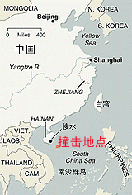
The US side argued the April 1 incident took place in the international airspace, in which US planes have the right to fly over. The article says it must be pointed out that the incident occurred in the airspace above the waters merely 104 kilometers to the southeast of the Hainan Island, which is above the exclusive economic zone of China.In accordance with the current of international law, although foreign aircraft enjoy the freedom to fly over the exclusive economic zone of a certain country, such freedom is by no means unrestricted and foreign aircraft have to observe the relevant rules of the international law while enjoying the freedom of overflight, says the article.
According to Article 58 of the UN Convention on the Law of the Sea promulgated in 1982, foreign aircraft enjoy the freedom of overflight under the relevant provisions of the Convention. Section Three of the article made it clear that foreign planes, while enjoying the freedom of overflight over an exclusive economic zone of other countries, " shall have due regard to the rights and duties of the coastal state and shall comply with the laws and regulations adopted by the coastal state in accordance with the provisions of this Convention and other rules of international law in so far as they are not incompatible with this part."
According to Article 56 of the Convention, the coastal country concerned not only has the right to exploit, utilize, maintain and administer natural resources in its exclusive economic zone, but also enjoys other rights concerning exclusive economic zones laid down by the Convention, it says.
Threat Against Territorial Intergrity of a State
In accordance with Article 301 of the Convention, a certain country, while enjoying its rights or carrying out its duties stipulated by the Convention, " shall refrain from any threat or use of force against the territorial integrity or political independence of any State, or in any other manner inconsistent with the principles of international law embodied in the Charter of United Nations," the article says.
This article demonstrates that the "other rights" concerning exclusive economic zone of coastal states include that the sovereignty and territorial integrity of these countries should not be infringed upon, and they have the right to safeguard its national security and maintain peaceful order as stipulated in international law.
The article says that a plane of a state, while it exercises freedom of overflight in the air over the exclusive economic zone of the other state, should respect the sovereignty and territorial integrity of the coastal state.
It can't infringe upon national security and peaceful order of the coastal state, and any act ignoring the above rights of the coastal country will abuse the freedom of overflight, says the article.
It needs to expound that the above provisions, stipulated in the United Nations Convention on the Law of the Sea, are the generally acknowledged principles of international law. Even the non-signatory countries should also abide by these principles, because it is confirmed by international judicial practice.
The article points out that during the collision incident, the US trouble-making plane is not a common aircraft, but a military surveillance plane equipped with advanced electronic surveillance facilities.
Moreover, the US plane did not exercise a common flight over China's exclusive economic zone, but a reconnaissance mission. The US act is not a single and accidental one, but a continuation and part of the frequent US reconnaissance activities in recent years in the airspace over China's coastal waters, the article notes.
Such US military activities during peace time are characterized by its hostility towards China. These activities constitute threats to Chinese national security and peaceful order, and the provocation to Chinese national sovereignty. The US act violates the fundamental principles of international law, that stands for all states to respect sovereignty and territorial integrity of each other, the article stresses.
The article says that China is firmly opposed to such provocative and threatening acts of the US, and lodged protests many times, and made solemn representations in this regard.
The article says that after the collision, the US, on several occasions, criticized China for tracking and monitoring the US military surveillance planes, and after the US crew members were released, the US attributed the incident to Chinese plane's tracking operation, trying to shirk its responsibilities.
Sending Planes to Track and Monitor
It is obvious that the criticism is unacceptable in the political, military and law sense, says the article. According to international practice and law, when a foreign military plane is engaged in activities which could threaten a state's national security in the airspace over coastal waters of a coastal country, it has the right to take relevant defense measures, including sending planes to track and monitor the foreign plane.
The article says that the purposes of the activities of the coastal country are: firstly, to exercise the right of sovereignty authorized by international law, prevent foreign planes from entering the airspace of its own country and safeguard its territorial airspace and waters; secondly, to alarm foreign planes not to conduct any activity threatening the territorial integrity and national security of the coastal country.
In fact, the article points out, it is the common practice for all countries of the world to track and monitor a foreign military aircraft when it flies into a country's territorial airspace, and the US practice in this regard is particularly obvious.
The article says that the US has designated Air Defense Identification Zone in the airspace over its coastal waters, and the sphere of the zone is much wider than that of the exclusive economic zone of 200 sea miles.
Air Defense Identification Zone
The US demands that any foreign planes in the Air Defense Identification Zone should fly according to the US stipulated course, and should obey the procedures the US has prescribed, and if any foreign plane violates these rules, the US will send its planes to intercept it.
The article says that as Francis Boyler, a US professor of international law, pointed out that the US would not tolerate it if China took similar actions like the US military plane has done in the airspace over Chinese coastal waters within the US Air Defense Identification Zone.
The US plane, after ramming and destroying the Chinese plane, entered the Chinese territorial airspace and landed at a Chinese military airport without authorization, seriously encroaching upon the Chinese territorial sovereignty. According to the set principles governing international law, a state has complete and exclusive sovereignty over the sky above its territory. Without permission, it is absolutely forbidden for foreign military planes to enter the territorial airspace of other states. This principle was first stated in the Paris Convention on the Regulation of Aerial Navigation of 1919. The Article 1 of the convention stipulates that "the contracting States recognize that every State has complete and exclusive sovereignty over the airspace above its territory." Based on this principle, the convention stipulates that military planes of a signatory to the convention cannot make unauthorized flights over or landing at the territory of another signatory, it goes on to say.
Article 3 of the Convention on International Civil Aviation, concluded in Chicago in 1944, not only sets the same rule, but also states clearly in this article to strictly tell civil airborne vehicles from military airborne vehicles. According to Article 3, "No state aircraft of a contracting State shall fly over the territory of another State or land thereon without authorization by special agreement, or otherwise, and in accordance with the terms thereof." It has been a set rule that foreign military planes cannot enter into the territorial airspace of another country. Practice against this rule is deemed as encroachment upon the territorial sovereignty over a country, which has the right to curb this encroachment with any means according to the international law, it continues.
In this incident, the US plane which collided with the Chinese jet did not apply to the Chinese side for entering the Chinese territorial airspace and landing at the Chinese territory, according to relevant regulations governing emergency cases. Without permission from the Chinese side, it entered into the Chinese territorial airspace and landed at a Chinese military airport. Obviously, illegality is clearly seen in this case of encroaching upon the Chinese sovereignty, the article says.
US Contention not Tenable
The US side contended that after the collision, the US plane was in a state of emergency, and under such a circumstance, it was not illegal for the plane to enter into and land at the Chinese territory, out of needs of averting emergency. Such kind of contention is not tenable according to the law. The international law has only references to civil airborne vehicles and have no reference to military airborne vehicles. All countries have strict procedures on this, because state sovereignty and national security are involved. International law also does not acknowledge what was called by the US as an emergency landing right owned by military planes. Under special circumstances, which call for an emergency landing, foreign military planes must follow domestic laws of the country concerned and get a definite approval before landing, it says.
It should be pointed out that the telecommunication system of the US plane was working properly, and the US side had sufficient time and ability to request the Chinese side to approve its plane's urgent entering into and landing at the Chinese territory, during the more than 20 minutes from colliding with the Chinese plane to its landing at the Lingshui Military Airport in China's Hainan Island.
Without requesting, the US plane made an unauthorized intrusion into the Chinese territorial airspace and an unauthorized landing at the Chinese military airport. This is a practice that completely ignores China's sovereignty and territorial integrity. The "avoiding of an emergency" alleged by the US side cannot at all be considered as a legal proof to exempt the illegal nature of encroaching upon the Chinese territory by the US plane. What's more, the state of emergency was a result of the practice of the US plane itself. To such a foreign military plane that illegally entered into the Chinese territorial airspace and landed at an airport demarcated as a military forbidden zone of China, the Chinese side has the self- protection right granted by the international law to take necessary and forcible measures. The Chinese side, however, did not take resolute measures against it after it entered the Chinese territorial airspace, and this was out of humanitarian considerations, the article says.
After the collision, the US side did not voice any apology, instead, it asked China to return its aircraft and the crew which caused the collision and even threatened that China should not board the plane and conduct investigations, says the article.
To work out legal excuses for this kind of outrageous demands, the US side went so far as to fabricate nonsenses like the aircraft is part of the US territory and part of US state assets, so it enjoys a sovereign immunity, the article goes on.
The so-called saying that the aircraft is part of the US territory is another version of the extraterritoriality theory popular in the 19th century, says the article.
This theory has long been abandoned by modern international law, it stresses.
Established principles of international law on this issue are that all foreign military forces including military personnel and facilities can possibly enjoy sovereign immunity in a receiving country only after getting permission from this country, which means they are not subjected to the administration of this receiving country, notes the article.
If foreign military forces crash through the gate of another country without permission, such military forces can never claim a sovereign immunity in this country, continues the article.
The Restatement (Third) Foreign Relations Law of the US, the most authoritative international law document in the US, even holds that only getting a permission to enter is not enough, and a special agreement should be reached between a receiving country and a foreign country on the basis of such a permission to ensure this foreign country to enjoy sovereign immunity in this receiving country, points out the article.
So, in this case, the article emphasizes, China -- the vicitim of the collision, the site of the occurrence of the US illegal acts and the country the US plane landed on, is completely entitled to administer the treatment of the US aircraft and the whole incident, and conduct necessary inspections on the plane and necessary inquiries with the crew members, so as to find out facts about the incident.
In a summary, the article states, the US aircraft misused the freedom of overflight in the airspace off China's coast, flew against flight rules, crashed a Chinese jet, and entered into China's territorial airspace and landed at China's military airport without permissions, which have constituted a case of seriously violating international law.
In this incident, the above-listed illegal acts of the US side have brought about a severe infringement upon China's rights, interests and dignity, notes the article.
In accordance with international law, the article points out, the US should bear state responsibilities for its illegal acts, including suspending infringement, compensations for China's losses, promising a non-recurrence of similar incidents and an apology to China.
The US government should see this point clearly, conduct active and earnest cooperation with the Chinese government to carry out investigations into this case, and shoulder all responsibilities arising therefrom.
(Xinhua 04/16/2001)