China’s national defense building is an important part of the country’s modernization drive. To meet the needs of safeguarding its national security, China insists on modernizing its national defense according to its own conditions.
During the past two years, the legal system relating to China’s national defense has made much headway. In March 2000, the National People’s Congress (NPC) enacted the Legislation Law of the PRC, which for the first time expressly defined the legislative power of the CMC and all general headquarters/departments, all services and arms, and all military area commands. The CMC may formulate military statutes in accordance with the Constitution and laws. The general headquarters/departments, services and arms, and military area commands may, within their respective authorities, formulate military regulations in accordance with the law and the military statutes, decisions and orders of the CMC. The military statutes and regulations are implemented within the armed forces. Procedures for formulation, amendment and nullification of military statutes and regulations shall be stipulated by the CMC in accordance with the principles specified in the provisions of the said Law. The above stipulations have provided for the important position of the military legislative system within the overall legislative system of the state.
Since 2000, China has issued 3 decisions, 56 statutes and 420 regulations in respect of laws and law-related issues concerning national defense and armed forces building. The National Defense Education Law of the PRC enacted by the Standing Committee of the NPC has provided a legal basis for national defense education. The newly revised Law of the PRC on Officers in Active Service has further perfected the military service system pertaining to PLA officers. The State Council and the CMC have jointly formulated the Implementation Measures for the Law of the PRC on Protecting Military Facilities, which expressly provides for the organizational leading system regarding the protection of military facilities, as well as specific protection and penalty measures. The newly revised Routine Service Regulations of the PLA and Discipline Regulations of the PLA provide a powerful legal guarantee for enhancing the effort of running the armed forces according to law under the new conditions.
To safeguard the interests of national defense and the legitimate rights and interests of military personnel in an age of reform and opening-up, China has reformed its military judicial system. Authorized by the Supreme People’s Court of the PRC, military courts have begun to adjudicate civil cases within the armed forces, including cases on contract, marriage and family, real estate, intellectual property rights, damage claims in medical accidents, and applications for adjudication of the missing or death of servicemen, thus exercising the function of civil adjudication inside the armed forces. Relevant organs of local governments at various levels and the armed forces are trying to create a favorable legal environment for national defense and armed forces building by establishing and improving the mechanism of protecting the legitimate rights and interests of the service personnel and their families.
Under unified arrangement by the state, the Chinese armed forces launched in 2001 the Fourth Five-Year Program on Education to Popularize Knowledge of Laws. The main contents include studying the Constitution, basic laws of the state and laws and regulations in relation to national defense and armed forces building, performance of the armed forces’ functions, development of the socialist market economy, and the vital interests of the officers and men. The contents of the military law, the law of war and armed conflicts, etc., have been included in the legal courses at military colleges and schools, and the training programs of the armed forces. The PLA has set up courses for field-grade officers of the Army, Navy and Air Force on the armed conflict law once every two years, and organized lectures on the armed conflict law for officers of the division level and above, who are enrolled at the National Defense University every year.
At each level of the people’s government from the county up to the state, there is a national defense mobilization commission, which has under it, offices and coordinating bodies responsible for the mobilization of the people’s armed forces, national economy and transportation, civil air defense, and national defense education. The premier of the State Council takes the position of chairman of the State National Defense Mobilization Commission, and vice-premiers of the State Council and vice-chairmen of the CMC are vice-chairmen. Other members include heads of relevant ministries and commissions under the State Council, leaders of the general headquarters/departments of the PLA and heads of their subordinate offices. The chairman of the local national defense mobilization commission is the principal leader of the local government at the same level. The vice-chairmen are the deputy leaders at the local government of the same level and principal leaders of the military organ at the same level.
The state conducts mobilization preparations in peacetime by integrating mobilization of the armed forces, the national economy and transportation, civil air defense, and defense education into the state’s overall development plan and relevant programs. Mobilization of the armed forces refers to the mobilization of the active and reserve forces of the PLA, the Armed Police Force, the militia and the reserve personnel, as well as the mobilization of appropriate weapons, equipment and logistical materials. Its main task is to prepare in peacetime for manpower mobilization and, in case of need, call up the reservists and other citizens of service age, ensure a quick expansion and reorganization of the PLA, and expansion of the other forces, and organize the masses to support and join in the operations of the armed forces. Mobilization of the national economy includes mobilization of industry, agriculture, science and technology, material supplies, commerce and trade, and finance. Its main task is, in peacetime, to integrate the preparation for mobilization with economic development in an organized and planned way, and in time of war, reallocate economic resources, and exercise centralized control and use of national financial and material resources so as to increase the production of weapons, equipment and other military supplies, and meet the needs of war. Mobilization for civil air defense includes mobilization of civilians and people with special civil air defense skills, material and technical support for civil air defense projects, and civil air defense early-warning systems. Its main task is to mobilize social forces in construction of air defense projects, establish and train specialized air defense service, conduct civil air defense publicity and education, organize evacuations and sheltering, assist in air defense operations, and deal with the aftermath of air raids. Mobilization of transportation includes mobilization of transportation, communications and postal services. Its main task is to organize in peacetime the formation of professional transportation and communications support force, defense infrastructure construction, equipment build-up, war material storage and mobilization preparations of civil transportation means and in time of war, organize the rush repair and construction of transportation and communications facilities, and transportation support for troop movement and material supply.
In recent years, some army units and local governments have, pursuant to relevant laws and regulations, jointly organized defense mobilization drills for transportation and air defense. China is further improving its defense mobilization laws and regulations, perfecting its defense mobilization system, and actively promoting modernization in this area.
China emphasizes popularizing and strengthening national defense education with patriotism at its core, strives to enhance the national defense awareness of the whole people, and helps citizens perform defense duties conscientiously.
The nationwide defense education is under the leadership of the State Council, with the assistance of the CMC. The State Defense Education Office is responsible for the planning, organization, direction and coordination of the nation’s defense education. Local people’s governments at all levels exercise leadership over defense education in their respective administrative areas. All relevant departments perform their respective duties, cooperate with one another, and, combined with their own work, ensure that defense education activities are carried out smoothly. The National Defense Education Law of the PRC was formally promulgated and came into force on April 28, 2001, putting China’s national defense education on the legal track.
China implements a military training system in institutions of higher learning, senior middle schools and schools corresponding to senior middle schools. Since 1985, more than 200,000 officers and men have helped these institutions and schools organize military training for students, and more than 30 million students have been trained. In the past several years, the percentage of university and college freshmen receiving military training has reached about 60%. Commencing in 2002, students of all regular institutions of higher learning and senior middle schools are obliged to take military training in accordance with relevant regulations and plans.
On August 31, 2001, the NPC Standing Committee set the third Saturday of September every year as the National Defense Education Day. This has provided a vehicle for the participation of the entire population in national defense educational activities, which helps ensure enhanced and continued implementation of the educational programs in this area.
The Chinese government has always been strict in its control, management and supervision of defense spending, and has established a complete system of relevant laws and regulations for that purpose. Pursuant to the National Defense Law of the PRC, the entire defense expenditure comes from the state financial budget. In order to meet the defense needs, the Chinese government exercises a system of financial appropriation of defense funds, and implements administration in accordance with the Budget Law of the PRC. China’s defense budget and final accounts are reviewed and approved by the NPC. The state and armed forces’ auditing organs exercise strict auditing and supervision of the execution process of the budget.
In recent years, in line with financing and budgeting reforms in the government, the administration of defense expenditure has undergone a whole array of reforms, including reform in the defense expenditure budgeting method, centralized payment for weapon and equipment procurement, and a tendering and bidding system for the procurement of defense materials, projects and services. Defense funds are therefore managed in a more just, fair and transparent way.
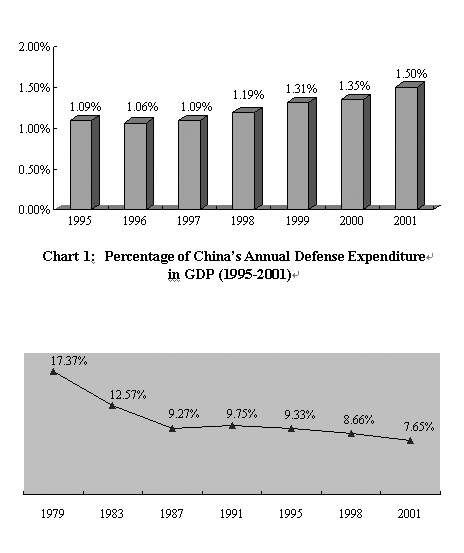
Based on the continuous economic growth, China’s defense expenditure has increased somewhat. The proportion of annual defense spending in the GDP was 1.09% in 1995, and 1.50% in 2001 (see Chart 1). However, China’s defense expenditure has been kept at a fairly low level, and the increased part is basically of a compensatory nature. From 1979 to 2001, the proportion of defense expenditure in the state financial spending is on a declining curve (see Chart 2) from 17.37% in 1979 to 7.65% in 2001 — a drop of nearly 10 percentage points.
China’s defense spending was RMB 120.754 billion yuan in 2000, and 144.204 billion yuan in 2001. The budget for defense expenditure in 2002 is 169.444 billion yuan (see table on p. 26), accounting for 7.60%, 7.65% and 8.03% of the state financial expenditure in the same year, respectively.
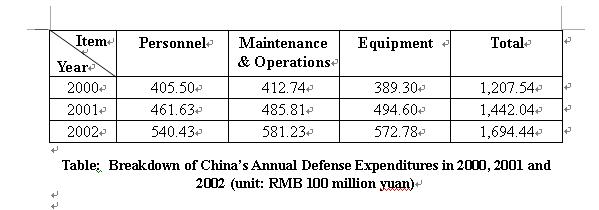
The increased defense expenditure in recent years has primarily been for the following purposes: 1.Increase of personnel expenses. Along with the socio-economic development and the per-capita income rise of rural and urban residents, it is necessary to improve the living stan-dards and conditions of military personnel. The past decade has witnessed the increase of the board expenses in the armed forces on five occasions, and an 84% salary raise for officers and 92% allow-ance raise for soldiers. 2.Establishment and gradual improvement of a social security system for servicemen. In accordance with the re-quirements of the market economy, China has, since 1998, established such systems as injury and death insurance for servicemen, medical insurance for demobilized servicemen and housing subsidies for ser-vicemen, and adjusted and enhanced living expense standards for PLA retirees. 3.Increase of expenses of a maintenance nature. Since the armed forces stopped commercial activities in 1998, the budget for training has increased year by year. With the gradual improvement of living facilities and progressive office automation, expenses of a maintenance nature have kept rising. 4.Increase of expenses spent on cooperation with the international community in anti-terrorism ac-tivities. 5.Appropriate increase of expenses for the improvement of military equipment to enhance defense capabilities under the condi-tions of modern technologies, particularly high technologies.
On the whole, China’s defense expenditure has remained at a fairly low level in the world in 2002 (see Chart 3). Compared with the USA, Russia, UK and France, the percentage of China’s defense expenditure in its GDP and the state financial expenditure is also fairly low (see Chart 4).
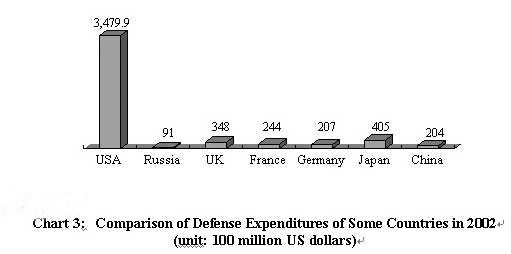
Note 1: The exchange rate used here is based on that announced by China’s
State Ad-ministration of Exchange Control in 2002, which is US$ 1.0˜RMB
8.28 yuan.
Note 2: Statistics in the chart are sourced from the national defense
reports, financial reports and other government reports published by the
said countries.
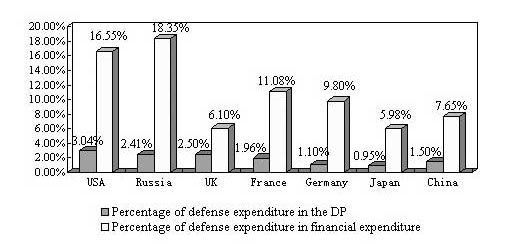
Chart 4: Comparison of the Percentages of Defense
Expenditure in the GDP
and Financial Expenditure of China and Some Other Countries in 2001
Note: Statistics in the chart are sourced from the national defense reports, financial reports and other government reports published by the said countries.
Science, Technology and Industry for National Defense
China’s defense-related science, technology and industry is the state’s strategic industry, and the important industrial and technologi-cal foundation for national defense modernization, as well as a major driving force for the development of the national economy, science and technology. China builds and develops its defense-related science, technology and industry independently, enhances the overall level and economic efficiency of defense-related science, technology and industry, and promotes the coordinated development of national defense and economy.
The Commission of Science, Technology and Industry for National Defense of the PRC is an organ under the State Council in charge of work in this regard. It is responsible for researching and formulating principles and policies, as well as laws, rules and regulations in re-spect of the development of defense-related science, technology and industry; deliberating the development plan for defense-related sci-ence, technology and industry, and overseeing the overall planning of and proper connections between defense-related research, production and construction; organizing qualification examination and approval work for research and manufacture of military products; examining and verifying contracts in respect of scientific research and production between the military and the producers; coordinating, supervising and inspecting execution of ordering contracts so as to ensure the produc-tion and supply of military equipment; exercising administration of the nuclear, space, aviation, shipbuilding and weaponry industries; giving guidance to the administration of the military-related electronics sec-tor; organizing, studying and implementing reform of the system of defense-related science, technology and industry; organizing adjustment of the capability, structure and layout of the defense-related science, technology and industry; drawing up plans for investment in fixed as-sets in respect of defense-related science, technology and industry, and for technical transformation and development of defense conversion technologies, and organizing the implementation of such plans; and conducting foreign exchanges and international cooperation in the field of defense-related science, technology and industry.
After decades of development, China has formed a defense-related science, technology and industry system, which is by and large com-plete in disciplines and coordinated with regard to means of research and production; trained and fostered a contingent of professionals with a good mastery of advanced technology and a sound work style; and laid an important material and technological foundation for inde-pendent research and manufacture of military equipment in China. Currently, China has 11 military industrial group corporations, namely, China National Nuclear Corporation, China Nuclear Engineering and Construction Corporation, China Aerospace Science and Technology Corporation, China Aerospace Science and Industry Corporation, China Aviation Industry Corporation I, China Aviation Industry Corporation II, China State Shipbuilding Corporation, China Shipbuilding Industry Corporation, China North Industries Group Corporation, China South Industries Group Corporation, and China Electronic Science and Technology Corporation. Each is responsible for the organization and administration of its R&D and manufacture, and exercising the rights of an investor authorized by the state over state-owned assets in its subordinate enterprises.
China’s defense-related science, technology and industry gives pri-ority to the development of new- and high-tech weaponry and equipment, and strives to raise their modernization level. It is im-perative to speed up the adjustment of capability, structure and layout, enhance capability in research and production of new- and high-tech weaponry, streamline the work force of military industry, optimize the industrial layout, and gradually establish a new system of de-fense-related science, technology and industry. It is imperative to further strengthen the development of defense-related science and technology, promote the progress of science and technology, concen-trate resources to make breakthroughs in a number of key technologies, enhance the capability of self-reliance and innovation and sustained development capability in defense-related science, technology and industry, and strive to achieve leapfrog technological progress. It is imperative to bring up talented people and create a well-structured contingent of high-caliber people in a whole array of disciplines needed for the development of defense-related science, technology and industry. At present, in China’s defense-related science, technol-ogy and industry, 141 academicians of the Chinese Academy of Sciences and the Chinese Academy of Engineering are active, of which 52 are academicians of the Chinese Academy of Sciences, 95 are aca-demicians of the Chinese Academy of Engineering, and 6 belong to both academies.
The Chinese government has always stressed the peaceful use of military industrial technology, and encouraged and supported defense-related science, technology and industry to bring its techno-logical and human resource advantages into full play, and develop dual-purpose technologies and new- and high-tech industries, and thus promoted the development of the national economy. Nuclear power for civil use should be industrialized. Civil aerospace tech-nologies have made remarkable achievements in the applied satellite, carrier rocket, and manned spaceship. The “Long March” series of carrier rockets have successfully launched 27 foreign-made satellites, entitling China to a position in the international commercial satellite launching service market. In 1999, 2001 and 2002, China successfully launched in succession three experimental unmanned spaceships, marking a breakthrough for China in mastering basic manned spaceship technology. This has provided a solid foundation for China to send a manned spaceship into space. The aviation industry for civil use, while strengthening technological research, expanding sub-contracting scope for production, and improving existing plane models, has made important headway in manufacturing gen-eral-purpose aircraft and the “Xinzhou 60” aircraft, and has begun the R&D of new feeder liners. The shipbuilding industry for civil use has already become a highly competitive pillar export industry among China’s electromechanical industries. In recent years, China’s shipbuilding output has continuously increased, ranking third in the world for seven consecutive years. The accomplished shipbuilding output in 2001 accounted for 6% of the world’s total.
China’s defense-related science, technology and industry endeavors to establish and perfect an organizational system and an operational mechanism tailored to the needs of national defense building and the socialist market economy. It encourages a specialized division of labor, gradually forms a new multi-tiered cooperative system of principal weaponry contractors, sub-contractors and suppliers of parts and components. It also presses forward with the strategic reorganization of military industrial enterprises and institutions, optimizes the alloca-tion of resources, develops core industries, and gradually forms a batch of internationally competitive conglomerates. It makes efforts to deepen the reform of military industrial enterprises, establish a mod-ern enterprise system, and push forward the diversification of investors of the enterprises and transformation of operational mechanisms so as to enable these enterprises to turn into market competitors operating independently and responsible for their own profits or losses. The defense-related science, technology and industry stresses the reform of its sci-tech system, strengthens the organic inte-gration of production, education and research, and transforms the defense-related science and technology into actual productivity. In ad-dition, the defense-related science, technology and industry adheres to opening-up, and actively participates in international exchanges and cooperation in line with the principles of the complementarity of each other’s strengths, reciprocity, mutual benefit and common develop-ment.
China pursues a policy of good neighborliness and friendship. It de-fends and administers its land borders and seas under its jurisdiction, safeguards the country’s territorial sovereignty and maritime rights and interests, and secures both its land and sea borders strictly in ac-cordance with treaties and agreements it has signed with neighboring countries, and the United Nations Convention on Law of the Sea.
China advocates settling unresolved border and maritime demarcation issues through negotiation, and demarcating maritime boundaries with neighboring countries or countries contiguous to opposite coasts based on the principle of equity, and opposes the use of force or provocative acts. China has solved or basically solved boundary issues left over by history with most of its adjacent countries. In December 2000, China and Viet Nam entered into the Beibu Gulf Demarcation Agreement. In May 2002, China and Tajikistan signed the Supplementary Agreement on the Boundary Between the People’s Republic of China and the Re-public of Tajikistan.
China attaches importance to having frontier defense exchanges and cooperation with neighboring countries, and jointly maintaining order along the borders. China has signed treaties, agreements and under-standings with Mongolia, Russia, Myanmar, Viet Nam, Laos and India on border control and handling border affairs, setting up confi-dence-building measures, and preventing dangerous military activities. Since 1995, the Chinese Ministry of National Defense has signed frontier cooperation agreements with the General Administration of Frontier Defense of the Russian Federation and the Administration of Frontier Guards of Mongolia. In January 2002, Chinese Ministry of National Defense and the National Security Commission of Kazakh-stan signed the Frontier Defense Cooperation Agreement Between China and Kazakhstan. In April 2002, China sent a delegation to at-tend the meeting of leaders of frontier defense authorities of the member states of the Shanghai Cooperation Organization (SCO) held in Alma-Ata. At the meeting, the leaders of the frontier defense au-thorities of China, Russia, Kazakhstan, Kyrgyzstan and Tajikistan agreed that the frontier defense authorities of the five states will, within the framework of the relevant documents of the SCO and in accordance with the circumstances of the areas of common borders of the member states, strengthen exchanges of information in respect of frontier defense; further deepen corresponding bilateral and multilat-eral cooperation; take effective measures for the joint fight against terrorism, separatism and extremism, and for preventing cross-border criminal activities of all forms; safeguard order along the common borders of member states; and provide powerful guarantee for the development of good neighborliness and friendship and economic, trade and cultural relations between the member states. China’s frontier authorities and frontier troops faithfully implement relevant treaties, agreements and understandings, actively establish or improve the systems for consultation, frontier defense talks and meetings with counterparts of neighboring countries, carry out frontier defense con-tacts and cooperation at various levels, and deal appropriately with border affairs. Therefore, mutual understanding, trust and friendship between China and neighboring countries have been increased, and a peaceful and friendly atmosphere along borders has been created.
The Chinese government attaches importance to border area develop-ment and endeavors to promote transportation, communications, culture, education, public health, radio and television services in bor-der areas. Since 1996, the State Frontier Defense Commission has organized the construction of frontier defense infrastructure on a large scale in nine overland frontier provinces and autonomous regions, which has effectively improved the administrative conditions of border areas, and given impetus to economic and social development there. While earnestly performing their duties and unremittingly improving them-selves, the land and sea border defense forces have actively participated in and supported local economic development and the building of spiritual civilization. This has helped to strengthen the relations be-tween the armed forces and the local governments, and between the military and civilians, and to safeguard political and social stability, and the unity of ethnic groups in frontier regions.
China’s civil air defense sector implements the concept of people’s war. In view of wartime requirements, and based on the economic capa-bility of the country, it relies on the broad masses, gives play to the initiatives of the central and local governments, ensures its readiness to provide effective protection. The basic tasks of civil air defense in-clude: spreading knowledge of air defense among the people; building all types of protection projects; setting up a civil air de-fense communications and warning system; making plans for personnel and material evacuation; organizing and training specialized air defense contingents; guarding and protecting important facilities of the national economy; and in wartime, organizing and directing people to protect themselves against air-raids. In accordance with the needs for preparation against war, China has identified cities and regions for the conduct of civil air defense, and urban civil air defense is taken as the focal point of civil air defense.
The civil air defense sector adopts a system of joint leadership by the people’s governments and military organs. The State Council and the CMC exercise leadership over civil air defense nationwide. Author-ized by the State Council and the CMC, the military area commands exercise leadership over civil air defense in their respective regions. Local people’s governments at the county level and above and the corresponding military organs exercise leadership over civil air de-fense in their respective administrative areas. The administrative organ in charge of nationwide civil air defense is in the General Staff Head-quarters, and those in charge of the military area civil air defense are in the headquarters of the military area commands. The administrative organs in charge of civil air defense at the county level and above are in the people’s governments at the same level. The relevant depart-ments in charge of planning, programming and construction in the people’s governments at the county level and above are responsible for relevant civil air defense within their respective scopes of du-ties.
The civil air defense sector adheres to the policy of long-term readi-ness, construction of key projects, and combination of peacetime footing with wartime footing, and implements the principle of devel-oping in coordination with economic construction and in combination with urban construction. In peacetime, the state carries out civil air defense construction, divides cities into different categories for pro-tection, incorporates civil air defense construction into the national socio-economic development program, integrates the civil air defense construction plan into the overall urban development plan, and ensures the smooth operation of the civil air defense communications and warning system. The state protects civil air defense facilities from be-ing damaged, adopts a preferential policy toward construction of air defense facilities, and encourages and supports enterprises, institutions, social organizations and individuals to invest in civil air defense con-struction projects. In peacetime, the state encourages submission of civil air defense projects to the service of economic development and people’s daily needs; the use of civil air defense communications and warning facilities for emergency rescue and disaster relief, and as-sumption by civil air defense organs and specialized contingents of rescue and relief missions assigned by people’s governments. To meet the needs of the changing situations, civil air defense will gradually be integrated with disaster prevention, and capabilities in rapid-reaction, damage-resistance, emergency rescue and self-improvement will be enhanced so as to cope with modern warfare and serious disasters and accidents, and effectively protect citizens’ lives and property.
China has promulgated and implemented the Civil Air Defense Law of the PRC, and formulated a number of auxiliary civil air defense regulations. China sets store by cooperation and exchanges in respect of civil air defense with countries worldwide, and joined the Interna-tional Civil Defense Organization in 1992.
Participating and Supporting the Development of the Western Region
The development of China’s western region is important to the coun-try’s economy, politics and national defense. In accordance with the strategic decision for the large-scale development of the western re-gion made by the state, the CMC has established a special leading group and a dedicated office, and made unified arrangements. The PLA and the Armed Police Force have contributed more than 1.5 mil-lion troops and 450,000 motor vehicles and machines to actively participate in and support the western region development efforts.
Concentrating strength on supporting the construction of key in-frastructure projects. The Chinese armed forces regard the participation in the construction of transportation, energy, water con-servancy and communications projects as the focal points in supporting the development of the western region. They have engaged in the expansion or reconstruction of 8 airports, 3 national highways and 4 expressways; the construction of 9 energy facilities such as pipelines, natural gas fields and oil-and-gas fields; the construction of 7 hydropower stations and 19 trunk diversion channels; and the laying of 8 optic telecommunications cables totaling more than 20,000 km.
Taking part in the protection and construction of the ecological environment. The armed forces stationed in the western region have, in order to improve the ecological environment, taken an active part in activities such as forestation, sand prevention and control, closing mountains to facilitate forestation, and restoring the reclaimed land to forests and grasslands. They have planted trees in an area of more than 3 million mu (one mu equals one fifteenth of a hectare), sown grass on more than 1.8 million mu of land, and restored more than 1.5 million mu of reclaimed land to forests and grasslands. Technical troops specializing in mapping, meteorology, water supply and avia-tion have provided such services as geographic survey, weather forecast, water source exploration, aerial sowing and artificial pre-cipitation in the western region.
Providing talented personnel, and intellectual and technical sup-port. Chinese armed forces have selected and transferred professionals from military colleges and schools, hospitals and scien-tific research institutes to support the development of the western region; arranged, in a planned way, demobilized officers to work in the western region; encouraged or persuaded demobilized soldiers from densely populated areas to settle in the west; and assigned increased numbers of soldiers from the western region to units stationed in developed areas, so as to help the cultivation of talents and the re-newal of thinking for the development of the western region. Some colleges and schools, hospitals and scientific research institutes have actively provided services to the western region by way of jointly running schools, sponsoring short-term training courses, offering dis-eases prevention and treatment assistance, and transferring achievements of scientific and technological research.
Opening and developing military facilities. On the premise of en-suring military security, the armed forces have opened 5 military airports, more than 200 military rail lines, 30 oil pipelines, 70 com-munication lines and more than 100 rear area warehouses for civilian use. Some of the military farms, real estate, support enterprises and army horse-breeding farms have been handed over to local authorities. The armed forces have improved such facilities for preparation against war as air traffic control and frontier defense roads, in order to support the development of the civil transportation.
Carrying out activities to help the poor and needy.
The armed forces stationed in the western region have sent officers and
men to help repair roads, install electricity lines, sink wells, teach
useful skills and develop a diversified economy. These efforts have enabled
more than 200,000 local people to get rid of poverty. The armed forces
have also helped build or enlarge more than 300 middle and primary schools,
and helped more than 50,000 school dropouts return to class. In addition,
100 PLA hospitals have made arrangements with 105 lo-cal county hospitals
in the poor areas of the western region to provide assistance.