Structure and Organization of the Armed Forces
The armed forces of the PRC are composed of the PLA, both the active and reserve components, the Chinese People's Armed Police Force and the militia. The CMC of the PRC directs and assumes unified command of the nation's armed forces. The Ministry of National Defense under the State Council directs and administers national de-fense work.
The active components of the PLA are the country's standing army, which mainly undertake the task of defensive military operations, and help to maintain social order, if necessary, in accordance with the law. Its basic organizational structures can be categorized into the general headquarters/departments, the services and arms and the military area commands.
- The general headquarters/departments. The PLA's general headquarters/departments system is composed of the General Staff Headquarters, the General Political Department, the General Logistics Department and the General Armaments Department, which are placed under the leadership of the CMC. The CMC, through these four general headquar-ters/departments, directs and commands all the military area commands and the services and arms. The routine work of the Ministry of National Defense is handled, respectively, by these four general headquarters/departments. The General Staff Headquarters is the leading organ of all military work of the nation's armed forces. It organizes and leads the military construction of the nation's armed forces, and or-ganizes and commands their military operations. Under it there are departments in charge of operations, intelligence, training, adjutant and force structure, mobilization, etc. The General Political Department is the leading organ of all po-litical work of the nation's armed forces. It administers the armed forces' Party work, and organizes their political work. Under it there are departments in charge of Party affairs, personnel, publicity, security, etc. The General Logistics Department organizes and directs the armed forces' logistics construction and logistical support. Under it there are departments in charge of financial affairs, quartermaster, health administration, military transportation, materials and POLs, capital construction and barracks, auditing, etc. The General Armaments Department organizes and directs the weaponry and equipment construction work of the armed forces. Under it there are departments in charge of planning; armaments for Navy, military aviation and strategic equipment; Army equipment research, development and procurement; general equipment support; electronics and information infrastructure, equipment and technology coop-eration, etc.
- The services and arms. The PLA is composed of three services - the Army, Navy and Air Force - and an independent arm, the Second Artillery Force. The Army has such arms as the infantry, artillery, armor, engineering, communications, anti-chemical warfare and Army aviation, as well as other specialized units. The Navy has such arms as the surface, submarine, naval aviation, coastal defense and marine corps, as well as other specialized units. The Air Force has such arms as the aviation, surface-to-air missile and antiaircraft artillery, radar, and airborne, as well as other specialized units. The Second Artillery Force is composed of the strategic missile, conventional missile, and other specialized units.
- The military area commands. The military area commands (theaters of
war) of the PLA are military organizations set up according to the state's
administrative divisions, geo-graphical locations, strategic and operational
orientations, and operational tasks. Under each military area command
are a number of Army combined corps, units of various arms, logistical
support units, and provincial or garrison commands. Their major functions
include organizing and coordinating the joint operations and exercises
of the ground, naval and air forces in each military area; exercising
direct leadership over Party affairs, military training, administration,
political work, logistical and armaments support of the Army units under
its jurisdiction; and directing the militia, military service, mobilization,
civil air defense and battlefield construction work in the military area.
At present, the PLA has seven military area commands, namely, Shenyang,
Beijing, Lanzhou, Jinan, Nanjing, Guangzhou and Chengdu.
The PLA has the Academy of Military Science (AMS), the National Defense University (NDU), and the National University of Defense Technology (NUDT). The AMS is the PLA's highest-level research institute and center of military science. The NDU and the NUDT are the two institutions of higher learning directly under the CMC. The former is mainly responsible for the education and training of senior commanding and staff officers and researchers, while the latter is mainly responsible for the education and training of senior scientists and engineers, and specialized commanding officers.
The PLA's reserve force is a force with its preset organizational structure, with the reserve personnel as the base and active personnel as the backbone. The reserve force, which is incorporated into the PLA's order of battle, receives military training in peacetime according to relevant regulations, and helps to maintain social order, if necessary, in accordance with the law. In wartime, it may be called into active service in pursuance of a state mobilization order.
The Chinese People's Armed Police Force undertakes the task of maintenance of security entrusted by the state. It is under the dual leadership of the State Council and the CMC, and consists of internal security forces, and gold mine, forest, water and power, and transportation security forces.
The militia is a component of the state's armed forces. The militiamen and women, under the command of military organs, perform combat readiness support and defensive operations, and help to maintain social order. The General Staff Headquarters is in charge of nationwide militia work. Each military area command is responsible for the militia work under its jurisdiction. Each provincial command exercises leadership and command over the militia in its region.
The Standing Committee of the National People's Congress (NPC) decides on general or partial mobilization, and the State Council and the CMC jointly direct mobilization preparation and implementation. In November 1994, the State Commission for National Defense Mobilization was established. The Commission is a consultant and coordinating body in charge of nationwide defense mobilization under the leadership of the State Council and the CMC. Its major tasks are to carry out the military strategy of active defense, organize and implement the state's defense mobilization, and coordinate the relations between economic and military affairs, the armed forces and the government, and manpower and materials support in defense mobilization, so as to enhance national defense strength and the ability to shift from a peacetime to a wartime footing.
In peacetime the state conducts mobilization preparation and integrates mobilization of the armed forces, the national economy, civil air defense, national defense transportation and other fields into the state's overall development plan and program. Mobilization of the armed forces entails the measures and actions taken by the state to turn the armed forces from a peacetime to a wartime footing. Mobilization of the national economy entails the measures and actions taken by the state, in a well-organized and planned way, to shift the economic sectors and related institutions from a peacetime to a wartime footing. The major tasks of civil air defense mobilization include the directing, building and management of civil air defense projects; command, communications and warning systems, and evacuation areas; the protection of key economic targets; the conduct of civil air defense publicity and education; and the management of civil air defense funds and assets. The Air Defense Law of the PRC went into force on January 1, 1997. Defense transportation mobilization provides organizational, material and technological support to transportation and communications and construction during peacetime, and organizes and implements transportation and communications support during wartime.
All the state organs and armed forces, all political parties and mass organizations, and all enterprises, institutions and citizens, must fulfill the mobilization obligations during peacetime according to regulations stipulated by laws, and fulfill the prescribed mobilization tasks after the state has proclaimed a mobilization order. At present, in line with the principle of combining a peacetime with a wartime footing and the military with the civilian sectors, and having reserve soldiers among the people, China continues to perfect its defense mobilization system, strengthen its mobilization potential and capacity, and promote the modernization of defense mobilization work.
China's defense education is guided by the principle which com-bines regular education with intensive education, universal education with advanced education, and textbook education with conduct education. Education in defense theories, spirit, and knowledge and skills is provided for all citizens. This aims to improve the citizens' under-standing and knowledge of national defense, to develop their spirit of patriotism and to help them perform defense duties conscientiously.
According to the National Defense Law of the PRC, all state organs and armed forces, all political parties and mass organizations, and all enterprises and institutions are responsible for organizing and carrying out defense education in their respective regions, departments or units. The state and society at large launch defense education and publicity activities in various forms using mass media and other means. The armed forces make use of their military museums, military history exhibitions, halls of fame and memorial halls of heroes as bases for patriotism and defense education among the people. Schools and colleges, with the assistance of military organs, offer appropriate defense courses according to their levels and types, or add defense education to related courses. The state has made national defense education part of the education of the whole people, gradually bringing it into a socialized, diversified, regularized and institutionalized pattern.
The Chinese government has consistently stuck to the principle of strict control, management and supervision of defense spending. It has established a complete administrative and regulatory system. China's defense budget and final accounts are examined and approved by the NPC. The state and armed forces' auditing organs exercise auditing and supervision of the total defense budget, itemized budgets and the budgets for various departments, as well as the entire process of execution of these budgets.
China's defense expenditure falls into the following categories: personnel expenses, costs for maintenance of activities, and costs for equipment. Personnel expenses mainly cover the pay, food and clothing of officers, non-ranking cadres, enlisted men and civilian employees. Costs for maintenance of activities mainly cover training, construction and maintenance of facilities and running expenses. Costs for equipment mainly cover research, experimentation, procurement, maintenance, transportation and storage. China's defense expenditure covers not only the active forces, but also the militia and reserve forces. Support for some retired officers, the education of the children of military personnel, and other social spendings are also provided in the defense expenditure.
China's annual defense expenditures in 1998 and 1999 were RMB 93.47 billion yuan and 107.67 billion yuan, respectively, and that for 2000 is RMB 121.29 billion yuan (see Table below). The annual increase in defense expenses went or will go for the most part to cover the increased spending for carrying out their routine duties and operations after the armed forces have ceased commercial activities; increased spending for the placement of retired officers and their pensions; increased spending for pay and subsidy raises for military personnel to keep their living standards in step with the nation's social and economic development and with the increase of the per capita in-comes of urban and rural residents; and increased spending for maintaining a garrison in Macao.
Table: Composition of China's Defense Expenditures in 1998, 1999
and 2000 (Unit: RMB billion yuan)
 |
Personnel
Expenses |
Maintenance of Activities
|
Costs for Equipment
|
Total
|
|
1998
|
322.7
|
298.0
|
314.0
|
934.7
|
|
1999
|
348.6
|
380.3
|
347.8
|
1076.7
|
|
2000
|
405.5
|
418.1
|
389.3
|
1212.9
|
Overall, China's defense expenditure has remained at a fairly low level.
In 1998 and 1999, the proportion of defense spending in the total state
financial expenditure was 8.66% and 8.20%, respectively, and that in 2000
is 8.29%, all lower than those in 1997 or earlier (see Chart 1). In terms
of US dollars, China's annual defense expenditure in 2000 is US$ 14.60
billion, which is only 5% of the USA's defense spending, 30% of Japan's,
40% of UK's, 48% of France's, and 64% of Germany's (see Chart 2). In addition,
the percentage of China's defense spending in its gross domestic product
(GDP) is also lower than those of the USA, the Republic of Korea (ROK),
India, UK, France and some other countries (See Chart 3).
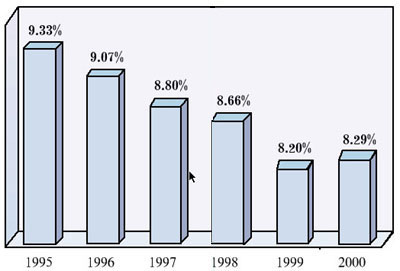 |
Chart 1 The Percentage of China's Defense Expenditure in the Total
State Fi-nancial Expenditure 1995-2000
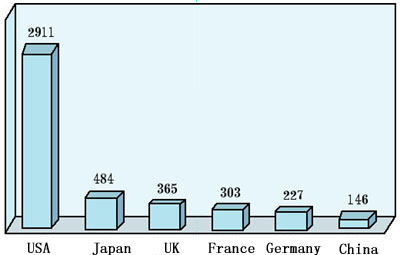 |
Chart 2 Comparison of Defense Expenditures of Some Countries in 2000
(Unit: billion US dollars)
Note: The exchange rate used here is based on that announced by China's
State Admini-stration of Exchange Control this year, which is US$ 1.0??RMB
8.28 yuan.
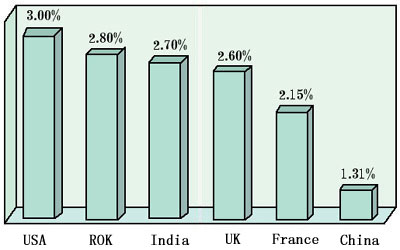 |
Chart 3 The Percentage of Defense Expenditure in the GDP of Some Countries
in 1999
Note: The above data are taken from defense, financial or other government reports pub-lished by the said countries.
Science, Technology and Industry for National Defense
China's fundamental aim in developing science, technology and industry for national defense is to satisfy the basic demands of national defense, guarantee the production and supply of military equipment, and raise the level of national defense modernization.
Since the establishment of the PRC in 1949, the country, with a relatively small input and within a relatively short period of time, has built a comparatively complete defense science, technology and industry system independently through self-reliance, basically meeting the requirements for transforming the PLA from a simple ground force into an integrated armed service comprising the Army, Navy, Air Force and Second Artillery Force. In the field of sophisticated technology, the successful development of atomic bombs, missiles and man-made satellites has made China one of the few countries in the world with its own nuclear weapons and space technology. In the field of conventional equipment, China has made a fundamental shift from copying to independent production, giving a powerful boost to the modernization of the PLA's weaponry.
To meet the demands of the development of the socialist market economy, and set up a new defense science, technology and industry system with topnotch efficiency, China has carried out foundamental structural reforms. In March 1998, a new Commission of Science, Technology and Industry for National Defense was set up, to act as the leading department of the State Council in this regard, responsible for carrying out disciplinary management like policies, laws and regulations, plans, standards, and supervision in defense science, technology and industry. In July 1999, the corporations of five military industries, involved in nuclear, astronautics, aeronautics, ship-building and weapons sectors respectively, were reorganized into ten corporations, namely, China National Nuclear Corporation, China Nuclear Engineering and Construction Corporation, China Aerospace Science and Technology Corporation, China Aerospace Machinery and Electronics Corporation, China Aviation Industry Corporation I, China Aviation Industry Corporation II, China State Shipbuilding Corporation, China Shipbuilding Industry Corporation, China North Industries Group Corporation and China South Industries Group Corporation. Through this reform, the market competition mechanism has been introduced into China's national defense science, technology and industry, the structure and layout of which have been gradually improved. In addition, the contingents of military industry have been streamlined, the capability of shifting from a peacetime to a wartime footing has been enhanced and strenuous efforts have been made to establish a new military industry system of an open type.
In developing its defense science, technology and industry, China adheres to the principle of reliance on science and education, makes full use of the country's scientific and technological capacity to develop military research and production, strengthens cooperation and exchanges in this field with other countries worldwide, promotes development of new and high technology weapons and equipment, accelerates the pace of application of scientific research findings, and strives to supply arms of high performance, reliable quality and complete sets. Meanwhile, China's defense science, technology and industry, by strongly promoting the peaceful use of military industry technology and bringing the advantages of military industry into full play, gives priority to the development of civilian-use nuclear energy, aerospace, aviation, and shipbuilding industries, and thereby forms a benign circle of mutual military-civilian progress. Now, China's defense science, technology and industry has become an important force in the country's national economic development.
Frontier Defense
China's land borders total more than 22,000 km in length; its mainland
coastline stretches for some 18,000 km; and it neighbors more than 20
countries, either contiguous or separated by stretches of sea. The Chinese
government pursues a policy of good neighborliness and friendship. It
defends and administers its land borders and territorial seas, safeguards
the country's territorial sovereignty and maritime rights and interests,
and secures both its land and sea borders, strictly in accordance with
treaties and agreements it has signed with its neighboring countries,
and the United Nations maritime conventions. China advocates settling
pending and unresolved border and maritime demarcation issues through
negotiations, attaches importance to the setting up of a mutual confidence-building
mechanism in border regions, and opposes the use of force or provocative
acts. China has solved or basically solved boundary issues left over by
history with most of its adjacent countries. In the 1960s, China and the
Democratic People's Republic of Korea (DPRK), Mongolia, Afghanistan, Pakistan,
Nepal and Myanmar settled their border issues through negotiations. In
the 1990s, China signed new border treaties or agreements with Laos, Russia,
Kazakhstan, Kyrgyzstan, Tajikistan and Viet Nam, re-demarcating or basically
demarcating the respective boundaries. The borders between China and Laos
and Russia were resurveyed; the field survey of the border between China
and Kazakhstan has been completed; the survey of the border between China
and Kyrgyzstan has started, and the survey of the border between China
and Viet Nam is about to commence. China has signed treaties, agreements
and un-derstandings respectively with the DPRK, Mongolia, Russia, Myan-mar,
Viet Nam and Laos on border control measures, setting up confidence-building
measures, preventing dangerous military activities and promoting border
cooperation, jointly maintaining frontier order within a bilateral or
multilateral legal framework and preserving peace and stability on the
borders. In the course of its vigorous development of various kinds of
cooperative relations with its neighboring countries, China has opened
more than 200 ports along its land and sea frontiers.
China exercises a joint military-civilian land and sea border man-agement system, headed by the military and with a sharing of responsibilities between the military and the local authorities. The State Council and the CMC exercise unified leadership over land and sea border defense. The Chinese government places the utmost importance on the formulation of laws concerning frontier defense. It has enacted a series of laws and regulations, and corresponding local laws and regulations have been put in place by concerned provinces, autonomous regions and municipalities directly under the Central Government. The concerned departments of the state have promulgated special regulations with regard to exit and entry control and the management of land and sea ports. Border control departments conduct publicity and education activities aimed at enlightening the people of the frontier areas as to the nature of the boundaries, the concept of frontier defense, and border policies and laws. They also wage special battles to crack down on smuggling and narcotics, and hit hard at transnational, trans-border criminal activities in accordance with the law.
Following the Chinese government's resumption of sovereignty over Hong Kong in 1997, on December 20, 1999, it resumed sovereignty over Macao, an important symbol of which is the stationing of a PLA garrison in Macao to fulfill defense duties. It is also an important guarantee for safeguarding national sovereignty and security, as well as the long-term peace and stability of Macao.
The stationing of the PLA garrison in Macao was carried out strictly in accordance with the provisions of the law. The Basic Law of the Macao Special Administrative Region (MSAR) of the PRC, passed by the First Session of the Eighth NPC in March 1993, clearly states that the Central People's Government of China is responsible for the defense of the MSAR. In June 1999, the Tenth Meeting of the Standing Committee of the Ninth NPC deliberated and passed the Garrison Law of the MSAR of the PRC, which officially went into effect on December 20, 1999. The provisions of the Garrison Law state that the Macao Garrison will not interfere in the local affairs of the MSAR, but if the government of the MSAR, in a time of need, requests the Central People's Government for the assistance of the Macao Garrison in the maintenance of social order or in case of disaster, the Garrison is obligated to render the necessary assistance in complince with the instructions of the CMC. The Garrison's tasks are to fulfill defense duties, manage military installations, handle matters concerning foreign military affairs, and ensure Macao's security and stability. The expenses of the Macao Garrison are undertaken by the Central People's Government. The Macao Garrison practices a per-sonnel rotation system. The Garrison Law also contains regulations governing the obligations and discipline of the members of the Garrison, as well as judicial jurisdiction.
The PLA Macao Garrison, subordinate to the leadership of the CMC, is mainly composed of ground forces, with some naval and air force personnel on its staff. In carrying out its defense duties, the Ma-cao Garrison must observe the national laws as well as those of the MSAR, and uphold the rules and regulations of the PLA. Following its stationing in Macao, the Macao Garrison has strictly adhered to the law in the aspects of its garrisoning, administration, conduct and man-agement, undertaken arduous training, observed strict discipline, and strengthened in an all-round way the building of the force along the line of regularization. By adhering to the regulations of the Garrison Law, the Garrison has set up normal working relations with the government of the Special Region and has timely established channels for contacts with Macao society, thereby promoting the Macao people's understanding of and trust in the Garrison.
The PLA Macao Garrison will persevere in the guideline of "one country, two systems," fulfill its defense responsibilities efficiently and perform every item of its duties under the Garrison Law, so as to contribute to the country's security and Macao's stability and development.