Spring
Festival
The Spring Festival, also known
as Chinese New Year or the Lunar New Year, is the most important
and joyous of Chinese traditional holidays. The date of the new
year is still determined by the lunar calendar even though the
government of the Republic of China adopted the international
Gregorian calendar in 1912.
Almost everyone in China's
cities enjoys at least three days off work to celebrate Spring
Festival, and the celebration lasts even longer in rural areas:
from the eighth day of the last month of the lunar year to the
15th day of the first month of the following lunar year. Rural
residents use this time, following a year's hard work and prior
to the spring planting, to rest and relax as the climate in northern
China is still quite cold.
The Han people (the majority
ethnic group in China, accounting for more than 90 percent of
the population) have a tradition of eating laba -- rice porridge
with beans, nuts and dried fruit -- on the eighth day of the 12th
lunar month. This pastime symbolizes the peasants' wishes for
an abundant harvest and healthy animals.
Starting on the 23rd day of
the 12th lunar month people clean their houses and decorate them
with paper cuts and streamers, hoping to sweep away all the ill-fortune
there may have been in the family to make way for the wishful
in-coming good luck. Meanwhile, people also shop for special Spring
Festival foods and gifts, and begin preparing the New Year's banquet.
On the day before New Year's
Day, many families decorate their front door with a pair of couplets
designating good fortune. These couplets are written in fine calligraphy
on long strips of red paper. The text of the couplets is often
taken from famous poems or old sayings, and the sentiments expressed
are for happiness, good health, bumper harvests, family harmony
and prosperity.
In the old days, various kinds
of food are tributed at the altar of ancestors.
The Eve of the New Year is
very carefully observed. Supper is a feast, with all members coming
together. One of the most popular courses is jiaozi, dumplings
boiled in water. "Jiaozi" in Chinese literally mean
"sleep together and have sons", a long-lost good wish
for a family. But traditionally, jiaozi was thought to be able
to scare away evil spirits, misfortune and disease. Today this
well-loved dish is as closely associated with Spring Festival
as turkey is with Thanksgiving in the United States.
Chinese have been making jiaozi
for more than 1,600 years, but the preparation of this delicious
food varies by region. One variety is made with fillings of meat,
Chinese cabbage or other vegetables, peanut and sesame oils, with
ginger, green onion and salt for flavoring. Another variety is
filled with eggs and dried shrimp along with Chinese cabbage,
Chinese chives and other flavorings.
On New Year's Day people traditionally
eat dumplings made with egg and shrimp fillings to encourage a
year of peace. Families in some rural areas have a custom of wrapping
a small piece of candy or a coin in one of the dumplings. The
person who eats this dumpling is considered lucky and will have
a happy and prosperous new year.
Following dinner, most families
watch special holiday shows on television, which last
well into New Year's Day. Many families stay up very late, some
even stay up all night, playing cards, laughing, chatting, or
telling stories to the children.
At midnight a barrage of firecrackers
breaks the silence. It is auspicious to light firecrackers again
the next morning, before noon.
The tradition of lightening
firecrackers on New Year's Eve was originally to scare off the
legendary beast "nian" -- which means "year"
in Chinese. Legend has it that "nian" appeared regularly
at the end of winter, wreaking havoc among people. Gunpowder hadn't
yet been invented, so people burnt dry bamboo sticks, which created
an crackling sound -- thus the Chinese name for firecrackers,
"baozhu" (cracking bamboo).
While the custom of setting
off firecrackers during the Chinese New Year can be traced back
2,000 years. However, nowadays some of Chinese cities have banned
firecrackers for the fear of injury, fire, and noise pollution.
Very early the next morning,
children greet their parents and receive their presents in terms
of cash wrapped up in red paper packages. This is called "Yasui"
money. In Chinese, "ya" means suppress and "sui"
means evil. According to Chinese New Year legend, parents gave
children "yasui" money in order to bribe "nian"
not to eat them.
Afterwards, the family start
out to say greetings from door to door, first their relatives
and then their neighbors. It is a great time for reconciliation.
Old grudges are very easily cast away during the greetings. The
air is permeated with warmth and friendliness.
During and several days following
the New Year's day, people are visiting each other, with a great
deal of exchange of gifs.
The celebratory climax occurs
on the 15th day of the first lunar month during the Lantern Festival.
This festival, also known as
Shangyuan Festival, began more than a thousand years ago in the
early Tang Dynasty (618-907). Since the Song Dynasty (960-1279)
people have on this day eaten a special food, called floating
balls, made of glutinous rice flour with various fillings and
boiled in water. As Yuanxiao is still another name for this festive
day, the balls have also come to be called yuan xiao.
The Lantern Festival is a day
to "have fun." During the week before lanterns are displayed
in every house. These lanterns, in beautiful colors and all kinds
of shapes, show off the wonderful skill of the craftsmen who make
them.
New Year's Day typically occurs
sometime in early spring (February). This year, the day falls
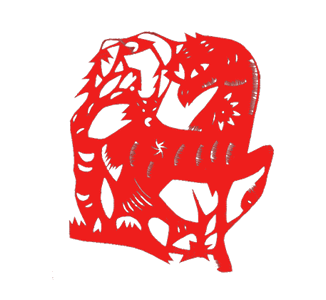
on Tuesday (February 12), ringing in the Year of the Horse.
The history of the close relationship
between the horse and Chinese people goes back to ancient time.
In the eyes of ancient people,
a horse symbolized vitality, dignity and military strength.
Steeds belonging to many historical
figures were recorded down the years.
Some horses have even been
worshipped by ordinary people as deities for thousands of years.
The red steed of Guan Yu, a brave general in the Eastern Han Dynasty
(25-220), is an example.
According to legends, Guan
Yu fought enemies while riding a strapping steed named Chitu.
As time passed, the red horse developed a deep love for its master.
The horse ultimately died from
sadness after Guan Yu's death. Its faithfulness touched people
to such an extent that it was regarded as a god later on.
Horsed feature heavily in art
and literature. Being the object of eulogy, horses have always
been endowed with a heroic image.
According to Chinese fortunetellers,
people who were born in horse years are energetic and open-minded.
They are inclined to make friends with others and enjoy an enduring
harmonious relationship with friends.
For people who were born in
horse years, the year 2002 is also ironically considered to be
a year of bad luck. Chinese friends may advise you to be especially
careful and to wear a red cloth band, which can protect you from
bad luck.
Twelve animals hold a special
place in Chinese folklore.
They are the rat, ox, tiger,
rabbit, dragon, snake, horse, sheep, monkey, rooster, dog and
pig.
Each one of them is used by
Chinese people to symbolize the Chinese lunar year in which a
person is born. After every 12 years, a new cycle will start.