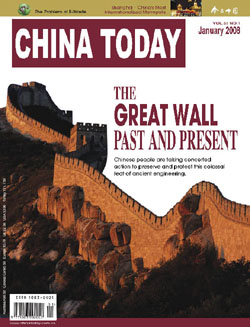
By staff reporter LU RUCAI
The Great Wall has been synonymous with China since travelers
and adventurers first spoke of the Middle Kingdom to the rest of
the world.
The absence of mention of the Great Wall in the famous
travelogue, The Travels of Marco Polo, is a main reason to doubt
its veracity. Later visitors unfailingly referred to this ancient
Chinese engineering feat. The 16th century Portuguese writer
Fernauo Mendes Pinto, for instance, commented on the governmental
practice of sending prisoners to build the Great Wall. The Spanish
missionary Juan Gonzalez de Mendoza also spoke of, "the Great Wall
that is 500 leagues long" (1 league = 4.8 kilometers) in his The
History of the Great and Mighty Kingdom of China (1585 edition),
clearly stating, "the emperor who ordered its building was
Qinshihuang." Ferdinand Verbiest (1623~1688), a Belgian missionary
resident in China for more than 20 years, remarked that the
combined seven wonders of the world could not compare to the Great
Wall, and that descriptions published in Europe failed to convey
its true magnificence.
As greater numbers of missionaries and envoys visited China from
the 16th century onwards, its image in the West became inextricably
linked with the Great Wall. By the 18th century era of
enlightenment it had become the ultimate symbol of both China and
the Chinese civilization. Mendoza and Voltaire regarded the Wall as
an aspect of China's strength; others later perceived it as a sign
of weakness. But the Western fascination with the Great Wall has
never abated.
?The Great Wall was designated a UNESCO World Heritage site
in 1987, and voted one of the new Seven Wonders of the World in
July 2007.
Despite its fame and glory, only? 2,000 kilometers or so of
the 6,500-kilometer-long Great Wall still stands. Its rate of
conservation is outpaced by organic erosion and human damage.
Premier Wen Jiabao signed a State Council decree on
October 11, 2006 enforcing the Regulations on the Protection of the
Great Wall as of December 1, placing its protection on a legal
basis. The conservation of this ancient Chinese engineering feat is
now the common concern of the government, NGOs and everyday
citizens of China.
Special Report
Ancient and Contemporary Changes to the Great
Wall
By staff reporter LU RUCAI
A survey among influential statesmen and entrepreneurs from 50
countries in connection with the 2008 Beijing Olympic Games, headed
by Feng Huiling, vice president of the Renmin University of China,
confirms that the Great Wall is still the main sightseeing priority
of visitors to China.
?
How Long Is the Great Wall?
"Most people associate the Great Wall with Badaling," says Dong
Yaohui who, as vice-president of the China Great Wall Society, is
an authority on the subject. "Construction of the wall began during
the Spring and Autumn Periods more than 2,000 years ago, and
continued through to the Ming Dynasty (1368-1644). Its total length
exceeds 6,500 kilometers." Badaling is just one 3.47-kilometer
section of the Ming Dynasty Great wall currently open to tourists,
a length that will double in time for the 2008 Olympics.
Building of the Great Wall was initiated by the southern State
of Chu in the 7th century B.C., when China was in a state of
anarchy as numerous independently ruled vassal states vied for
power. The aim of the Wall was to strengthen defense of the local
regime. The State of Qi and others in the north took similar
defensive action. After Qinshihuang united the country and
established the Qin Dynasty in 221 BC, the defensive walls built by
former northern vassal states were linked. Its total 5,000
kilometer length extended from Liaoning in Northeast China to
Gansu's Minxian in Northwest China. Today, just a few sections of
the Qin Dynasty Great Wall still stand in northern Datong in Shanxi
Province, western Minxian County in Gansu Province and Guyang in
Inner Mongolia Autonomous Region.
Construction of the Great Wall continued during the ten dynasties
succeeding the Qin, that on the largest scale? during?
the Han (260 BC - AD 220) and Ming dynasties. The total length of
the Han Dynasty Great Wall exceeded 10,000 kilometers, and was
around 6,000 kilometers in the Ming Dynasty, according to
research.
Most of the Great Wall still standing was built more than 600
years ago, in the Ming Dynasty. The length within the Beijing
boundary, including the well-preserved sections of Badaling,
Simatai and Mutianyu, extends for 629 kilometers.
No matter how solidly it may have been built, the Great Wall,
like everything else, has a life span," says Zhou Youma, deputy
secretary general of the China Great Wall Society. "Its ‘quality
guarantee period' was 50 years, according to Ming Dynasty
standards. If any problems occurred within that time, the officer
in charge of its construction was punished. Today, even the most
recently constructed sections of the Great Wall have a history of
300 to 400 years, which is why their condition is fragile."
Zhou confirms that the Great Wall is extremely vulnerable to
erosion, whose pace far outstrips that of restoration.
For War or Peace?
The Great Wall of China by Franz Kafka (1883-1924) is an
imaginative description of this ancient project that raises the
points, "With this method of construction (section by section) many
large gaps arose;" "there are said to be gaps which have never been
filled in at all." It then asks, "The wall was conceived as a
protection against the people of the north, as was commonly
announced and universally known. But how can protection be provided
by a wall which is not built continuously?"
?As vice-president Dong Yaohui of the China Great Wall Society
remarks, "Military defense is generally considered to have been the
aim of the Great Wall. But it actually performed a peaceful rather
than warlike function." Dong acted as guide to former US president
Bill Clinton and current US president George W. Bush. Both
presidents were keen to know why so much manpower, material and
funds had been expended on this massive, yet apparently incomplete,
defense project throughout the centuries. Dong explains, "The Great
Wall was a means of reconciling China's nomadic and farming
economies. Clashes between the Han and nomadic communities
occurred? throughout Chinese history. Nomadic ethnic groups
north of the Great Wall, such as the Qin and Han Dynasty Huns and
Ming Dynasty Mongols, sought pastures for their horses, cattle and
sheep. They coveted land in the Central Plains areas that had been
settled by Han farmers. Nomad sheep and cattle ruined painstakingly
cultivated Han crops, and farmers retaliated by slaughtering nomad
livestock. "
The conflict caused many farmers to migrate southward, leaving
large areas of farmland in the north to waste. Dong continues, "In
order to halt this agricultural retreat, troops were sent in by the
government of the Central Plains areas to protect farmers and their
land, but they would arrive only to find that the marauders had
already retreated. The nomads would simply renew their attack as
soon as the troops had withdrawn." Construction of the Great Wall,
therefore, was with the aim of restoring order to the farming
economy, and the function of troops stationed on it was to maintain
peace on the border.
The Great Wall to some extent promoted development of border
trade. As the nomadic economy produced only meat and hides, nomads
would attack Central Plains farming communities and pillage the
cloth and iron implements they produced. As Dong Yaohui explains,
"Construction of the Great Wall prevented looting and established
trade." Great Wall passes such as the Niangzi and Zijing were
outposts for collecting tariffs.
"Few battles occurred along the Great Wall for thousands of
years, and those that did were of short duration. The Great Wall
was built to avoid wars, and its solidity was with the aim
maintaining peace. There are forks on certain sections, and it is
not continuous in mountainous regions as building on steep slopes
was pointless. The Great Wall, therefore, should not be defined
simply as a military project," Dong Yaohui concludes.
"A main principle followed in building the Great Wall was to
‘take advantage of natural barriers and take measures appropriate
to local conditions,'" is? Zhou Youma's reply to Franz Kafka's
questions.
Historical Great Wall Inhabitants
Many villagers living at the foot of the Great Wall in Shanxi,
Shaanxi, Gansu and even Beijing, are descendants of its original
builders and garrisons.
Qinshihuang dispatched more than 300,000 troops that had just
wound up the military campaign against Hun invasion to build the
Great Wall. The emperor requisitioned a further 500,000 civilian
laborers, among them convicts. "The soldiers were from all over the
country, and Ming Dynasty builders were from both southern
provinces as well as those in the north such as Shandong," Zhou
Youma says. A mural inside an Eastern Han tomb discovered in
Horinger County, Inner Mongolia Autonomous Region in 1971 indeed
depicts the occupant's journey from Chang'an (present-day Xi'an) to
Horinger via the Juyong Pass. There was consequently a meeting of
cultures at the various localities along the Great Wall.
Garrison troops were sent to the Great Wall upon its completion
to consolidate frontier defenses. Soldiers and peasants were
ordered to cultivate wasteland along the Wall, and taxes were
levied to cover soldiers' pay and provisions.
Other than at times of invasion, garrisons on the Great Wall
rarely exceeded one or two soldiers to a single watchtower. When an
enemy attack was reported, soldiers lit beacons to inform nearby
troops, and the message would be passed via the Great Wall beacon
towers to the military headquarters in the capital. During the Ming
Dynasty, beacons were lit to raise the alarm and gunshots signaled
the number of invaders. The beacon system was capable of alerting
the capital to an attack within two hours from as far as a thousand
miles away.
Many perceive the Great Wall simply as a huge wall, but it
consists of many military facilities, such as barriers, passes,
terraces, beacon towers, and arsenals as well as defense guard
headquarters and barracks. Its multiple functions include fight,
command, observation, communications, and shelter. A defense
project of such dimensions was an effective safeguard against nomad
cavalry.
?
The Contemporary Role of the Great Wall
Since opening to the public in 1952, the number of visitors to
the Badaling Great Wall exceeds 150 million, including more than
400 foreign heads of state.
Several other sections of the Great Wall, amounting to some 30
kilometers, have since been opened to tourists. They include
Mutianyu, Simatai and Juyongguan. Other sections are badly in need
of repair and consequently dangerous. The Regulations on the
Protection of the Great Wall prohibits visitors to these areas.
Tourism development, Dong Yaohui believes, is a double-edged
sword. "If no one visits the Great Wall, how can it be called a
tourist attraction?" In his opinion, the most developed tourist
spots are those best preserved. The income from admission tickets
brings the administration authorities funds enough to invest in its
conservation and more efficient management. Dong is keen to make as
many sections of the Great Wall open to tourists as possible.
His hopes will soon materialize. Several more sections of the
Great Wall, such as Huanghuacheng, Qinglongxia and Shuiguan, are
undergoing repair, according to the Beijing Municipal
Administration of Cultural Heritage. They will be opened to tourism
upon completion.
Gansu Province has been more proactive than Beijing as regards
protection and utilization of the Great Wall. The local cultural
heritage protection department contracted a section of the Ming
Dynasty Great Wall to local farmer Yang Yongfu in 2000. Yang
invested RMB 800,000 in its restoration and signed a contract to
protect, repair and utilize the section for a 30-year period. His
Shiguanxia Great Wall Tourist Area has since been designated a
tourist spot.
Real estate and performance circles, in addition to the tourism
industry, have also taken advantage of the Great Wall's business
promotion potential. One example is the architectural cluster
designed by 12 outstanding Asian architects at the foot of the
Shuiguan Great Wall north of downtown Beijing. Known as the
"Commune at the Foot of the Great Wall," its breathtaking backdrop
and avant-garde architectural styles have won it several
architectural awards. It is now a characteristic hotel and a venue
for media events, fashion shows and celebrity press
conferences.
"The symbolism of the Great Wall is far greater today than its
historical significance. It is above all a landmark, regardless of
the roles it played in history," concludes Dong Yaohui.
(China Today January 8, 2008)