The Japanese army's atrocities are irrefutable
- By Liu Yuan and Li Wuzhou
 0 Comment(s)
 Print
Print E-mail China Today, August 31, 2015


|
|
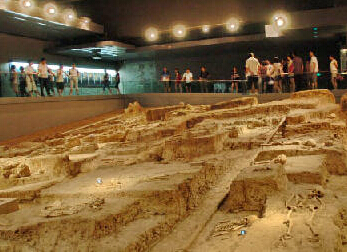
| The Nanjing Massacre Memorial Hall Mass Grave. |
For decades, certain people in Japan have persistently whitewashed – even denied – the aggressive war on China that went on for 14 years, and the atrocities Japanese fascists perpetrated on the Chinese people. Some, moreover, have even sought to justify such unspeakable acts. History, however, does not lie; facts and historical evidence of the massive loss of life directly attributable to the Japanese army’s inhumane acts invalidate the plausibility of such mendacious claims.
Coal Supersedes Humanity
Beneath the peaceful rolling hills that sprawl for miles in Nanshan, Sunjiawan of Fuxin City in Liaoning Province are four mass graves.
After occupying Northeast China in the early 1930s, Japan began a desperate search for natural resources. The coal that its armies plundered in Fuxin cost the lives of hundreds of thousands of Chinese forced laborers. Their corpses were buried in four pits around the mines, over 10,000 in each one.
Curator of the mass grave memorial hall Zhang Baoshi told the reporters the stories of Ma Yuqi and Zhu Tao.
Ma Yuqi, now 92, was a forced laborer at the Sunjiawan mine. Aged just 16, he and eight other young fellow villagers were pressganged into working in the mines, at temperatures of minus 20 to 30 degrees Celsius. They slept in sheds blasted with arctic winds and lived on one bowl of stewed millet and a salted potato each day. If they did not finish their meal in five minutes they were beaten. Many got sick with digestive problems and soon died. Their corpses were taken to a makeshift morgue and, when that was full, thrown into a mass grave.
Zhu Tao was a teacher at the Chinese People’s Anti-Japanese Military and Political College in central Hebei Province when the Japanese army captured him in 1942.
He and other captured soldiers and teachers, called “special workers,” were forced to labor at least 12 hours a day in mines where the roofs could cave in at any time. Workers perceived as slacking would be beaten, sometimes to death, on the spot. Punishments included being branded, given electric shocks, and having starved dogs set on them. By the end of August 1945, more than 1,890 of the 4,000 so-called “special workers” had died.
Zhu Tao and a few comrades escaped on March 5, 1943, and made their way back to the anti-Japanese bases in central Hebei Province. He passed away in Guangzhou last year at the age of 101. Late in his life, when recalling what he had endured in Fuxin, Zhu said: “There are 18 layers of hell, but we laborers worked beneath the 18th layer.”
Survivors Win Their Cases
The first exhibit visitors see on entering the Memorial Hall for the Victims of the Nanjing Massacre by Japanese Invaders is a giant black statue of an anguished woman holding the limp body of her dead child.
“The entire memorial hall is built on the sites of mass graves,” curator Zhu Chengshan said. During its construction between 1984 and 1985, large amounts of skeletons were excavated, and more remains were found in 1998. The former were buried in the foundations of a special exhibition hall and the latter on the site of the original mass grave, named the “common grave whose number is counted in tens of thousands.” “The name comes from burial records documenting that the bodies of more than 20,000 victims were buried here,” Zhu said.
The sound of weeping and sobbing can sometimes be heard in the hall. Among the historical pictures on display are those of a Japanese officer wielding a saber over a woman kneeling in an attitude of prayer; of Chinese civilians half buried in a pit as Japanese soldiers stand by laughing; and of the heads on barricades of beheaded civilians, some of whose mouths are stuffed with cigarettes.
Nanjing, then capital of China, was besieged by Japanese troops late in 1937. During the six weeks between December 1937 and January 1938 that Japanese troops occupied the city, more than 300,000 people were killed.
Videos, images and texts in the memorial hall gleaned from survivors tell of this orgy of slaughter 78 years ago.
One of the videos is of Xia Shuqin, now 86, telling what happened to her on December 13, 1937. She lived at No. 5, Xinlukou Street, east of Zhonghuamen, one of the main gates to the inner city. On that day, Japanese soldiers burst into her house and killed seven members of her family: her grandparents, parents, and three of her sisters. Soldiers raped and then killed her mother and two elder sisters. She was stabbed three times and passed out. Of the entire family, only Xia and her four-year-old sister survived.
The hall guide told the reporter that in 1998, Japanese historian Matsumura Toshio and Professor Shūdō Higashinakano of Asia University claimed in their respective published monographs that Xia is a fake witness to the massacre. Xia sued them in Japan for defamation. The Tokyo District Court, Tokyo High Court, and Supreme Court of Japan all found in favor of Xia. She received 4 million yen in compensation.
River of Corpses
“On December 14, we marched from the city to the banks of the Yangtze River … all we could see on the river’s 2,000 or more meter-wide surface was the bodies of men, women, and children, slowly floating like rafts. Looking upriver, more corpses, like mountains, moved toward us in what seemed an endless stream. There must have been at least 50,000. The Yangtze River had become a river of corpses.” This account was given by Japanese veteran Akahoshi Yoshio, from Weeping Yangtze River, a memoir collection by veterans published in Japan.
“In the square about 100 people sat, hands tied behind their backs. In front of them were two freshly dug pits, about five meters square and three meters deep… the soldiers carrying out the executions appeared agitated, their faces manically contorted.” Former military correspondent Sato Shinju so recounted in his book March as Military Correspondent.
On December 14, 1937, Tokyo Nichi Nichi Shimbun (Tokyo Daily News) published a report on the two Japanese officers Toshiaki Mukai and Tsuyoshi Noda who vied to see who could kill 100 people with a sword in the shortest time. The locations where the two officers held their contests – Changzhou, Danyang and Jurong in Jiangsu Province – are mentioned in the report, signifying that the atrocities were not limited to Nanjing.
European and American
Witnesses
A Western-style two-story brick building stands at the intersection of Zhongshan Road and Guangzhou Road in bustling downtown Nanjing. It is the site of the Siemens refugee camp, one of 25 sanctuaries established by the International Committee for the Nanjing Safety Zone.
A group of foreigners set up the demilitarized zone for Chinese civilians, and 25 sanctuaries within it, shortly before Nanjing fell to the Japanese army, according to Yang Shanyou, director of the former residence of German businessman John Rabe (1882-1950), who was chairman of the committee. The Siemens refugee camp alone accommodated 135 households, or more than 600 civilians. Throughout the massacre the safety zone gave sanctuary to around 250,000 Chinese.
One committee member, American priest John G. Magee (1884–1956), risked his life filming what was happening during the Japanese occupation with a 16 mm camera. Kodak later made four copies of his films that have gradually come to light. Miner Searle Bates (1897-1978), then professor of history at the University of Nanking, published several articles in foreign newspapers revealing the facts of the massacre. In 1988 his diary recording the savagery of the Japanese army came to light in Yale University.
On February 15, 1946, the military tribunal that tried war criminals, established in Nanjing by the Chinese Army General Headquarters, based on masses of evidence, held that: “The Japanese army carried out 28 planned massacres, killing about 190,000 civilians, and 858 sporadic killings. As many as 150,000 corpses were buried by charity organizations.” The verdict is also on display at the memorial hall.
The Japanese government explicitly acknowledged the number of victims of the Nanjing Massacre determined by the military tribunal when it signed the Treaty of San Francisco in 1951, with the governments of the U.S. and other countries.


