Rising cost of returning home for Spring Festival
 0
0 


 |
|
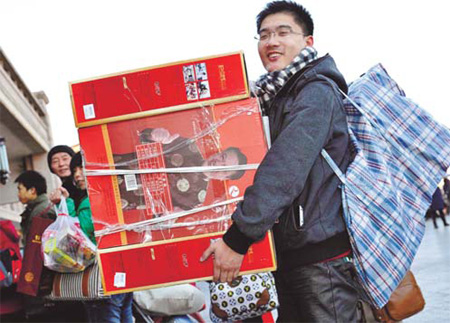
People traveling for the Spring Festival arrive at Beijing Railway Station with gifts for relatives and friends back home. |
Yi Linhua lays a fat wad of red envelopes on top of bags of milk candy, bottles of white liquor, packs of cigarettes and dozens of gift parcels.
"Liquor and cigarettes are for uncles, scarves for aunties, candies for neighbors, and red envelopes are for parents and children," said Yi, whose hometown is in Pingxiang in East China's Jiangxi province. (He asked that his real name not be used for privacy reasons.)
The 30-year-old IT salesman in Shanghai and millions of other white-collar workers in big cities are going home for the most important Chinese holiday. The one-week reunion is at a cost. To Yi and his wife, who have a toddler to provide for and a mortgage to pay, it is nearly two months' household income.
"There is always pressure to go home. But you have to go," Yi said. "The big family is waiting for us. After working away from them for one year, going home with wife and child shows my respect and gratitude."
Yi and others who migrated from rural regions are feeling a growing financial burden from the tradition of giving money or gifts for Spring Festival. Some say the lunar new year produces not only a large human migration but also a major migration of wealth.
For Yi, the total this year is about 30,000 yuan, including 12,000 yuan to his parents and parents-in-law, more than 30 red envelopes to nieces and nephews, and extra money for children of distant relatives who might visit unexpectedly.
"The amount I put in the children's envelopes, varying from 50 yuan to 500 yuan, depends on how close we are with their families and how much help they have provided to my parents when I am away," Yi said. "I am broke after every Chinese New Year."
Hua Xu and Fang Jingjing, both from northwestern Gansu province, will spend 20,000 yuan for the holiday, about one-seventh of their 150,000 yuan annual income.
"When we are giving as much as 1,000 yuan as a wedding gift to friends, we can't just give our parents 2,000 yuan for new year," Fang said. She feels guilty for not taking care of her parents and sees giving money as a way to make up. She has doubled the amount to 4,000 yuan this year.
Jin Wen, a 26-year-old in his second year as a civil servant in Shanghai, said he will start paying red envelopes this year worth 10,000 yuan, which is two months' salary. "If I still go home with hands empty, both my parents and I will lose face."
Much symbolism
Giving money is a Chinese tradition for young people to show gratitude and respect as well as provide a financial subsidy to their families, especially in rural regions where the economy lags far behind cities. In cities such as Beijing and Shanghai, where most university graduates go for opportunities, the average disposable income is around 30,000 yuan a year, about three times the amount in rural regions.
Yu Hai, a sociology professor with Shanghai's Fudan University, said that to the Chinese gift giving is an investment to build up connections, within the family or outside it. For white-collar workers who live in one place and have family in another, the spending doubles and the expectations, due to the widening wealth gap, are high.
"For many, it is a way to compensate for their absence with the family and the extended families at home," Yu said. And it is a way for their families to show to their neighbors and villagers the success of the young generation in the city.
"They have received a high education and settled in big cities," said Xu Anqi, a sociologist specializing in marriage and family study with Shanghai Academy of Social Sciences. "Their families are proud of them and have high expectations of them. And their relatives believe they are living a much better life. They have to return home in glory."
The tradition has been carried on for generations, Yu said. The problem for today's younger people is that they live under high pressure in the cities, and the tradition only exacerbates the situation. And it becomes more of a burden when the amount of money is interpreted as the amount of gratitude.
"According to our hometown tradition," Yi said, "you will have to give money (to the family) when you go home during the New Year. And men give more than women. Otherwise my parents will lose face in front of the relatives."
To some, the face-saving work also means buying a handbag for a sister-in-law, subsidizing a mortgage for siblings and paying tuition for a younger generation, according to posts at tianya.cn. They will be called stingy if the red envelopes are slim.
For many who have either just started a career with a meager income or who are struggling to pay for their own home due to soaring prices, big-city life is far from glorious. In a 2010 Mercer's survey of the world's most expensive cities, Beijing, Shanghai, Guangzhou and Shenzhen were listed as Nos 16, 25, 38 and 42.
Hua Xu and Fang Jingjing have just moved into a small apartment in suburban Shanghai, and they spend two hours traveling to work every day. To pay for the mortgage and the home visit for the New Year, the couple plans every cent well.
As an editor at a car magazine, Fang wears nothing comparable to the fashionable and luxurious style of her publication. And when Hua, an IT engineer who specializes in banking system applications, broke his 180-yuan glasses recently, he had them repaired rather than replaced.
They know only too well how much financial pressure they will face after the New Year, but Fang said they "have been expecting the day (to return) for a whole year. The idea gives us strength to conquer the loneliness and difficulties we suffer in the city."
Ties get weaker
To some, the pressure also comes from sustaining a decent city life while being bound to traditions they no longer cherish, said IT engineer Yu Yang, who works in a multinational software company's Beijing office.
"iPhone, iPad, name brands and girls - we have them all. Those are things young people vie with each other no matter where you are from," said Yu, who is 31 and from Inner Mongolia autonomous region. He recently purchased Apple's new tablet and is an active snow skier.
He described himself and many who were born in or after the 1980s, when the economy started to boom, as spoiled and spending more than they earn. "Without us spending money, the country's economy would not have grown so fast and the luxury market would not have been developed."
No one wants others to know they are from rural regions or a poor background, Yu said. What they have and what they wear are closer to conform to urban life. "It is about your face," he said.
To them, city life is much more appealing than the tradition of New Year or family, which is becoming distant to them. They spend most of their grown-up years in cities, where family size is smaller and connections to extended families are loose.
"People who save nothing just choose another time to go home (when money gifts are not expected)," Yu said. He also believes that nowadays, most families are well off enough that they don't actually need money from their children.
But older generations, who have more faith in tradition, disagree and believe that unwillingness to give money symbolizes a lack of gratitude from the younger generation.
He Xuesong, vice-dean of the school of social and public administration at East China University of Science and Technology in Shanghai, lauds the tradition. He blames the New Year pressure on a consumption-oriented economy that does not encourages savings.
To He, a 40-year-old from Anhui province, the tradition connects urban and rural regions and is a way to pay back rural residents for their contribution to the nation's economic development.
"It is the large number of immigrants from rural regions who have helped the city economies to develop most. And the New Year is the time for the city to pay back," said the professor, who goes home every year. "Young people suffer pressure no matter where they are. Taking more family responsibilities only prompts them to work harder and become better. Every young person has lived through such difficulties."
Much of their success in the city is from the sacrifice or contribution of their traditional families, said He Xuefeng, director of the China Rural Governance Research Center in Huazhong University of Science and Technology. He said he and many others in his generation (he is 43) are grateful to their families who supported them in higher education, which then provided them with the chance to migrate to cities.
Usually, rural families in poor regions can afford higher education for only one child, he said. The other siblings have to make sacrifices when the one, usually a boy with good school performance, is chosen to go to university. "Money-giving, usually to support their children in schooling, is a way to pay them back," He said.
With an annual income around 200,000 yuan, He supports the education of many of the next generation in his and his wife's families. "I don't think it will be a huge burden to young professionals in the cities," He said. "And once they have reached a stable stage of their career, the pressure will be less."


