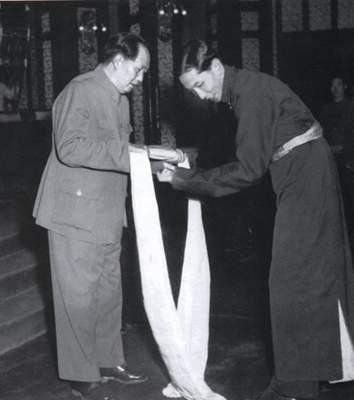
On the 24th May of 1951, the chief of the delegates of Tibet local government Apeiawangjinmei made offering to Chairman Mao.
Signing of the agreement on methods for the Peaceful Liberation of Tibet
On May 23, the signing ceremony of The Agreement Between the Central Government and the Local Government of Tibet on Method for the Peaceful Liberation of Tibet (also known as The 17-Article Agreement) was held in Beijing.
Vice-Chairmen of the Central People's Government Zhu De and Li Jishen and Vice-Premier Chen Yun attended the ceremony. Chen Yun chaired the ceremony on behalf of Premier Zhou Enlai. Li Weihan and Ngapoi Ngawang Jigmei signed the agreement on behalf of the Central Government and the Tibetan government respectively.
Attendants at the signing ceremony also included relevant Party, government and army leaders and leaders of various democratic parties. Lhamin Yexei Curchen, Jijigmei and Nawang Jinba attended the signing ceremony on behalf of the 10th Panchen Erdeni.
Li Weihan and Ngapoi Ngawang Jigmei addressed the gathering, as did Vice-Chairman Zhu De.
Major contents of The Agreement Between the Central Government and the Local Government 0f Tibet on Methods for the Peaceful Liberation of Tibet ate:
(1) The invading powers of imperialist countries shall be expelled from Tibet, and the Tibetan people shall return to the big family of the People's Republic of China.
(2) The Tibetan government shall give active assistance to the stationing of the PLA troops in Tibet, so as to enhance the country's defense.
(3) Regional ethnic autonomy shall be implemented in Tibet under the unified leadership of the Central Government.
(4) Various reforms shall be implemented in Tibet. The local government of Tibet shall voluntarily carry out these reforms. When the people put forward specific requests for reform, the problem shall be solved through consultations between the people and the Tibetan government.
(5) Solidarity shall be realized among the ethnic Tibetans, which mainly refers to a unity between the Dalai Lama and the Panchen Erdeni.
(6) Freedom of religious belief shall be guaranteed, and the religious beliefs, traditions and customs of the Tibetan people shall be respected.
(7) Agriculture, animal husbandry, industry, commerce, education and culture shall be gradually developed in Tibet according to local conditions.
On May 24, Chairman Mao Zedong hosted a banquet to celebrate the signing of The Agreement Between the Central Government and the Local Government 0f Tibet on Methods for the Peaceful Liberation of Tibet. Some 180 people attended the banquet, including the plenipotentiary representatives of the Central Government and Tibetan government, 10th Panehen Erdeni and other religious personnel and government officials.
Chairman Mao told the gathering. "Now, the forces (if the Dalai Lama, the forces of the 10th Panchen Erdeni and the Central Government have united. The Chinese people have reached this goal through overthrowing the rule of the imperialists and the reactionary government."
The signing of this agreement was endorsed by the people of all ethnic groups of the entire country. especially the Tibetan people. In many places across the country, people rallied or paraded to celebrate the liberation of the last portion of the mainland.
The agreement was formally publicized on May 28. The People's Daily printed the entire text of the agreement and published an editorial entitled Upholding the Agreement Between the Central Government and the Local Government of Tibet on Methods for the Peaceful Liberation of Tibet, pointing out that the signing of the agreement marked the point of the Tibetan people's break-away from imperialism and their first step toward light and happiness from darkness and misery.
On May 29, the 10th Panchen Erdeni and the Panchen Kampus Assembly made a formal statement, expressing their heartfelt support for the agreement. The statement indicated their resolution to guarantee the correct implementation of the agreement and to realize solidarity between the different ethnic groups of China and ethnic solidarity among the Tibetans.
On May 30, the 10th Panchen Erdeni telegrammed the 14th Dalai Lama, expressing his hope for unity and his vow to support the 14th Dalai Lana and the government of Tibet with the implementation of the agreement under the guidance of the Central Government and Chairman Mao.
Central Government representative Zhang Jingwu and several representatives of the Tibetan government left Beijing on June 2. They were followed by a second group of Tibetan representatives on June 1 3. Zhang Jingwu and the Tibetan representatives Kemo Soinam Wangdui and Tubdain Dainda reached Yadong in Tibet on July 14 by way of Hong Kong. Singapore and India. Two days later, Zhang Jingwu met with the 14th Dalai Lama, delivering a letter from Chairman Mao and a copy of the agreement. In his letter, Chairman Mao affirmed that the 14th Dalai Lama had "begun to change his attitude" and said, "It was totally correct" that he send delegates to participate in the negotiations in Beijing.
Mao went on to point out, "The agreement is in the interest of the Tibetan ethnic group and the Tibetan people, and at the same time in the interest of the people of all ethnic groups of the country. From this time on, the local government of Tibet and the Tibetan people, within the social family of the motherland and under the united leadership of the Central Government, are able to rid themselves of the shackles of imperialism and to strive for their own causes. I hope you and the Tibetan government under your leadership can genuinely implement The Agreement Between the Central Government and the Local Government of Tibet on Methods for the Peaceful Liberation of Tibet and assist the People's Liberation Army as it enters Tibet."
The 14th Dalai Lama left Yadong on July 22 and returned to Lhasa on August 17. Zhang Jingwu left Yadong on July 24 and arrived in Lhasa on August 8. According to instructions from the Central Government, he made extensive contact with people of all circles in Lhasa, propagating and interpreting the principles and policies of the Central Government and the spirit of the agreement for officials, clerics, and the general population, dispelling their misgivings. On August 18, the Central Government said in a telegram to Zhang Jingwu, "Don't hasten to adopt measures or to implement reforms." "Any activities should be undertaken with caution in consideration of long-term interests. Be patient and avoid taking any hasty action."
Ngapoi Ngawang Jigmei, Tuden Legmoin and other participants at the signing ceremony returned to Lhasa by way of Qamdo. On September 19, Ngapoi Ngawang Jigmei visited the 14th Dalai Lama and explained in detail the content of the agreement. In light of his personal experience , he briefed the 14th Dalai Lama the policies of the Central Government, persuading him of the Central Government's sincerity.
From September 26-29, the Tibetan government convened a representative conference to discuss the 17-Article Agreement. The general impressions were that the agreement was very good. The 14th Dalai Lama and the Tibetan government telegrammed Chairman Mao on October 24, expressing their endorsement of the agreement and their resolution to implement it. The telegram read in part, "The representatives of both sides signed The Agreement Between the Central Government and the Local Government of Tibet on Methods for the Peaceful Liberation of Tibet on May 23, 1951 on a friendly basis.
The local government of Tibet and Tibetan religious and secular leaders support the agreement. We are determined to actively support the stationing of PLA troops in Tibet, enhancing the country's defense, expelling the imperialist powers and securing the integrity of national territory and State sovereignty under the leadership of Chairman Mao and the Central People's Government."
On the eve of the signing of the agreement, the Central Military Commission held a conference. The representatives studied and discussed the details concerning the stationing of the PLA in Tibet. On May 25, Mao Zedong, Chairman of the Revolutionary Military Commission of the Central Government, ordered the PLA to station a certain number of troops in Tibet in order to guarantee the realization of the agreement, to enhance the country's defense and to prevent unexpected incidents from cropping up at any time.
On October 26, 1951, a regiment of the 18th PLA Corps marched into Lhasa and held a grand and solemn ceremony. They were welcomed by officials of the Tibetan government and a gathering of more than 20,000 Tibetans from all walks of life. The PLA troops were then deployed along important border points, such as Nagqu, Ngari, Zayu, Gyangze, Xigaze and Yadong. Wherever they went, the PLA soldiers were welcomed by the Tibetan people. It is this point of complete deployment that is viewed as marking the peaceful liberation of Tibet and the realization of the re-unification of Tibet with the motherland.
The peaceful liberation of Tibet was a turning point in the historical development of Tibet. It marked the success of Tibet in casting off imperialism, in returning to a society of equality, friendship, solidarity and cooperation as part of the People's Republic of China and in stepping onto the bright road of solidarity, prosperity and development.