IMF cuts global growth forecast
 0 Comment(s)
 Print
Print E-mail Xinhua, April 20, 2022


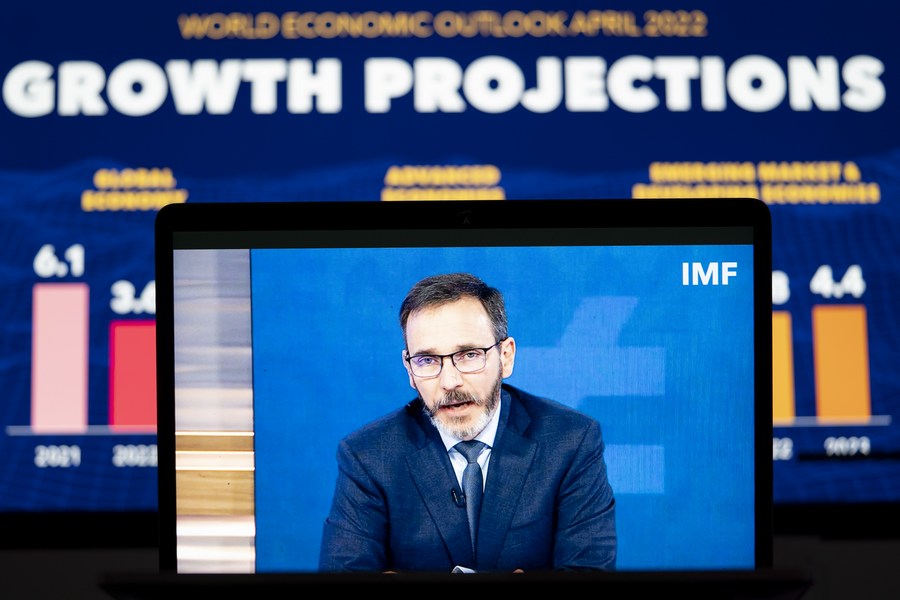
The International Monetary Fund (IMF) on Tuesday slashed global growth forecast for 2022 to 3.6 percent amid the Russia-Ukraine conflict, warning that inflation has become "a clear and present danger" for many countries.
The risk is rising that inflation expectations drift away from central bank inflation targets, prompting more aggressive tightening, the IMF noted, adding that financial fragility risks are raising the prospect of a sharp tightening of global financial conditions as well as capital outflows.
Crisis upon crisis
The Ukraine crisis unfolds while the global economy is "on a mending path" but has not yet fully recovered from the COVID-19 pandemic, the IMF said in its latest World Economic Outlook (WEO) report, noting that global economic prospects have worsened "significantly" since the forecast in January.
"In the matter of a few weeks, the world has yet again experienced a major shock," IMF chief economist Pierre-Olivier Gourinchas told a virtual press conference during the 2022 spring meetings of the IMF and the World Bank.
"Beyond its immediate and tragic humanitarian impact, the war will slow economic growth and increase inflation," Gourinchas said. "Overall economic risks have risen sharply, and policy tradeoffs have become even more challenging."
A severe double-digit drop in gross domestic product (GDP) for Ukraine and a large contraction in Russia are "more than likely," along with worldwide spillovers through commodity markets, trade and financial channels, the report showed.
This year's growth outlook for the European Union has been revised downward by 1.1 percentage points to 2.8 percent due to the indirect effects of the conflict, making it a large contributor to the overall downward revision, according to the report.
The U.S. economy is on track to grow 3.7 percent in 2022, 0.3 percentage points lower than the January projection, before growth moderating to 2.3 percent in 2023, the report showed.
The Chinese economy, meanwhile, is expected to grow 4.4 percent this year, 0.4 percentage points lower than the previous projection, followed by a 5.1-percent growth in 2023.
The IMF forecast came one day after China's National Bureau of Statistics reported that the country's GDP grew 4.8 percent year on year in the first quarter, which marks a steady start in 2022 in the face of global challenges and a resurgence of COVID-19 cases.
Global growth is projected to decline from an estimated 6.1 percent in 2021 to 3.6 percent in both 2022 and 2023, 0.8 and 0.2 percentage points lower for 2022 and 2023, respectively, than in the January projection, the IMF report noted.
"To put it simply: we are facing a crisis on top of a crisis," IMF Managing Director Kristalina Georgieva said last week in a curtain raiser speech ahead of the spring meetings, noting that the impact of the Russia-Ukraine conflict would contribute to forecast downgrades for 143 economies this year -- accounting for 86 percent of global GDP.
Malhar Nabar, division chief at the IMF's Research Department, told Xinhua in a virtual interview Tuesday that the baseline projection is based on the assumptions that the negative impacts from Omicron variant start fading from the second quarter onwards, and the sanctions against Russia announced as of the end of March remain in place indefinitely.
Nabar, however, noted that in a downside scenario, where sanctions expand significantly and lead to much bigger drop in Russian energy exports, inflation rises even more and inflation expectations increase, and financial conditions tighten significantly, global output would be 2 percent below baseline in the near term, and 1 percent below baseline by 2027.
Inflation pressures amplified
Noting that inflation has become "a clear and present danger" for many countries, Gourinchas said at the press conference that even prior to the Russia-Ukraine conflict, inflation surged on the back of soaring commodity prices and supply-demand imbalances.
In the United States and some European countries, inflation has reached its highest level in more than 40 years. Many central banks, including the U.S. Federal Reserve, had already moved toward tightening monetary policy.
Conflict-related disruptions "amplify those pressures," said the IMF chief economist. "We now project inflation will remain elevated for much longer."
For 2022, inflation is projected at 5.7 percent in advanced economies and 8.7 percent in emerging markets and developing economies, 1.8 and 2.8 percentage points higher than the January projection, the WEO report showed.
Gourinchas noted that financial conditions tightened for emerging markets and developing countries immediately after the conflict. "Several financial fragility risks remain, raising the prospect of a sharp tightening of global financial conditions as well as capital outflows," he said.
According to the IMF's newly released Global Financial Stability Report (GFSR), emerging and frontier markets are facing tighter financial conditions and "a higher probability of portfolio outflows," with forecast at 30 percent now, up from 20 percent projected in October 2021.
The latest GFSR urged policymakers to "take decisive actions" to rein in rising inflation and address financial vulnerabilities while "avoiding a disorderly tightening of financial conditions" that would jeopardize the post-pandemic economic recovery.
Tobias Adrian, director of the IMF's Monetary and Capital Markets Department, said at a virtual press conference Tuesday that it is extremely important for the U.S. Federal Reserve to tighten monetary policy at this point, "in order to prevent an unmooring of inflation expectations," where anticipation of continued price increases in the future becomes the norm.
"At the moment, medium-term inflation expectations are well anchored, but of course there's a risk of de-anchoring, so there's a risk that expectations would move beyond the target level in a markable manner," Adrian said in response to a question from Xinhua.
"So some tightening of financial conditions is intended," Adrian said. "But of course you don't want a disorderly tightening of financial conditions."
Risk of fragmentation
The WEO report also warned that the conflict increases the risk of a more "permanent fragmentation" of the world economy into geopolitical blocks with distinct technology standards, cross-border payment systems and reserve currencies.
Such a "tectonic shift" would cause long-run efficiency losses, increase volatility and represent a major challenge to the multilateral rules-based framework that has governed international and economic relations for the last 75 years, according to the report.
Georgieva noted that fragmentation is already impairing the capacity for countries to work together on the two crises. "And it could leave us wholly unable to meet other global challenges, such as the existential threat of climate change," she warned.
At the press conference, Gourinchas said the world is on the path towards a multi-polar world and that just reflects the rise of emerging markets in the global economy. "The question is what kind of transition we put in place to get there," he said.
"One scenario is one where we have divided blocks that are not trading much with each other, that are on different standards, and that would be a disaster for the global economy," Gourinchas said.
"The other scenario is one where we have managed transition that maintains and protects gains from globalization that have lifted hundreds of millions out of poverty, have allowed emerging market economies to see their economies soar in the last 30, 40 years," he continued.
The IMF chief economist reiterated the multilateral organization's view that countries are able to grow faster, increase their standards of living to higher levels when they are benefiting from being integrated into the global economy, and when they "can be plugged into global supply chains that are quite diversified and resilient."
Echoing his remarks was World Bank East Asia and Pacific Chief Economist Aaditya Mattoo, who told Xinhua in a recent virtual interview that it's "unfortunate" that over the last few years, many countries in the world have started "looking inwards," and have started thinking about bringing back value chains.
The World Bank economist said there is a risk of reversing globalization amid the conflict, but this "would not be desirable," as a retreat from openness shrinks opportunities for trade, and barriers on goods, ideas, investment and beyond would hurt growth prospects.
In response to a question from Xinhua, Gourinchas said that the IMF thinks fragmentation "is more of a longer run risk than a short run risk."
"We are not anticipating that there will be immediately severe dislocation, but you could see countries sort of de-globalizing or reverting and undoing some of the gains from trade integration," said the IMF chief economist. "And that's certainly a source of worry for us."


