Why and How the CPC Works in China
 0 Comment(s)
 Print
Print E-mail
China.org.cn, October 27, 2011
E-mail
China.org.cn, October 27, 2011
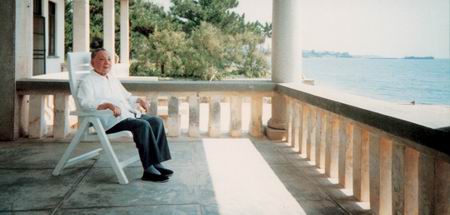
Combining reform and development with stability
China's reform was different from that of the Soviet Union and Eastern European countries. They also started their reform in the economic field at the beginning, but before they obtained any significant results, they comprehensively pushed forward the reform in the political field. Whether it is political or economic reform, failure to pay attention to the combination of reform, development and stability often results from undue haste and leaves hardly any room to save the situation.
For example, when Mikhail Gorbachev came to power in 1985 he focused on economic reform, but because he did not achieve the desired results quickly he came to believe that it was Party organizations and government officials at various levels that were blocking the reform. Despite lack of adequate preparation, political reform was hastily carried out. Many times in the 1980s Gorbachev became the darling of the media. With buzzwords such as "new thinking," "openness" and "diversity," he gained popularity not only with the Soviet people, but also with people all around the world. But in the end, public enthusiasm for reform made them impatient with the Party and government's inertia, and people's sense of identity with the Party and reform sharply declined.
In the autumn of 1990 a crisis occurred in market supply; strikes, demonstrations, debates and other subversive activities appeared one after another all over the country; feelings of impetuosity caused by a sense of frustration continued to brew and ferment in the whole of society. To complete the transition to a market economy in as short a time as possible, the Soviet leaders decided to implement the "five hundred day plan," intending to fully achieve the transition from a planned economy to a market economy within a year and a half. This radical plan not only separated itself from the reality of the Soviet Union and exacerbated economic chaos, it also fell short of the people's expectations of reform. A general feeling of discontent and resentment arose, confidence in socialism was shaken, and eventually the Soviet Union disintegrated.
Compared with the Soviet Union and Eastern European countries, China carried out its reform as follows: Start with the economy; with economic and social development gradually moving forward, place political reform on the agenda step by step. In this process, close attention was paid to dealing with the relations between reform, development and stability. The three words "reform," "development" and "stability" are mentioned or discussed almost in every chapter of the third volume of the Selected Works of Deng Xiaoping.
In the process of reform and development, the CPC and the Chinese government adopted a developmental strategy of "proceeding step by step in an orderly way." The Thirteenth National Congress of the CPC in 1987 put forward China's "three-step" economic development strategy, namely, first, double the 1980 GNP to solve food and clothing shortages; then quadruple the 1980 GNP by the end of the century to achieve a relatively good standard of living for the people; and finally by the middle of the 21st century raise the per capita GNP to that of the intermediate-level developed countries, achieve a comparatively well-off standard of living for the people and basically complete the nation's modernization.
In 1997, when the goals of the second stage of economic development were achieved three years ahead of time, the Fifteenth National Congress of the CPC held in the same year refined the objectives of the third step and put forward the new "three-step" goals, which stressed, "Looking into the next century, we have set our goals as follows: In the first decade, the gross national product will double that of the year 2000, the people will enjoy an even more comfortable life, and a more-or-less ideal socialist market economy will have come into being. With efforts to be made in another decade, the national economy will be more developed and the various systems will be further improved when the Party celebrates the centenary of its founding (i.e. 2021). By the middle of the next century when the People's Republic of China celebrates the centenary of its founding (i.e. 2049), the modernization program will have been accomplished by and large, and China will have become a prosperous, strong, democratic and culturally advanced socialist country."
Breaking down a large objective into several smaller ones to be achieved gradually not only met the current needs of the people, but also filled them with longing for the future. The two interim strategic objectives of development, that is, a "well-off society" and "reaching the level of the moderately-developed countries" properly linked the ideal that has been traditionally pursued in China with the international standard of modernization, bringing forth a strong response from the Chinese people, and gaining wide approval.
Nevertheless, the CPC maintained a relatively clear head. Deng Xiaoping pointed out, "Achieving the goal of these two stages requires two conditions. One is a peaceful international environment, and the other is political stability and unity at home, so that we can conduct our socialist construction under proper leadership and in an orderly fashion."
In other words, stability was the prerequisite and guarantee for reform and development. The painful lessons of the ten-year Cultural Revolution had caused the Chinese Communists and other Chinese people to realize that once social and political stability and unity are lost, "we can neither realize democracy nor develop the economy; there will only occur national chaos and demoralization of the people." Because of this, Deng Xiaoping repeatedly emphasized, "China's best interest is stability."
From different angles Deng Xiaoping illustrated the importance of stability. Talking about why the reform and opening up started in the rural areas, he pointed out, "Eighty percent of China's population lives in the rural areas, and whether China is stable or not depends on this eighty percent." Again, he said, "If the rural areas are not stable, the whole political situation will be unstable. If the peasants do not shake off poverty, our country will not get rid of poverty."
In the view of the CPC and Deng Xiaoping, stability had two aspects, "One is the stability of the political situation, and the other is policy stability." Of the two, the former was the core and the key as well. To achieve the desired goal of China's reform, "First, we need the stability of the political situation. The key to conditions for China's development is the stability of the political situation." Policy stability was the condition and guarantee. "The key to the issue is that China's current policy cannot be changed, whether it is domestic or foreign policy." If the current policy changed, people's life would certainly deteriorate, inevitably leading to social instability and even political unrest.
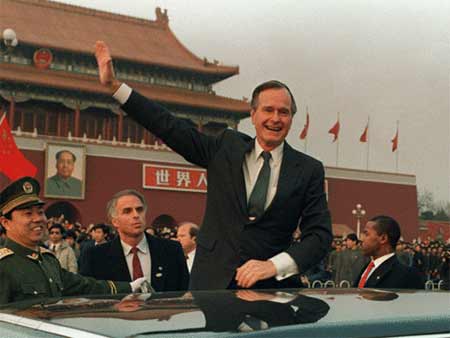
On February 25, 1989 US President George Bush, who had been in office for just over a month, made a 40-hour working visit to China. On February 26, holding talks with Bush, Deng Xiaoping pointed out, "For China, the overriding need is for stability. Without a stable environment nothing can be done, and what has been achieved will be lost." He added, "It is necessary to have a stable political environment to carry out reform in China."
However, in spring and summer 1989, under the political influence at home and abroad, a political disturbance arose in Beijing and other parts of China. It hampered the reform and development greatly, and underscored the importance of "stability."
In October 1989, when meeting former US President Richard Nixon, Deng Xiaoping reiterated, "The reason is very simple: China has so large a population and so weak an economic foundation that without a political environment of stability and unity or stable social order, nothing can be accomplished. Stability overrides everything."
Earlier, on June 29, 1987, when meeting former US President Jimmy Carter, he also pointed out, "If some people take to the streets today and some tomorrow, there will be trouble every day, for there are one billion people in China and 365 days in a year. How can people lead their lives? How can people have the energy for construction? So you should not treat China's problems from your own perspective. China's main objective is to develop, to get rid of the backward situation, to increase the country's power and to improve the people's life gradually. For this, there has to be a stable political environment. If there is no such environment, nothing can be accomplished."
Over time, the CPC realized increasingly that reform was the driving force; development was the objective; stability was the condition; and the three had to be unified organically. In 1998, at the meeting to commemorate the 20th anniversary of convening the Third Plenary Session of the Eleventh Central Committee of the CPC, which launched the reform and opening-up policy, the then CPC Central Committee General Secretary Jiang Zemin pointed out, "We should always correctly grasp the relationship between reform, development and stability. Development is of overriding
importance, and the key to resolving all China's problems depends on our own development.
"Reform is the driving force behind development, and the only way to our modernization. Stability is the basic premise of reform and development; if there is no stability, nothing can be accomplished. Practice has proved that the basic principle set by our party of seizing opportunities, deepening reform, expanding opening up, promoting development and maintaining stability is entirely correct. We should always follow this principle.
"According to the specific circumstances of different periods, taking an overall view of the situation and through careful planning, we shall coordinate and unify the intensity of reform, speed of development and bearing capacity of our society, promoting reform and development in the midst of social and political stability, and maintaining social stability and the country's long-term peace and stability in the course of reform and development."
Could it be said that the position and attitude which the CPC adopted to deal with the relationship between reform, development and stability were part of the reason that socialist China did not fall at that time?


