Why and How the CPC Works in China
 0 Comment(s)
 Print
Print E-mail
China.org.cn, October 27, 2011
E-mail
China.org.cn, October 27, 2011
Serious departure of effect from motive
From 1949 to 1956, it took New China only seven years to basically complete the socialist transformation of private ownership of the means of production and initially build a socialist society. At the end of 1957 most construction indicators of the First Five-Year Plan (1953-1957) were overfulfilled, due to the Chinese people's determination to change the impoverished and backward state of the country. As Mao Zedong pointed out, "I have never seen people so proud in spirit, strong in morale and firm in determination as they are at this time." "Over the past seven or eight years, everyone has seen that there is hope for our nation, and all hope that our country can become a big and strong one. I feel that our nation is now like the release of heat when an atom is split."
Under these circumstances, the Great Leap Forward movement was launched in 1958 without serious investigation, research or even a pilot study by the CPC, which had no experience of socialist construction and an inadequate understanding of the laws of economic development and the basic situation of China's economy.
During the three years of the Great Leap Forward dizzyingly high targets, random issuing of orders, a trend of boasting and exaggerating, and infringing upon the fruits of other people's labor were common.
In agriculture the grain yield per mu (one mu equals to 1/15 hectare) was exaggerated again and again by people at all levels. According to the output reported by various provinces, cities and autonomous regions, the Ministry of Agriculture released statistics which indicated that in 1958 the grain output of the country reached 800 billion kilograms (actually, it was only 400 billion kilograms).
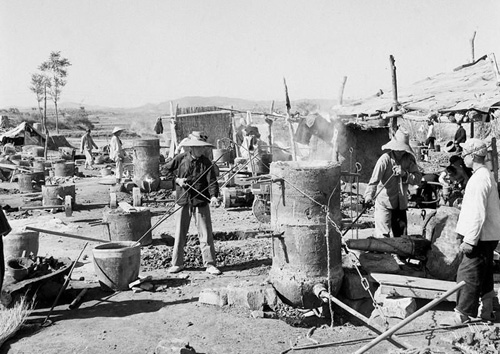
In industry, high steel production targets were pursued. The slogan of "surpassing Britain and catching up with America" was put forward, for which a nationwide Mass Steelmaking movement was launched, tens of millions of people in the country pitching into the work. Also, taking "steel as the key link" gave an impetus to the Great Leap Forward in other sectors.
The Great Leap Forward disrupted the national economy, wasted a lot of manpower and resources, and caused a serious imbalance in the proportion of industry to agriculture. Compared with 1957, the average food consumption of urban and rural residents in 1960 decreased by 19.4 percent, and per capita consumption in rural areas shrank by 23.7 percent. Per capita consumption of vegetable oils shrank by 23 percent. Due to lack of nutrition, edema was quite common in many areas, and the mortality of the rural population in many provinces increased. It was estimated that the direct economic losses caused by the Great Leap Forward amounted to 120 billion yuan.
With regard to this period of history, Deng Xiaoping pointed out that the political "Left" tendency led to the economic Great Leap Forward in 1958, which made production suffer greatly and the people live in poverty. In the very difficult three years of 1959, 1960 and 1961, people had not even enough to eat. In 1962 people's lives began to become better, and gradually reached their original level. But the "Left" mentality persisted, and led to the disastrous Cultural Revolution, which started in 1966 and lasted for a decade.
As Deng Xiaoping said, the Cultural Revolution was a catastrophe: Politically, it confused friend with foe, and people were unjustly, falsely, or wrongly charged or sentenced; economically, it denounced the "doctrine of the unique importance of the productive forces," and the national income lost 500 billion yuan; culturally, it caused "a hundred flowers to wither" (only eight model operas were produced and performed on stage), and education and science and technology suffered heavy losses. The ten-year calamity widened the economic, scientific, cultural and educational gap between China and the developed countries.
The Great Leap Forward and Cultural Revolution brought huge losses to the party, the state and the nation, and their lessons were profound. Through study of and reflection upon the Great Leap Forward, Cultural Revolution and other mistakes, people could come to different conclusions from different perspectives, but from the perspective of the CPC's independent exploration of its own path to socialist construction, the two movements had something in common, that is, they both reflected a serious departure of subjective knowledge from objective reality, and of effect from motive.
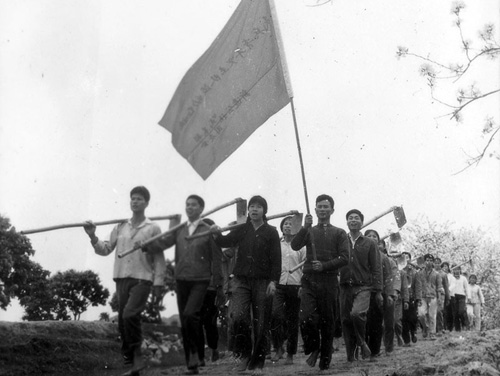
The aim of Mao Zedong's launching of the Great Leap Forward was to quickly change the backward nature of the country, so that China could soon become a great power, and catch up with the developed countries. This motivation and purpose should be beyond reproach. Huang Kecheng, who had been labeled a member of the "anti-Party clique" due to his agreement with Peng Dehuai at the Mount Lu meeting in 1959, and had been exiled to the countryside for 20 years, said after resuming his post that Chairman Mao was still very ambitious in his later years, and he wanted to do things normally accomplished over several hundred years in just the few years or decades remaining to him in his lifetime. As a result, he brought about trouble, which brought the party and people misfortunes and traumas, even though he wanted to do good things for the people and push forward the revolutionary cause. He worked hard all his life for his ideal. Roderick MacFarquhar pointed out in his book, The Origins of the Cultural Revolution 2: The Great Leap Forward 1958-1960:
There was a positive side to the leap [Great Leap Forward]. In any developing country, it is critical that the people should be seized of the idea that they do not have to sit submissively under the yoke of nature. Mao hammered home that point insistently. Like a sergeant major inducting raw recruits into their new world by bawling his squad into life…
Mao's colleagues seem to have swept along by his vision. They had made a revolution in order to remake China. The man who had led them on the Long March to victory now offered them a short sprint to Utopia; not some misty Marxist nirvana beyond the horizon, but a new nation—socially pure, economically strong, internationally respected—here and now in the fields and factories of China."
The problem was: The ways and means to achieve this goal ran into trouble, so the effect of the Great Leap Forward was not satisfactory, even negative.
Similarly, the subjective desire of Mao Zedong's launching of the Cultural Revolution was to build a new socialist society. As The Cambridge History of China, Vol. 15: The People's Republic points out,
Mao's restless quest for revolutionary purity in a post-revolutionary age provided the motivation for the Cultural Revolution…Mao's quest for revolutionary purity led him to exaggerate and misappraise the political and social problems confronting China in the mid-1960s.
…in Mao's eyes, the greatest danger to a successful socialist revolution is not the threat of attack from abroad, but rather the restoration of capitalism at home. Mao believed that the experience of the Soviet Union after the death of Stalin proved that the restoration of capitalism could occur if 'revisionists' usurped power within the ruling Communist Party. To prevent this, it would be necessary to wage continuing class struggle against those "Party persons in authority" who might attempt to follow the capitalist road. Indeed, this would be the major form of class struggle in socialist society after the nationalization of industry and the collectivization of agriculture. The method for waging this class struggle would be to 'boldly arouse the masses from below' in a Cultural Revolution, in order to criticize not only revisionist power holders within the Party but also the selfish and liberal tendencies within their own minds. Because the problem of revisionism was thus rooted in human selfishness, it would be necessary to have a succession of Cultural Revolutions over many decades to preserve the purity of purpose of a socialist society.
Such motivation as the maintenance of the purity of revolution and the establishment of ideal socialism was impeccable, but the problem was that the target was too divorced from reality and the ways and means to achieve this goal ran into trouble. In 1967, speaking of why he launched the Cultural Revolution, Mao Zedong stressed that it was because none of the struggles in the rural areas, factories and cultural circles, or the socialist education movement could solve the problem. Therefore, the Cultural Revolution had to be implemented, "with class struggle as the key link" and "great disorder across the land" leading to "great order." This way of thinking and the principle and line formulated thereby could only result in serious confusion in thought and action inside and outside the Party, and in fact resulted in serious social damage and retrogression.


