A truth that's stranger than fiction
 0
0 


 |
|
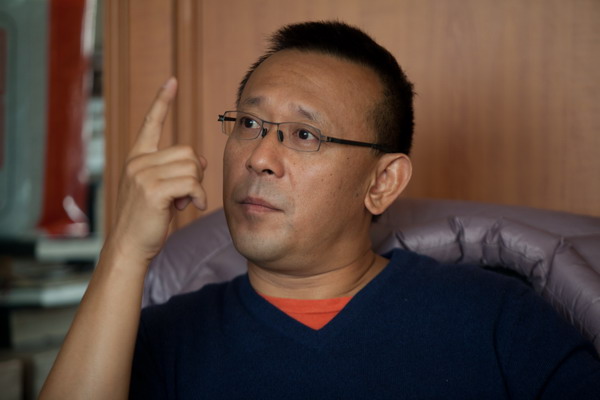
Actor-director Jiang Wen in his Beijing office. [Photo/China Daily] |
A surprise blockbuster has put Chinese cinema's enfant terrible under the public microscope. Jiang Wen tells China Daily what makes him tick in a rare, wide-ranging interview.
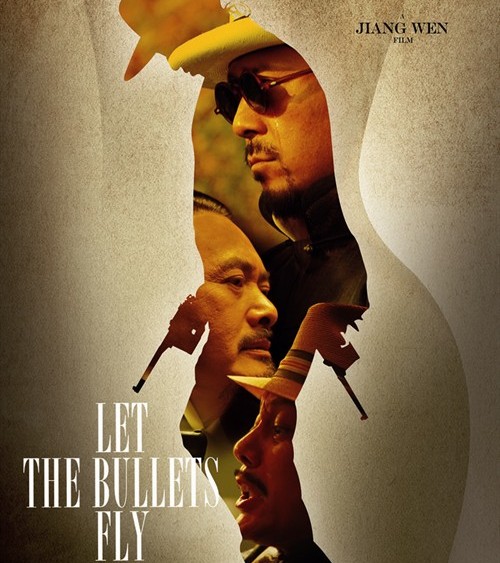
Jiang Wen is at the top of the world - the world of Chinese cinema, that is. His year-end release Let the Bullets Fly has just broken the box-office record for a domestic film with some 700 million yuan ($107 million) in gross receipts.
The actor-director clearly savors the moment, sitting in his less-than-spacious office cluttered with wooden furniture in Bejing's diplomatic compound while staff members shuffle in and out with all kinds of requests and announcements. His sangfroid is not disturbed even when told of an award for the film.
He does not need others to tell him how great he is - not any more.
Yet Jiang Wen is bitter - bitter about how his previous feature was received. He tries not to show it, but brings two members of his Bullets team into our conversation because "they were also involved in The Sun Also Rises".
And I suspect I have been granted this three-hour post-premiere rare interview mainly because I, as a movie critic, had praised The Sun Also Rises as the high point of his remarkable directing career - although it was not understood by most of its audience.
Most people would call the 2007 The Sun Also Rises an art-house film and the new one a genre movie, even though it does not fit neatly into an existing genre - gangster, heist or Chinese western.
Jiang laughs off such attempts at categorization. He uses a scene from Once Upon a Time in America in which Robert De Niro's character takes a girl to a fancy restaurant and overwhelms her with a live band and exclusive use of the venue.
"With The Sun, I gave my heart and soul. I thought the audience would appreciate it and would not mind sitting on the grass by the river, so to speak. But to my chagrin, they were just like the girl in the De Niro film. They wanted the limo and the band even though they may not have good taste in music. They tended to equate the bells and whistles with real love. So, with Bullets I gave them the treatment they preferred," Jiang says, changing his use of the term for "girl" from the folksy niu er to an ostensibly chic but innately tacky meimei before the end of the interview.
That does not mean he is not proud of Bullets. It's just that Bullets, for him, is fun while The Sun is dead serious. He is aware of all the political interpretations of his story that have sprung up across the Web and mainstream media. In 2007, I wrote a Freudian analysis of The Sun, and his response was condensed into a single word - "Sharp" - without elaboration. This time, I was intent on getting to the bottom of the affair.
"No, I did not mean to embed political meanings into the story," he says straightforwardly. When asked about one detailed reading that supplied a background link between the two characters and how they joined the 1911 Revolution together, Jiang pauses, saying he is fine with this kind of creative annotation, but "the focus is too narrow".
The Goose Town, the central setting for the movie, has come to symbolize China for some film buffs with a political leaning. Yet, in our dialogue, Jiang repeatedly uses the location as an outing to the murky world of genre-film making.
One of his achievements in his limited directorial canon is genre busting. His debut feature In the Heat of the Sun has the look and feel of a coming-of-age drama, yet it is not like any of the numerous movies that deal with this subject.
His follow-up is a WWII story, which opened our eyes to three-dimensional portrayals of both Japanese invaders and Chinese living under occupation and their complicated mentality. Then came The Sun Also Rises, which is so bold in its expressive flourishes that people left the theater either dazzled or puzzled.
Ambiguity is a major characteristic. Since two of his four features wax nostalgic about the "cultural revolution" (1966-76), a period that evokes painful memories for many Chinese, Jiang has often been accused of harboring conservative ideologies. Without getting deep into the topic, he hints that he is much more complex in his thinking than he is made out to be - by some tea leaf readers. And his personal opinion on some of the Chinese historical figures is far from black-and-white.
He explains that an artist should have his own unique way of seeing the world. He refuses any labels such as "surrealism" or "magic realism". Take the timepiece in Salvador Dali's Persistence of Memory. "Do you say the view is warped? No! This is exactly what time is, at least to people like me. It is reality."
The most brilliant touches in his movies all seem to traverse the stream of reality as we see it: In his first movie the teenager jumps into a tall chimney and later plays with an inflated condom with an incongruous guilelessness, The Sun has an otherworldly bird that flies around a big tree, and the latest film opens with a train pulled by white horses.
"I did not invent this set-up. For 30 years in the early 20th century, there was a segment of rail line in Northeast China that was powered by horses," he explains, without getting into the symbolic significance of such devices. "You may conceive the most unlikely scenes, and you'll find that fact is stranger than fiction."
Jiang reminisces that during the production of The Sun he conjured up a scene with beautiful flowers covering a desert. But while scouting for location, he came upon flowers even more over-sized and colorful than he had ever imagined. "Local people didn't know what they were called. The lesson is, never overestimate your imagination."
Jiang Wen was trained at the Central Drama Academy - as an actor. Yet he is known for his bold visualizations. He prefers scripts read to him by someone who can turn the words alive. His storyboards, as drafts for each shot, tend to be cursory. But his verbal description of each scene is so vivid the listener can quickly recreate each frame in his or her mind's eye. In 2007, I came up close and personal with such an experience, when he told me of encounters he had in his youth. It was movie-like, to say the least.
Cineastes have been studying his work for traces of influence from earlier masters. Emir Kusturica, a Serbian and Yugoslav filmmaker, and Sergio Leone, known for his spaghetti westerns, are often cited. But Jiang denies the link: "The pacing of my work stands in contrast with theirs." The only filmmaker whose work Jiang admits as having an impact on him is Martin Scorsese. After watching a string of the American director's movies, Jiang requested a meeting with him on a trip to the United States arranged by the US Embassy. Scorsese has acted like a mentor, sending him detailed materials from his production.
"When a director sees a story or a script he's crazy about, he does not have any towering figures in front of him. He must feel he himself is the greatest. It is nonsense when people say they are paying respect to this or that predecessor. If anything, it should be an apology for throwing those masters behind you," Jiang says.
Often criticized for his arrogance, he says he exercises much more restraint now than when he was a student. He also says that if there comes a day when Scorsese cannot obtain funding any more, he would be willing to raise funds in China for the American master - much as Scorsese and Spielberg did for Akira Kurosawa.
Asked why snippets of music from his previous film were audible in the Bullets soundtrack, he surprises me by saying: "That was me paying homage to myself."
Telling it as it is
Jiang Wen on the inspiration for Let the Bullets Fly
In the original story, the county magistrate bought the official position to make a fortune, but he could not finish all the things he wanted to do within that period. I thought, Gee, a fake official has time constraints, just like us filmmakers. That detail is tangential in the story, but it piqued my interest.
On political analogies
No matter how you shoot it or cut it, you will bring something of yourself into your movies, just as the old saying goes about everything being imprinted with ideology. You do not necessarily intend it. I never meant to make In the Heat of the Sun or Devils at the Doorstep autobiographical. Some people say the main character in Bullets is me post-Sun, others suggest he stands for Chiang Kai-shek. I'm an avid reader of history, but I don't think history should be approached only in the way we were taught in school. Artists have their own interpretations. So, we make art with our worldviews, but by no means do we create everything in our own self-image.
On film and theater
The term "cinematic language" could be misleading. Many film classics, such as Citizen Kane, The Godfather and Quentin Tarantino's works, have a close affinity with traditional stage plays. The essence of drama is to understand man, and it is done through literary and theatrical mechanisms. Performance has its charms. It enables someone to play God and create something. But to touch the inner world, you do not need a so-called cinematic language. Is "To be or not to be" fit only for stage exaggeration? Not when you reach my age. You could feel that way when you are 15 and say to yourself, "Why are you so verbose when you could simply kill the guy?" That's because you're too simple and do not have that sense in your heart. Simplicity is for nostalgia, not pride.
On Chairman Mao Zedong, who has often been reported to be his hero
I don't know what hero worship is. I simply cannot imagine in my mind what a hero is like. It is ludicrous to be kowtowed to by others. My ideal is a world where everyone has dignity and independent thinking. If there is a good script, I'd be willing to play Chairman Mao Zedong, but not direct the project. I don't know whether the time is right for that. He is a historical figure with huge influence, yet controversial. However, he is not my idol. Because so many people take a brusque attitude toward him, I want to emphasize that he was not as ... (pause) as you thought.
On art and politics
Artists cannot be good politicians. I do not intend to get into politics because artists can turn into fascists when involved in politics. Or, shall I say, fascists are themselves a kind of artist. In art and literature, people have contempt for each other. In politics, you have to let people live and I don't know how to go about it.
On film critics
Why should Chinese film critics be obsessed with box-office revenue? That's the job of the investors and producers. What do you lose when you praise a good movie that does not sell? You should write what you believe in. Critics who are guided by money are pathetic.


