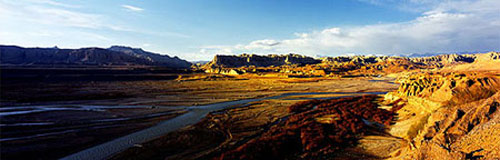
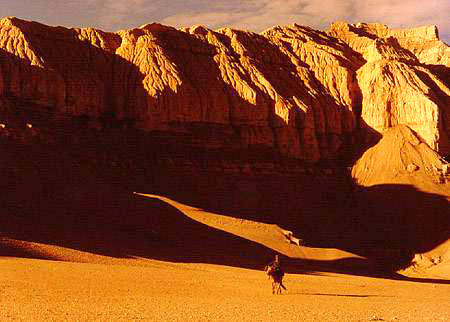
The ruins of Guge are in what is today Zhada County, Ngari Prefecture, Tibet. Guge is said to be the highest of ancient kingdom located on the ridge of the Roof of the World, as Tibet is called. Marching westwards to Guge from Lhasa, the Tibetan capital, is a long and hard journey that crosses a vast uninhabited desert.
Legend has it that in the first half of 20th century the Tibetan government sent a soldier to Guge to collect taxes. However, a couple of days later the soldier was back, frightened. All he could see there was a world of sand. The government dropped the taxation plan.
However barren, desolate and inaccessible the land might seem, the powerful Guge kingdom ruled over it for over 700 years from the 9th to 17th century. Altogether 16 kings ruled Guge. Yet, historical records reveal little about its rise and sudden demise. It was instead from some letters by western missionaries that people got to know more about the lost empire.
Ruins, the only visible legacy
Records show that Guge once made great religious and economic achievements. However, its glory was reduced to pieces when the mighty kingdom was involved in a fatal war in the 17th century. The invasion of the neighboring state Ldakah, coupled with the domestic rebellion of Guge monks, brought the kingdom to its knees.
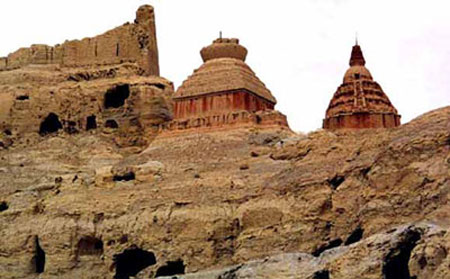
The ruins are the only visible legacy Guge has left behind.The ruins extend from the mid-ridge of a hill 300 meters high at its peak and cover an area of 720,000 square meter. It is the second largest ruin in Tibet, after the Potala Palace in Lhasa. Archaeologists have unearthed 445 earthen and wooden structures, 879 caves, 58 blockhouses (a kind of fortification building), four secret tunnels, 28 stupas (traditional pagoda-shaped Buddhist monuments), granaries and weaponry storehouses.
Guge was a rigidly hierarchical society. The residential area was compartmentalized depending on the social status of the people that lived there. Palaces and residences for the royal family sat on the hilltop, monasteries and houses for aristocrats sat in the middle of the hill and at the lowermost reaches of the hill were cave dwellings for ordinary people. The top position of the royal residence was to display imperial supremacy, and ensure military security.
A Buddhist kingdom
Guge was established by the descendents of the royal family of the Tubo Dynasty that ruled all Tibet from about 630 to 842 AD. Tibet was called Tubo by the Han at that time. The last Tubo king arbitrarily banned the practice of Buddhism by persecuting Buddhist followers and destroying monasteries, leading to the fall of the dynasty. Being far away from Lhasa, in western Tibet, present day Ngari, proved to be a safe harbor for the persecuted Buddhists. Years later, Guge, a Buddhist kingdom, was established and was said to have a population of 100,000 at its peak.
Guge was economically advanced and famous for its industrial achievements, such as panning for gold, smelting, pottery-making, weaving, carpentry, carving, and printing.
Geographically connecting India and the hinterland of Tibet, Guge played a significant role in spreading Buddhist doctrines. The ruling class was fervently Buddhist and they did a lot to promote its expansion.
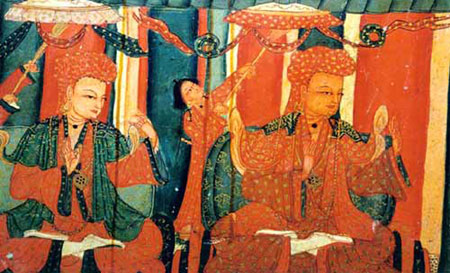
They invited Buddhist masters from India to spread Buddhism. A mural in one of the surviving structures vividly depicts a Guge king warmly welcoming a visiting Buddhist master from India. They also sent Buddhists to India to learn more about the religion, and had Buddhist scripture translated into the Tibetan language.
A secret cave filled with remains of Buddhist scripture was found in the ruins. Some were woodblock printed, and some were hand-written. Some were even written with liquid gold and silver, indicating the extravagance of the religious community of Guge.
Buddhist structures and murals
Guge was a Bhuddist state and this is reflected in its architecture and art. Stupas were built to show respect to the Buddhas and some caves at the base of the hill were reserved for meditation retreat. However, the best-preserved Buddhist structures are named after either the outward color of structures such as the White Palace or the Red Palace, or names of Buddhas such as the Yamantaka Chapel or the Tara Chapel, or Buddhist practices such as the Mandala Chapel.
Within these surviving structures, murals have been well preserved and still exude a luster through ages of dust. Most of the murals are religious paintings, either portraits of various Buddhas, works depicting scenes believed to have happened in their lives, or pictures reflecting the religious life of the Guge people. Attention was paid to the details when these murals were painted, such as eyes, brows, gestures, and even clothes of a Buddha.
Apart from murals, there are many metallic sculptures of Buddha in the Guge ruins. Guge Silver Eyes is one of the finest bronze sculptures of a Buddha ever unearthed. This Buddha has four arms and three eyes. Each arm holds a musical instrument used in a Buddhist mass. The three eyes are silver-gilt, hence its name.
Religious strife leading to demise
Facing such a huge wealth of artistic relics, people never stopped wondering how such a powerful state came to its demise almost overnight. What happened to her? Was it a sudden accident, or an inevitable event?
Some believe the Guge had something in common with the Maya in ancient Mexico and Guatemala and Pompeii in ancient Italy, all highly developed civilizations that inexplicably fell.
While religious enthusiasm prompted the birth and growth of Guge, religious strife brought it down. Conflict between the last Guge king and the upper-class monks, headed by the king's brother, arose and became hot when the latter grew powerful. It was said that Buddhist followers could be seen everywhere in Guge at that time. The last Guge king was worried that his kingship would be threatened if the monks grew more powerful. The idea came to him that Buddhism must be degraded.
So when, in 1624, P. Antonio de Andrade, a Portuguese missionary, reached Zhaburang, capital of the Guge, via northern India, the king took advantage of the opportunity and tried to establish Catholicism as a new religious weapon against the Buddhist monks. A church was built, and the king himself converted. He took the offensive, forcing lots of monks to be secularized and even exiled. There was a devastating insurgence from the monks. The neighboring rival state Ldakah saw an opportunity and collaborated with the monks to overthrow the rule of the Guge king. It turned out to be a long and bloody war.
The fortifications of Guge were carefully designed and distributed. Besides tactically located forts and walls, there was a network of secret underground tunnels that had been of great help in resisting previous invasions.
A story was passed down from generation to generation that tells how Guge was defeated by the allied forces of rebellious monks and Ldakah invaders. At the beginning of the war, the invaders captured some Guge citizens. But because the Guge castle was so heavily fortified and kept the attackers from moving up to the top where the royal family lived, the Ldakah invaders came up with an idea. They drove the captured Guge people to the front of the war, and had them build a huge, stone wall from the foot of the hill to the top. They could move upward under the protection of the wall, and those working on the wall would serve as a human shield. The Guge king was confronted with a dilemma: if he ordered an attack, his people would be killed. If not, the wall would reach the hilltop and the royal family would be captured, indicating the fall of the kingdom.
In the end, the king agreed to surrender on the condition that the enemy should spare his people. However when the Guge soldiers unarmed themselves the Ldakah army slaughtered them. Today, there's a cave crammed with skeletons near the Guge castle. It's believed to be a testament to the brutality of the war. It's strange that no skulls have been found there, but there was some braided hair. Some bodies were wrapped with robes. However, it is also thought to be a special funeral because some skeletons of young females were found in the cave.
Where are the Guge descendants?
Was it possible that nobody from Guge survived the war? Where have the descendants of the Guge gone? There are only a few houses near the Guge ruins, and the people there are not descendants of the Guge.
It is rumored that over 200 Guge were lucky enough to successfully flee through a secret tunnel within the Guge castle to escape the war, settling in today's Qulong town, waiting for a time to get revenge. It was said that a ceremony was held on the road to Qulong. Each of the survivors threw a stone towards a set place, in memory of their lost home and wishing for good luck in the future. (chinadaily.com.cn)
Tips for Tourists
Location: The ruins of the Guge Kingdom are in Zanda County in southern Ngari Prefecture, which borders India to its south. Zanda is 1,500 kilometers from Lhasa, the Tibetan capital, 200 kilometers from Shiquanhe Town in the prefecture capital Gar County, and 1,200 kilometers from Yecheng in Xinjiang Uygur Autonomous Region.
Transportation: There are two routes to Guge city. One is from Yecheng in Xinjiang to Zanda via Shiquanhe Town. The other is from Lhasa to Xigaze, then to Zanda. Taxis from Lhasa to Ngari charge RMB 4/5 per kilometer, and hiring a vehicle and driver costs RMB 12,000 to 14,000 plus the driver's accommodation. A chartered vehicle is needed for the trip from the Zanda County seat to the Guge ruins 18 kilometers west.
Frontier Visitor's Permit: A visitor's permit is required for travel to Zanda. Prospective visitors fill in the appropriate forms at the local police station, and receive the permit, free of charge, the same day.
Related Reading: Guge, the Pompeii of Tibet
(China.org.cn China Today August 6, 2007)