Statistics show that foreign families have adopted more than
50,000 Chinese abandoned babies since the 1990s, and the number
keeps rising. Foreign-related adoption not only helps release the
burden of Chinese orphanages, but also gives family love to these
children.
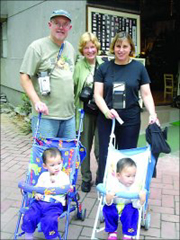
The Lissicks and their two Chinese daughters
In most cases, a couple decides to adopt a child because they are
eager to have a baby but cannot have one of their own.
But the situation in the Lissicks family is quite different.
Although they could have given birth to their own children, they
chose to adopt two Chinese children. Larro Lissick, the mother and
a freelancer, said: "We don't care whether our children are of our
own blood. What we do care is that they need a family, and we need
children. All children have the right to enjoy a lovely family no
matter where they live. We prefer offering our love to children who
are already present in the world and long for a family, rather than
bringing another baby into the world."
Michael Lissick, 35, a software consultant of a medical
insurance company, also owns a private company. He believes to
adopt a foreign child would help them understand cultural
difference.
The Lissicks' request for adopting a Chinese baby was satisfied
in June 2000 when they became the parents of their first Chinese
daughter -- Maya, from Nanchang, Jiangxi
Province, who was eight months old when she was adopted. To
show their thanks, the Lissicks donated US$3,000 to the local
welfare center.
"The procedure of adoption is very strict," said Larro. There
are several hundred adoption organizations in the United States,
and only 96 of them are recognized by the Chinese charity
organization. "First, we carefully chose an adoption agency to help
us with all the procedures. Then we had to fill many forms and
provide the information concerning our family. After the
organization received our application and all the required
materials, they sent one of their staff members to our home to
check if the information provided is true. The person asked us many
questions."
After this was done, the US adoption organization sent the
information to the China Center
for Adoption
Affairs (CCAA), which is the only social welfare center to deal
with foreign-related adoption. The CCAA then sent the Lissicks the
information about the child, together with three of her photos.
After the Lissicks showed their interest in her, the CCAA invited
them to meet the little girl in China. The whole process took them
one and a half year.
Again, in the past November, the Lissicks came to China to adopt
their second Chinese daughter -- Aria, taking along with them Maya,
who is four years old now. Before they set for the travel to China,
Maya drew a picture, in which the two countries, China and the
United States, were linked by an airline. Maya explained that her
parents would bring her to China to meet her little sister.
When Larro held an eight-month-old baby in her arms in
Guangzhou, capital of China's Guangdong Province, Maya knew her
dream had come true.
A new life in a new country
After Maya was taken back to Minnesota, it took several months
for her to fit into the new environment and feel at home with her
new family. She could call her parents "mom" and "dad" before she
was one year old. Every year on the day in June that marks Maya's
adoption, which they call 'GOTCHADAY', the couples bring their
daughter to a restaurant to celebrate the event. They always let
Maya choose her favorite restaurant and order her dish for the
special celebration.
Michael loves his daughter very much. In his eyes, Maya is a
beautiful, bright and active girl who always has a good appetite.
For Maya’s sake, he has begun to learn Chinese. He said that they
have decided to send Maya to Chinese classes because they don't
want the Chinese girl to lose her own culture. "When Maya grows
older, I will bring her to visit China," said Michael.?
Maya is very much fond of her dad too. Every morning, when
Michael is going to work, she rushes to the door to give her dad a
hug and say goodbye. Occasionally, when she gets up too late and
misses the hug, she cries. Every day, after dinner, the parents
read books and tell stories to Maya. "Maya likes stories, and
always asks many questions," Michael said. "She is just like me.
When I was a little boy, I had a lot of questions too."
Maya is growing up like an American child. She now speaks and
thinks in English, and will receive American education in the
future. Her parents are making a saving for her college education,
though she is in kindergarten.
One time, when Michael was staring at Maya who was sleeping
sweetly, he suddenly felt sad. "If we had not adopted Maya, what
would have happened to her? If we had had our own baby, this child
would have lost her chance to be adopted," he said to himself.
Lorra said that at that moment they decided not to have their own
baby but to adopt another daughter.
Aria is from Guangdong Province. She was found abandoned outside
a supermarket before she was admitted to the local welfare center.
Aria looks quiet and sweet. She likes to smile. Being curious and
excited about her little sister, Maya often drags Aria's socks.
Sometimes, children can be as serious as adults. The Lissicks
never intend to hide the fact that Maya is their adopted daughter.
Once Lorra told Maya: "You have your own parents who gave birth to
you. But for many reasons they could not raise you. So we have the
opportunity to live with you."
"But why can’t they raise me?"
"I don't know. I guess they were forced to do so. But we will
never leave you. We will be your parents forever."
"Even when you couldn't hold me in your arms?"
"Of course, even when we couldn't hold you in our arms, we are
still your parents."
Americans prefer Chinese babies
According to statistics from the US Immigration and
Naturalization Service, American families have adopted many Chinese
abandoned babies since the adoption service began in the early
1990s. There were only 61 babies adopted by American families in
1991. However, the number rose to 5,053 in 2002. In total, up to
last year, American families have adopted more than 35,000
children, about 90 percent of the foreign-related adoptions.
When the Lissicks came to China to adopt their daughters, they
stayed at the White Swan Hotel in Guangzhou. As the US consulate in
Guangzhou is the only office to be authorized to issue visas to
adopted children, all American families who want to have Chinese
babies must go to Guangzhou.
"When I walked through a corridor in the White Swan Hotel, I
could hear babies crying all around me. In the hall of the hotel,
we met many foreigners with their adopted Chinese children,"
recalled Larro.
Besides the United States, CCAA has also received foster
families from Denmark, Finland, Spain, France, Sweden, Iceland,
Ireland, Holland, Norway, New Zealand, British, Canada, Belgium and
Australia.
Statistics from the Citizenship and Immigration Canada shows
that Canadian families in 2001 and the figure for 2002 rose to 771
adopted 618 Chinese abandoned children. According to the Ministry
of Foreign Affairs of France, French families adopted 210 Chinese
children in 2002.
Why Chinese children?
The history of Americans adopting foreign children started
from the end of
World War II, when many war orphans from Vietnam and Korea were
adopted. According to statistics up to August 2003, more than 1.6
million children had been adopted in the United States, and more
than 20,000 of them are from foreign countries.
According to Mr. Zhong, chairman of Chinese Children Adoption
International (CCAI), the high rate of infertility is one of the
reasons for Westerners’ child adoption. The infertility rate among
married couples is as high as 9-12 percent in United States, and
that in Canada is 12-15 percent.
Cost is the second reason why people prefer to adopt a foreign
child. It is expensive to receive medical treatments for
infertility, not mentioning that those medical treatments are not
always effective. So many people choose adoption. The charge for an
American family to adopt a child from their own country is
US$20,000 to US$50,000, while the cost for them to adopt a Chinese
child is only US$15,000. The family also has to wait three of four
years before they are permitted to adopt a child in the United
States, while the waiting time for a Chinese baby is much shorter.
Furthermore, there is the problem that many US biological parents
want their children back after the adoption, bringing headache
legal issues to the foster families.
Chinese abandoned children are more and more popular in foreign
countries not only because of the low charges, but also because of
the active cooperation of the Chinese government, who has enacted
specific laws and regulations on foreign-related adoption.
The other reason is that most foreigners believe Chinese
children are healthy, beautiful and bright. On the other side, in
the United States, those families who have adopted children can
have their tax reduced.
Every year, thousands of American families ask the CCAI to help
them adopt Chinese abandoned children. In return, with the CCAI's
help, American families would adopt more than 70 children every
month.
What the orphanages say
The China Center for Adoption Affairs established in 1996 is the
only licensed Chinese agency for international child adoption. It
is appraised as "excellent and professional" by many foreign
adopters.
Orphanages welcome international adoptions because they can
reduce the number of orphans under their care. So far more than 200
orphanages in Guangdong, Guangxi, Jiangxi, Hunan, Hubei and Anhui
have foreign adoption service, with Guangdong alone having 37 such
orphanages in its urban and rural areas.?
One of the employees of an orphanage in Nanning, capital city of
southwest China's Guangxi
Zhuang Autonomous Region, said, "We really hope some people
will come to adopt some of our children because we cannot even
afford enough beds for them." The orphanage has submitted the
profiles of more than 100 orphans to the China Center for Adoption
Affairs to wait for foreign adoptions.
The situation is similar at the municipal orphanage of south
China's Shenzhen City. The orphanage originally had a capacity of
200 beds but it now accommodates nearly 300 orphans.
Sha Pei, a 16-year-old orphan in the orphanage said: "Another
five children will go to the United States in November. I hope I
can go too, but I'm too old. They want younger children." Sha said
she wants to go to the United States because it snows there.
Who are left behind?
"Now we have about 60 disabled orphans and only a dozen or so
healthy boys and girls. We don't worry about the healthy ones
because there will be people willing to adopt them sooner or later.
But few adopters will choose disabled children," said Zhong, an
employee of an orphanage in Foshan City, south China's Guangdong
Province.
Zhong said that disabled children often account for 60-80
percent of orphans in Chinese orphanages. They, in worst need of
help, receive least concerns because most adopters prefer healthy
children.
The China Center for Adoption Affairs noticed the problem and
hence publicized preferential policies for adopters to adopt
disabled children. Over 20 foreign adoption agencies have endorsed
the policies.
"Quite a lot of American families are willing to adopt children
with physiological defects such as blindness, heart disease,
bisexuality and limb deformities," Zhong said. "There was once a
Shaanxi girl who had heavy black hairs grown on her face,
nevertheless, an American couple adopted her and let her receive
skin-grafting. She looks very pretty now."?
Such disabled children are acceptable because their diseases or
defects are curable; however, nobody will adopt children having
cerebral palsy or infectious diseases such as hepatitis B, which
are hard to cure.
Cerebral palsy-ridden children are more possibly to be abandoned
and medical treatments of the disease cost a big part of the
orphanages' yearly allocation.
Foreign adopters in general require their babies to be
intelligent and healthy, and physical appearance seems not as
important, said an employee with the Shenzhen Orphanage.
About the US$3,000 donation
"We seldom receive reports or feedback about the use of the
money gained from adoption. We are just briefly notified that it
has been spent on improvements of environments of orphanages. I
think they should at least provide annual reports, even if details
on every item of expenditure is not available," a program manager
from a foreign adoption agency said.
The Chinese law for international adoption stipulates that all
donations to orphanages should be spent on betterments of orphans'
living conditions and donors should be informed about the
whereabouts of their donations. But the fact is that almost every
interviewed foreign adopter expressed that they never receive any
feedbacks on the expenditure of their donations and they know
nothing about where their money eventually went.
Some people working with the adoption service suggest to further
legislate the spending of the US$3,000-donation so as to limit
fiscal loopholes.
Actually embezzlement of donations already happened. In January
2001, Lin Jiayu, head of the Yanping District Orphanage, Nanping
City, Fujian Province, south China, was taken into custody on
charges of graft, embezzlement and taking bribery. He withheld
US$12,700 of donations from 49 foreign adoptions and divided the
money with his assistant Lin Fengying.
Traps
Foreign adopters also complained about the poor professional
quality of some Chinese orphanage employees.
"Sometimes orphanages hide the facts that the to-be-adopted
children have handicaps. After their arrival at the orphanages, the
adopters find the situations of the children are not the same as
described in their profiles provided by the China Center for
Adoption Affairs. Although most adopters will take the children any
way, they don't feel happy. It happens every now and then and
dishonesty exists till today," said a foreign adoption worker. "I
think they either lie or neglect their duty -- both result from
poor professional quality."
Double identities for the adopted children
The China Center for Adoption Affairs requires foreign foster
parents to report twice on the condition of their adoptee in the
first year of the adoption. The adoption procedures are finished
after the last report is made. But this does not mean that foster
parents will have nothing to worry about in the future.
As other parents, the foster parents worry about how they should
face their children when they reach their teens. Teenagers tend to
challenge everything, including their parents, during this period.
Adopted children are no exceptional for the adolescent period when
many of them want to find out who are their real parents and even
hope to find them.
Since international adoptions were introduced to China in the
early 1990s and most of the overseas Chinese children are still
under the age of 10, such problems have not yet shown up. But Zhong
predicted that the problem is likely to come out in five or six
years.
American parents share a common view that they should let their
foster children know their Chinese origin because the fact of
adoption cannot be kept as a secret.
Foreign parents choose to tell their foster children about their
motherland and bring them back to China for travel. This may
hopefully help these children recognize their double
identities.?
(The Beijing?News December 2, 2003,
translated by Wu Nanlan and Chen Chao for China.org.cn, December
17, 2003)