 Share:

The Norwegian Seafood Council and Freshippo launched their "Norwegian Salmon, Perfect for Sashimi" promotion program in Beijing on Nov. 30. Centered on Norwegian sashimi-grade salmon, the partnership will conduct initiatives spanning product presentation, consumer experience and origin awareness building to boost sales and meet the demand for higher-quality products.

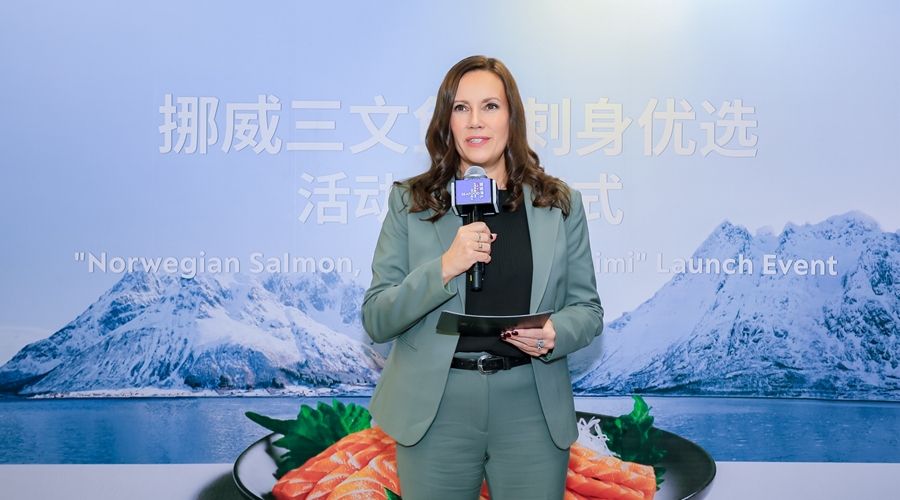
Marianne Sivertsen Naess, minister of fisheries and ocean policy at the Norway's Ministry of Trade, Industry and Fisheries, speaks at a press conference in Beijing, Nov. 30, 2025. [Photo courtesy of The Norwegian Seafood Council]
"China is one of Norway's most important seafood trade partners," said Marianne Sivertsen Naess, minister of fisheries and ocean policy at the Norway's Ministry of Trade, Industry and Fisheries. "We greatly value our Chinese partners and customers, and we hope that through closer cooperation, more high-quality, sustainable Norwegian seafood products will enter Chinese households. With China's evolving consumption structure, we also look forward to deepening collaboration across trade and industry to jointly promote the steady growth of bilateral seafood trade."
In the first ten months of 2025, China imported 143,743 tons of Atlantic salmon, a year-on-year increase of 47%. By the second quarter of 2025, China had risen from eighth place in 2023 to become the world's sixth-largest market for Atlantic salmon, surpassing traditional consumption markets such as Brazil and Spain with a continued demonstration of strong momentum.
As China's largest source of imported Atlantic salmon, Norway achieved particularly strong growth this year. In the first ten months of 2025, Norway exported 76,901 tons of salmon to China, up 111% year-on-year, with export value reaching 6.81 billion Norwegian kroner (about $672 million), an increase of 67%. Norwegian salmon's market share in China also expanded this year, maintaining its leading position.
Behind the rapid growth lies a profound shift in consumption patterns. The consumption potential of salmon is being unlocked alongside the expansion of China's middle-class population. For consumers, choosing salmon reflects not only a preference for healthy eating, but also a pursuit of high-quality dining experiences.
Under this trend, at-home consumption has become the primary channel for salmon, accounting for around 60% of total volume, according to a study conducted by the Norwegian Seafood Council a few months ago. At the same time, the development of new retail and online channels has significantly accelerated salmon's penetration into lower-tier cities.
Despite its rapid growth, salmon consumption per capita in the Chinese mainland remains relatively low. As of the second quarter of 2025, annual per capita consumption was only 100 grams, equivalent to about four to five slices of sashimi, indicating the market remains in an early stage with enormous potential for future growth.
As at-home consumption demand for salmon continues to rise, the retail sector is becoming a critical force driving market expansion. The Norwegian Seafood Council has collaborated for many years with Alibaba Group's Freshippo, one of China's leading new retail platforms, and has continuously deepened Norwegian seafood's presence in China through innovative joint initiatives.

(From left to right ) Sigmund Bj?rgo, China director of the Norwegian Seafood Council; Ji Wei, international public affairs managing director of Freshippo; Marianne Sivertsen Naess, minister of fisheries and ocean policy at the Ministry of Trade, Industry and Fisheries of Norway; Zhang Xinyu, deputy general manager of Freshippo Beijing; and Vebjorn Dysvik, Norwegian ambassador to China, conduct the ribbon cutting ceremony at a press conference in Beijing on Nov. 30, 2025. [Photo courtesy of the Norwegian Seafood Council]
According to Freshippo's 10th Anniversary Consumer Trends Insights, the number of salmon-related products on its platform increased by 30% year-on-year, reflecting sustained growth in Chinese consumers' demand for salmon.
Unlike other markets, Chinese consumers prefer salmon in raw form, with sashimi products long dominating consumption. Meanwhile, consumer expectations continue to evolve. Freshippo has introduced a wide variety of salmon-based products, including salmon belly sashimi, thick-cut sashimi and poke bowls, all to meet the growing demand for diversified raw salmon consumption.
Zhang Xinyu, deputy general manager of Freshippo Beijing, shared that the customer bases of Norwegian seafood and Freshippo share strong similarities, representing Chinese consumers who prioritize quality and taste. "Norwegian salmon is widely welcomed in the Chinese market due to its deliciousness and consistent quality. We look forward to working closely with the Norwegian Seafood Council to offer more premium options suited to at-home consumption scenarios and to continue elevating the quality of sashimi-grade salmon for upgraded consumption."
Looking ahead, the Norwegian Seafood Council will continue to work with Freshippo to further enhance consumer awareness of Norwegian-origin salmon, said Sigmund Bj?rgo, China director of the organization.
Bj?rgo added, "China is one of the most dynamic and promising markets for Norwegian salmon. We have observed that trends such as at-home consumption and new retail are strongly driving demand growth. The organization will continue partnering with leading retail players in China to bring consumers higher-quality, safe and traceable Norwegian seafood, enabling more families to enjoy premium Norwegian salmon with ease."


 京公網安備 11010802027341號