 Share:

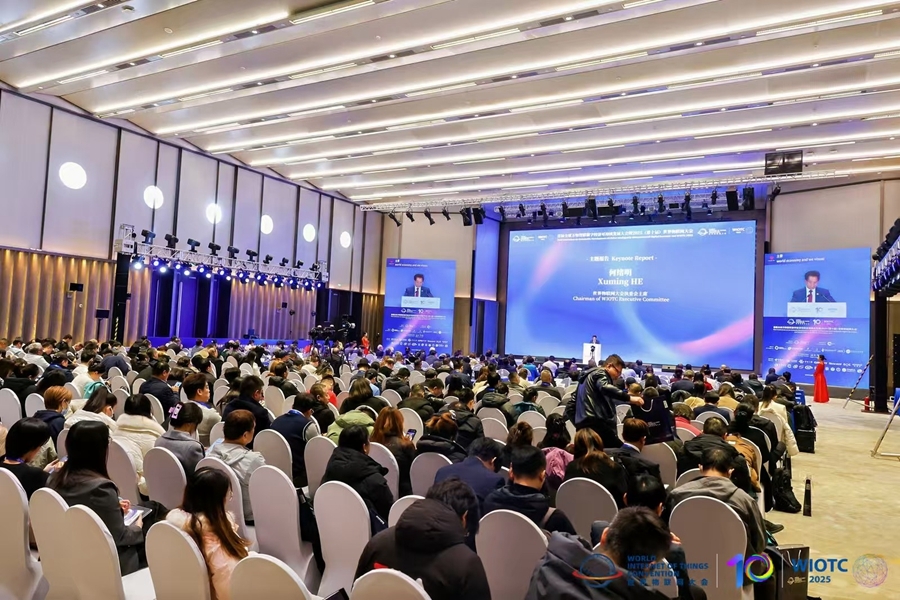
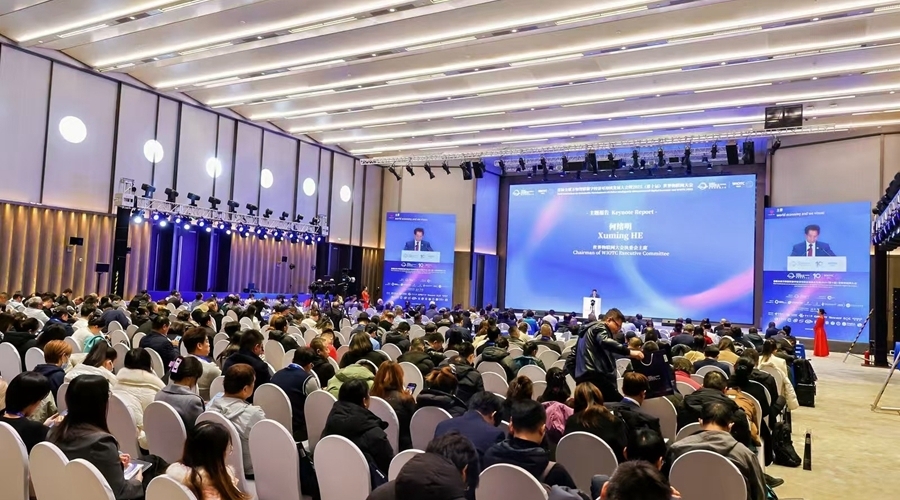
The 10th annual World Internet of Things Convention (WIOTC 2025) commences in Beijing, Nov. 28, 2025. [Photo courtesy of WIOTC]
The 10th annual World Internet of Things Convention (WIOTC 2025) opened Nov. 28 in Beijing, bringing together officials, experts, scholars and business representatives from over 80 countries to discuss building a secure and inclusive digital economy.
The event, held under the theme "Intelligently Interconnected New Economy, Smart Society in the New Era," also marked the inaugural Conference on Sustainable Development of the Global Intelligently Interconnected Digital Economy.
He Xuming, chairman of the WIOTC Executive Committee, said the Internet of Things (IoT) has now become widespread across governments and enterprises globally, serving as a new driver of socioeconomic progress.
IoT refers to everyday devices connected to the internet, from home appliances to industrial equipment, that enable smarter and more efficient operations. According to the United Nations Conference on Trade and Development (UNCTAD), the number of IoT devices is projected to reach 39 billion by 2029, nearly 2.5 times the 2023 level.
"We should uphold multilateralism and strengthen global cooperation to build an interconnected digital economy and share the benefits with all," he said.
Amandeep Singh Gill, U.N. under-secretary-general and the secretary-general's special envoy for digital and emerging technologies, emphasized the accelerating pace of global connectivity, saying "the number of connected devices has already surpassed the number of humans."
However, he warned that technology alone cannot guarantee socioeconomic development. "Innovation must always be guided by safeguards, ethics and cooperation," he said, adding that an inclusive, open, sustainable, fair, safe and secure digital future is achievable only through international collaboration.
Kathleen Kramer, president of the Institute of Electrical and Electronics Engineers (IEEE), highlighted the risks accompanying the rapid expansion of digital systems, including fragmented standards, data misuse and uneven access. "To guard against these risks, we must strengthen global cooperation," she said.
She added that governments, academia, industry and civil society must work together to inform policy, share best practices and build resilient digital ecosystems grounded in trust and transparency. "The digital economy must not only be smart — it must be ethical, resilient and universally empowering," she said.
Torbjorn Fredriksson, head of UNCTAD's E-Commerce and Digital Economy Branch, drew attention to the environmental impact of the fast-growing digital economy.
"The surge in data flows — from 100 GB per second in 2005 to 380,000 GB per second now — and the growing computing power linked to artificial intelligence have made the ICT sector a significant emitter of greenhouse gases," he noted, underscoring the importance of making the digital economy more sustainable.
Sung Hwan Cho, president of the International Organization for Standardization (ISO), stressed that international standards help ensure emerging technologies develop in a safe, responsible and inclusive manner. "Such standards both promote innovation and strengthen user trust," he said.
He explained that the IoT technical committee jointly established by ISO and the International Electrotechnical Commission (IEC) is advancing standards on device interoperability and data security to support the responsible development of IoT technologies and safeguard user privacy.
At the ambassadorial forum, Soeung Rathchavy, Cambodia's ambassador to China, said Cambodia's adoption of science, technology and innovation remains in its early stages. She called for strong global partnerships, particularly with China, and highlighted the China-Cambodia "Diamond Hexagon" cooperation framework as a vehicle for technology transfer, capacity building and innovation cooperation to accelerate industrial modernization.
Ambassadors from Pakistan, Senegal and Barbados also emphasized the importance of advancing digital economy development through international cooperation.

The "Declaration of the Global Intelligently Interconnected Advanced Digital Economy and Social Development" is released during the 10th annual World Internet of Things Convention, held in Beijing, Nov. 28, 2025. [Photo courtesy of WIOTC]
The conference saw the release of the "Declaration of the Global Intelligently Interconnected Advanced Digital Economy and Social Development." The two-day program features two main forums and six sideline sessions on IoT applications across industrial internet, smart energy, intelligent vehicles, AI-IoT integration, and low-altitude technologies, along with two supply-chain matchmaking events.
Founded in 2015, WIOTC aims to "build a smart world where all things are interconnected." The organization's goals include advancing IoT innovation within the U.N. framework, supporting the achievement of the U.N. Sustainable Development Goals, developing international standards, bridging the global digital divide, and improving quality of life through intelligent technologies worldwide.


 京公網安備 11010802027341號