

 Share:

The Lego Group and the Geng Foundation marked three years of collaboration on Thursday, revealing that their Play Box Program has reached over 16,000 children, including more than 8,000 with intellectual disabilities.

Yolanda Gu, director of social responsibility at Lego China, speaks at a press event in Beijing, Nov. 20, 2025. [Photo courtesy of Lego Group]
The two organizations jointly released evaluation reports at a press event in Beijing showing the program had organized 1,636 events by September 2025, along with a survey identifying key gaps in support for children with intellectual and developmental disabilities.
Yolanda Gu, director of social responsibility at Lego China, stated: "Looking back on our three-year partnership, we're pleased to see that through the Play Box Program, we've provided not just building bricks for children with intellectual disabilities, but more importantly, a warm window connecting them with society. This has helped more people recognize the unlimited potential these children demonstrate through play."
She added, "We firmly believe the concept of 'learning and development through play' is inclusive — it belongs to every child. In the future, we will continue working with the Geng Foundation to spread the seeds of play across broader horizons."
Launched by the Lego Group in 2019, the Play Box Program aims to provide creative play, learning and development opportunities for disadvantaged children. As of June 2025, the company has donated more than 78,000 Play Boxes across 235 Chinese cities, benefiting over 2.4 million children in total.
The Geng Foundation joined the program in 2022 with support from Lego and through the Effective Philanthropy Multiplier, a platform created by the Narada Foundation and partners.
A teacher involved in the program noted significant behavioral improvements, with children who typically struggle with emotional regulation demonstrating sustained focus and initiating social interactions during building activities.

Li Hong, chairwoman of the Geng Foundation, speaks at a press event in Beijing, Nov. 20, 2025. [Photo courtesy of Lego Group]
Meanwhile, the two parties surveyed 1,135 families of children with intellectual disabilities nationwide to understand their development status. It found children with intellectual disabilities face gaps across five developmental areas: physical health, cognition, emotion, social interaction and creativity. Social, emotional and creative skills emerged as the weakest areas.
The survey identified three barriers to development through play: insufficient play opportunities, limited play variety, and unequal access. Parents, identified as children's primary support system, showed a disconnect between their understanding of play's importance and their actual engagement, further widening the developmental gap.
"As a foundation long committed to supporting children with intellectual disabilities and their families, we deeply understand that creating play opportunities for these children is no easy task," said Li Hong, chairwoman of the Geng Foundation.
"By providing a systematic activity framework that combines practicality and conceptual guidance, we not only directly bring joy and comprehensive skill enhancement to children with intellectual disabilities but also profoundly influence the adults around them — including facilitators, teachers and parents — fostering positive shifts in their perceptions of children and interaction styles," she noted.
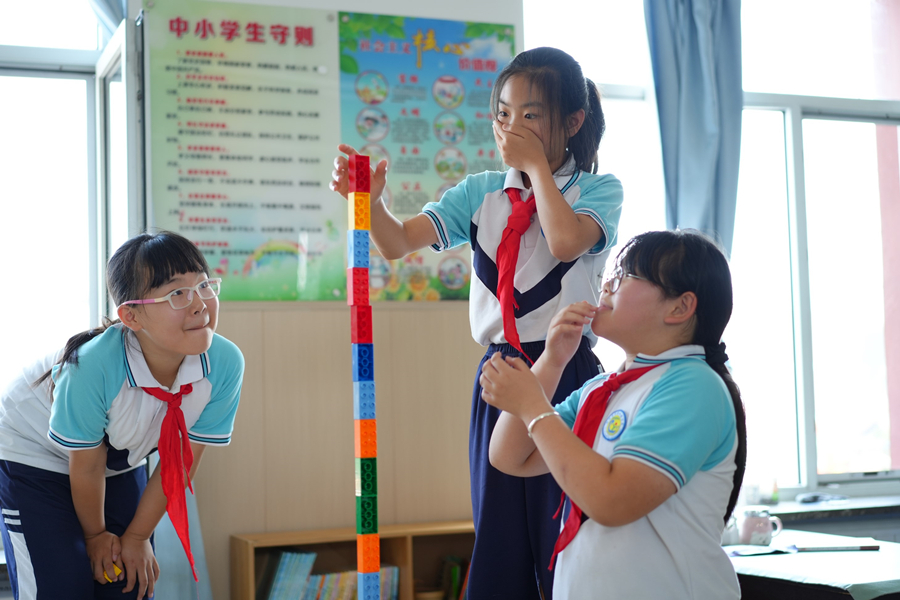
A photo shows children playing with Lego bricks. The Lego Group provides creative play opportunities for children through its Play Box Program. [Photo courtesy of Lego Group]
Lego has also launched a book series with Beijing Normal University's Faculty of Education to help parents, teachers and social workers engage children with intellectual disabilities through play.
The books feature interactive games focusing on physical, social, cognitive, emotional and creative development. Two volumes on physical and cognitive development have been published, with four more planned within two years.
As one of the main editors of the book series, Professor Hu Xiaoyi from the Institute of Special Education at the Faculty of Education at Beijing Normal University, shared at the press event: "While we often emphasize the importance of intervention, we tend to overlook that play itself is the most natural and effective form of intervention. This book series represents our systematic attempt to combine cutting-edge special education theory with Lego brick play practice."
"We hope it can serve as a practical toolkit, empowering frontline special education teachers to design more personalized teaching content, truly making every building session an opportunity to promote children's development," Hu added.


 京公網安備 11010802027341號