Academy Award-winning composer Tan Dun moves East and West
closer than ever before through his epic opera The First Emperor.
It is the first time a pantheon of Western opera, such as New
York's Metropolitan Opera, have commissioned a Chinese composer for
an original work. Tan spent 10 years developing the work and hired
a predominantly Chinese creative team and arguably the greatest
singer on today's opera stage Placido Domingo.
However, The New York Times led the critical assault. The very
influential classical music critic, whose reviews can make or break
the average work, did not hold back: "Tan's score is an enormous
disappointment, all the more so because whole stretches of it, and
many arresting musical strokes, confirm his gifts."
The Baltimore Sun says it is "visually spectacular, often
engaging, and not entirely successful".
The AP critic says it is "fascinating but flawed", however
others have called it "spectacular, dramatic and musically
inventive".
Tomorrow the opera will be broadcast via high-defination audio
and video to selected movie theaters worldwide. The opera is set to
be staged in Beijing during the 2008 Olympics if discussions
between the Met and the Beijing Gehua Culture Development Group are
successful.
The co-director
"We want The First Emperor to look Chinese at first sight, yet not
conventionally Chinese," says Wang Chaoge, co-director, who,
together with director Zhang Yimou, set designer Fan Yue and
costume designer Emi Wada, was responsible for the visual part of
the production at the Metropolitan Opera.
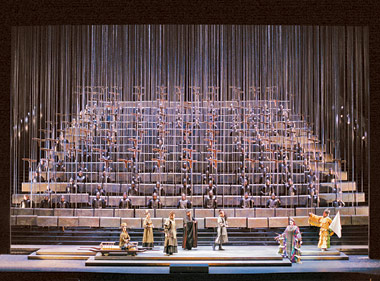
The team used the same elements "ropes and bricks" to create a
variety of scenes, including the imperial palace and the Great
Wall.
The idea of a two-dimensional space fascinated them, says
Wang.
They were guided by the quintessentially Chinese aesthetic
notion of xieyi, a form of expressionism that hints at something
larger rather than attempting to recreate it, according to
Wang.
Wang and big-name movie director Zhang steered clear of such
Chinese symbols as red lanterns, because, they represented folk art
while this opera has an imperial setting.
The set is also far removed from Hero, Zhang's movie about the
same emperor.?
"We often bandy about ideas and argue over them, a healthy way
of finding imaginative ideas," says Wang.
The trio of Zhang, Wang and Fan has collaborated on several
stage projects, mostly singing and dancing revues at popular
tourist sites such as Guangxi's Guilin, Yunnan's Lijiang and
Zhejiang's Hangzhuo.
"These projects make use of what nature has to offer and tend to
be in broad stroke in expression whereas The First Emperor is a
totally original stage work that demands visual innovation," she
says.
Even actors have a big say in shaping the characters.
Placido Domingo was not convinced by the directors’ conception
of his character, instead he sees the emperor more as a man and a
father.
"This opera production may appear to be Chinese to the Western
eye, but it is not authentically Chinese," notes Wang, "rather it
is avant-garde and international in nature.?
The critic
Following a request by the China Daily to elaborate on his
criticisms, The New York Times classical music critic Anthony
Tommasini published another piece this week on January 11.
Here is an excerpt:
The opening scene did not disappoint. As the orchestra emitted
an ominous, swelling tremolo, Wu Hsing-Kuo, a riveting singer from
the Peking Opera tradition, playing the Yin-Yang Master, began
telling the story of Qin.
A battery of percussionists pounded ferocious rhythms on Chinese
drums. Long-time Met-goers must have thought that such exotic
sounds would never come from that hallowed stage.
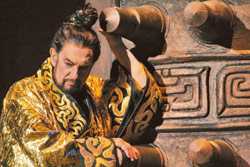
Alas, once Placido Domingo as Emperor Qin appeared, the Chinese
musical elements were overwhelmed by long stretches of tedious
neo-Puccini, pentatonic lyricism.
There were some compelling instrumental episodes evocative of Mr
Tan's pulsating, Oscar-winning film score for Crouching Tiger,
Hidden Dragon. But whole spans of the opera seem to float in some
nowhere land between a martial arts film fantasy and Turandot.
The score could be taken as a cautionary lesson about the
challenges of combining music from different cultures.
There seems to be an assumption today that the blending of
Eastern and Western musical traditions is intrinsically
interesting. Is contemporary Western opera in trouble? Just inject
a jolt of Asian music. Sounds good, except it depends on who is
doing the mixing.
For example, the Chinese-born American composer Chen Yi has
created a body of work that draws from both traditions. But she is
a formidable composer, a true modernist with an acute ear and keen
imagination.
Then there is Yo-Yo Ma's Silk Road Project, a bold and timely
venture to explore the interconnections of Asian, Central Asian and
Western culture along the historic Silk Road trading routes. Though
some genuinely intriguing new works have been created, the project
has also generated compositions with little to recommend them aside
from atmospheric colors and mystical allure.
The composer
Tan Dun ruminates the significance of The First Emperor. Tan, who
won an Oscar for Crouching Tiger, Hidden Dragon, says his work is
both evolutionary and revolutionary. "It has to be seen in the
framework of multi-culture, multi-tradition, multi-style and a
diversity of audience composition," he says.
Tan says previous revolutionary efforts in the arts "smashed"
traditions, but his grand opera inherits the mantle of tradition
and extends it, both the tradition of classical Western opera and
the Eastern dramatic heritage of Peking Opera and Japanese Kabuki,
among others.
Yet, he is confident his work is "unprecedented" in several
ways. It is avant-garde because it uses multi-style counterpoints
and contrasts of romantic and percussive, modern and classical and
East and West highlighted by the daring combination of "chromatic
and indeterminate pitch?
"I'm rooted in Chinese culture and also well versed in Western
civilization, which are vast terrains of soil that both nourish and
evolve," he says.
"I started my music education with Peking Opera, and I also have
great interest in contemporary philosophy, poetry and painting. I
absorb both the domestic and foreign, the old and the new."
The second breakthrough, he contends, is in the "operatic
language?
"I tend to use more simple, lyrical music for the voice, but
make the orchestration complex and dramatic," he says.
"An opera is about drama, it has to have ups and downs. If it is
slow and lyrical from beginning to end, it would be too saccharine
and boring."
Addressing unfavorable comparisons to his award-winning score
for Crouching Tiger, Hidden Dragon, Tan explains that a film score
has to serve what is on the screen "the dialogue, the image and the
story" while an opera has to stand on its own as drama. "It is
ludicrous to expect something like Crouching Tiger, a mainly
instrumental piece, from The First Emperor."
The third creative aspect that Tan says he has brought to opera
is the "operatic structure? He has removed the Western practice of
recitatives, the speech-like singing, which he says is too far
removed from the taste of present-day young and ethnic
audience.
Of the 36,000 tickets sold for this run of The First Emperor,
about half were snatched up by what he calls a "multi-audience?
skewing towards a younger demographic.
Tan also experiments with "concert within an opera" and
interludes that, with the curtain down, the orchestra not only
plays but also adds ritualistic chanting, receiving full spotlight.
"It's like in Peking Opera, when the band takes over the
story-telling to bridge the visual pause and add another dimension
to the drama. Audience applause for the Met orchestra confirms the
new role of the pit," he says.
And then is the path-breaking blending of languages and
performing conventions.
There are two characters in the opera that do not participate in
the plot: One is a feng shui master who sings in Chinese, in the
Peking Opera wusheng style, and uses more body language, and the
other is a shaman played by a mezzo-soprano who makes her
observations in English-language arias.
"They are actually two sides of one person. Music brings them
together, and they are here to deliver a philosophical message, and
it's a message about culture," clarifies Tan.
"I'm a product of multi-cultural attitudes. Although New York is
the capital of multi-cultures, it is not devoid of prejudice or
discrimination.
"The development of multi-culture and the future of classical
music lie in bridging the divide of both old and new, East and
West, and tradition and innovation.
"One person cannot do it alone. It'll take several generations.
But I'm making my efforts," and he is confident because audience
reaction to his work has been much better than that of media
critics."
Tan justifies that there are "three types of critics" those who
are sincere and those who are prejudiced, and in the middle is the
category for those who are not narrow-minded but limited in
knowledge.
However, press reviews have turned from mixed to generally
positive as more critics come to the recent performances, he says.
One criticism he accepts wholeheartedly is the length. "It needs
trimming. Actually, we're doing it for every performance. As the
show gets shorter, the standing ovation at the end is getting
longer. It now lasts 20 minutes," Tan laughs.
The actual opera, after nips and tucks, now stands at 2.5 hours,
"hardly long for an operatic experience"
Tan is confident that his opera will stand the test of time.
"Puccini or Stravinsky are my icons. During their day, a new work
made ripples within the realm of European culture.
"Nowadays, with globalization, The First Emperor is having
impact worldwide right after it comes out. That is good for opera.
And I want my opera to grow with me and be the mirror to the soul
of our time."
The singer
"I consider this period the peak of my career," says Tian Haojiang,
a Chinese bass who built his operatic career in New York's
Metropolitan Opera and who is singing the role of General Wang in
Tan Dun's The First Emperor.
"This is a major bass role, and the Met is one of the best opera
houses in the world," says Tian, who has more than 50 roles under
his belt. He admits that Western audiences may feel The First
Emperor is "foreign" to them, but opera, a Western art form, has a
future to accommodate the fusion of multi-cultures. "It is an
opportunity to let people here know more about Chinese culture and
history through the medium of music and drama," he answers from New
York, where he is also preparing for Verdi's Nabucco.
Tian adds that The First Emperor is getting very good word of
mouth. Audience reaction gets warmer with each performance, he
notes, and when composer and conductor Tan Dun comes on the stage
after each show, the standing ovation he receives is just as
thunderous as that accorded Placido Domingo, superstar tenor who
sings the title role.
Tian feels that First Emperor has more lucid and beautiful
melodic lines than Marco Polo, Tan's previous operatic outing. But
opera audience is a special lot, he maintains, as they are not a
majority in any society.
The critical brouhaha surrounding Emperor has made him ponder
the standard of a good opera. "Which is better, an opera with one
hummable aria, or one that impresses and moves as a whole" But he
asserts that a little controversy is the manifestation of vitality
of a piece of art work. Puccini's Madama Butterfly was not a
triumph when it premiered, he remarks, and it went through many
revisions before it assumed classic status. "You have to give a new
opera time and room to grow. A good opera takes more than one
listening or watching. One has to be open-minded and be willing to
embrace it and feel it," he suggests.
Whatever people say about this opera, it is a historical
milestone in cultural coalescence. It is the first "grand, modern
Chinese opera" to be staged in a world-class house. Later this
year, Tian will star in another world premiere, Poet Li Bai, in
Colorado. Unlike Emperor, that will be a smaller-scale "chamber
opera" and he will sing the title role.
"This is an unbelievable time," he enthuses, "and I'm very proud
and excited."
(China Daily January 12, 2007)